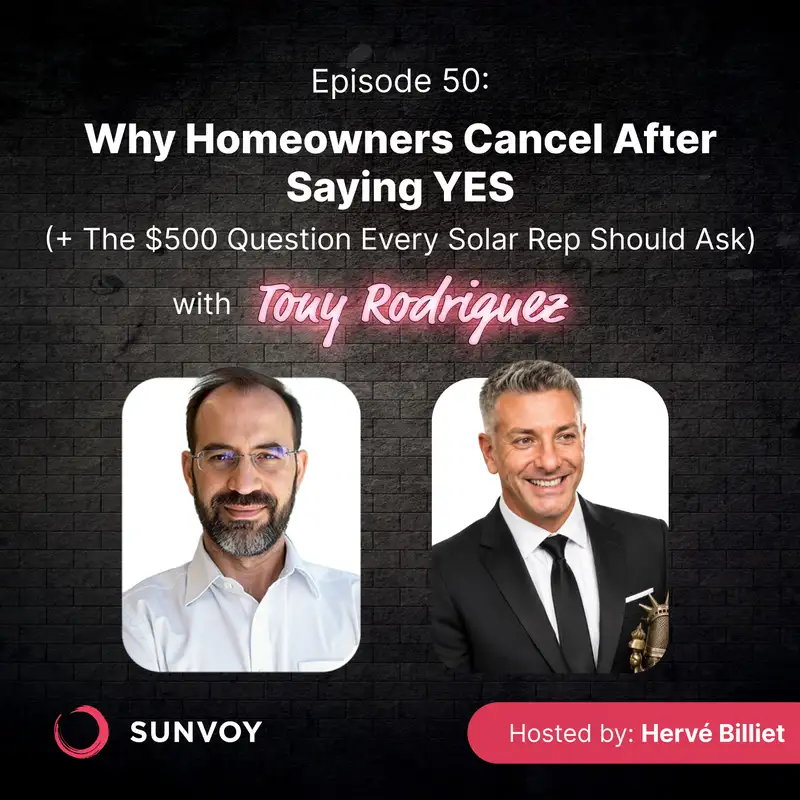
 Episode 50
· 46:19
Herve Billiet (00:00)
Welcome everyone to another episode of What Solar Installers Need To Know. My guest today is one of the most experienced solar lead generation and retail marketing executives in the country. Tony Rodriguez has run lead campaigns for Home Depot, Sears, Macy's and build what he calls the most successful solar retail gen campaign in the country. At Momentum Solar and now he oversees the lead generation events and dealer training at Current Home. He hosts also his own podcast, Award Winning
podcast and self-improvement. Tony, welcome to the show.
Tony Rodriguez (00:30)
I love a good intro. Thank you. It makes me feel it's a good way to start the day off. So I appreciate it. Thank you. So I'm excited. Thank you for I get excited when I get to go on other podcasts. So it's exciting news and thank you for the kind words for sure. So now I just have to live up to them. That's only challenge.
Herve Billiet (00:46)
Yeah, that's challenge I'm sure easily accepted from your part, but you're professional podcaster. Tell me where are you now?
Tony Rodriguez (00:53)
So, you know, it's interesting. think a lot of when I look at life, I view it through the lens of why not. And about a year and a half ago, a friend of mine had come to me and asked me about starting a podcast. And, you know, it's one of those things where I take a look at these things and I say, okay, what could I get out of learning how to do a podcast? And you know this from a professional standpoint, you know, I've been in marketing for 26, 27 years and the landscape is ever changing.
Social media, podcasts, clipping, AI, everything is now a bigger part in the podcast space. So when we started the podcast and we thought about it and I said, you know what's really great? Nothing can ever come of this, but I'm gonna learn a lot of skillsets for work. So myself and my buddy started with a green screen, couple phones, and literally didn't even know what the name was gonna be until we went live the first day.
And we went live and we decided to call it Advice Unfiltered. And the idea was that we have been in fitness and mental health and coaching and leadership positions for a long time, myself and my co-host. My co-host is the bestselling author. And we decided let's go live with no clue what people were gonna ask us. And let's just in real time.
Talk about these things, and especially from the position of our life and our past and the things that we've gone through as single dads. And you know what? We start off our first episode, 4,000 people watch live on a Tuesday night, and we were like, okay, let's see what happens. And we started chugging along. And what's really interesting about it is the only thing I promised myself and my co-host and the audience was we're gonna show up every Tuesday. I don't know how good it's gonna be.
But I know we'll show up and I think that's a big lesson for anybody in any business is the first part of it is just showing up is a consistency piece. And here we are now 69 episodes in a year and a half, a little less than year and half. And about 20 episodes in, we started getting recognized and we started winning awards. And now currently we are 2025 top podcasts in the world for self-help and self-improvement. And then this year we just won for dating and relationship advice.
So, and I think, you when I look at it, and then of course I've started the work podcast professionally, is, you yeah. So, yeah.
Herve Billiet (03:02)
Exactly. That's the link. Okay. I'm going to go to the link. Like this podcast gave
me the tools and the knowledge to do this for current home.
Tony Rodriguez (03:09)
Yeah, so in a really great way, think what I definitely would always tell anybody, first off from the C-suite level above, and I have to give credit to our CEOs, Brian and Skip, a lot of companies would look at that and say, okay, one of our faces of our company is doing something personally, and we from a professional standpoint should have some say in it, and I agree with that to an extent. And so they called me and we were already on fire and we're winning.
And oddly enough, they found the podcast on their own. Randomly got served to them on social media and we're starting to get found and Instagram was starting to push it out. And Brian, our CEO called me and he's one of the, I love him to death. He's one of the best guys in the world. And he calls me and he's like, hey, so I was driving in my car and with my wife and my kids. And I just so happened to come across a podcast that you're the base of.
And internally, it's a little bit of you that's like, "Oh God," and there's a little bit of you like, all right, this is interesting. And very kindly, he was like, hey, you guys are having tons of success. I love what you're doing. I love the fact you're taking risks as an entrepreneur. And he goes, I only have one favor to ask. And I was like, okay, here it comes. Like, what's the big favor? And he goes, start a podcast for us. And I was like, deal. Like, this is so great.
So, in a really great way, the support of Current Home has been wonderful. That's why I really endear myself to the business because not only is Current Home just a great company overall, but from a leadership standpoint, when you look at that opportunity, there's a lot of companies that would have told me no, or take that down, or don't go chase your dream. And I work for a company that said, I love you're chasing your dream. Hey, can you actually use those skillsets and help us here?
So it was just a great mix, so now I'm doing it professionally as well. And I really just think it's because people know I like to talk a lot, and they were like, this is probably a good way for Tony to burn some energy, so
Herve Billiet (05:00)
But so what is so so here was the thing I'm struggling with is For Sunroy we sell and market and talk to other solar installers all day long So having a podcast to other solar installers makes sense once they find us they keep listening to multiple episodes thank you very much everyone for listening and Do so much we can talk about
I've seen several podcasts for solar companies and they have a B2C. They speak to a homeowner about maybe how to get sore. But then once they went sore, they don't need a podcast anymore. That's where the advice Kind of stops. So
Tony Rodriguez (05:31)
Yeah.
Herve Billiet (05:32)
what have you done and what are you doing differently on your podcast to attract the audience?
Tony Rodriguez (05:38)
So in a really great way, what Current Home has done in the business is we're not current solar, we're current home. And I
Herve Billiet (05:44)
Mm-hmm.
Tony Rodriguez (05:44)
think that's a huge distinction, first of all, because the idea is that we're not here in a current home standpoint just to sell you solar and then you shake your hand and never talk to you again, right? A lot of people know in the solar
Herve Billiet (05:55)
Yeah.
Tony Rodriguez (05:56)
industry, solar tends to be the purchase a customer does one time. And I think the foresight for Skip and Brian was that, you know, in the future, people are going to go solar in that
You know, to save energy and reduce their bills and everything that comes with it. But also what else could you do for the customer who's been kind enough to reward you with their business and how else are you there for them? Right. So obviously I say this because there's other home improvements that go in this space. There's other projects that can go on. So I looked at the current home podcast series. My big thing was, can we talk about a couple,
a couple areas that I think benefit not only the people who come on the show, to your point, dealers, installers, managers, CEOs, business leaders, but how do I still make it about the customer? And this is where my professional experience as a podcaster for Advice on Filter comes. Advice on Filter is largely not even considered a podcast at this point because we go live. We are technically a live TV show.
I mean, over a hundred plus thousand people watch every Tuesday night live. And the reason they do is because every question that comes into the show is about and from the actual people that watch the show. So what I like to do on current homes podcast series is depending on who comes on and we have everybody from mortgage industry, solar leadership. We just did sales training, the dealer networks to your point. But not only do we talk about that from a professional standpoint, which I think is why professionals
you know, come and watch the show. But all the questions that I ask of the professionals, there's always about 10 or so that we get to, they're all from people who watch the show, just like my advice on Filtered is. And those questions are always from homeowners. And so you get a little mix of everything, right? You get a little mix of what's going on in a space, how to be a better leader, how to do better training. So it's not just about solar, right? And you know this, I've been in home improvement for almost my whole life.
So, you know, from roofing, siding, windows, sort of pro painting fences to, you know, in solar now, a lot of that management experience, that leadership experience, a sales training is relatively the same. I mean, minus, you know, the actual nuts and bolts of it. But I think even from the homeowner standpoint, what they really want to do is be able to ask someone experience the question about their home, about going to do certain projects. We had a person on not too long ago who was, his name was Josh numbers.
He was the, he's the number one mortgage broker for cross-country mortgages. Now it's nothing to do with solar, but it has to do with a home. And
even in that situation, his ability to us to talk about that industry, which I think a lot of people wanted to learn about, but then people wrote into the show, having questions for him. And I think that's what we do a little different. There's a balance on the current home in the home podcast series where you're able to attract a little bit of everybody. And, you know this better than as much as I do.
If you're in home improvement or in this space, we spent a lot of time in our car. We spent a lot of time driving or listening to things. So I think podcasts are a great way that somebody on the go can learn, catch up, hear questions, hit stop, come back to it later. So, um, yeah, it's been great. love being in this space and, I like doing it in a different way. So we go into these things and learn as much as we can.
But we take a lot of risks because at the end of the day we want to be a little different.
Herve Billiet (09:12)
Yep. Well, you told me right before we recorded a story about an elephant. Tell me more about it.
Tony Rodriguez (09:16)
Hmm. So yeah.
So the great thing about, current home, especially for me, and it's been, this is why I really love being here is it's not about, especially in this industry, doing everything exactly the same as everybody else. You know, you have to look at the landscape of what social media is and social media. What it is, is it's really capturing someone's attention, right? You want to get a message through to somebody and you want to be able to capture their attention. And a lot of times how many
people can get served the same ad, same message. Hey, go solar Loez, you can do this. And by the way, that's standard and you need those things. So I totally get it. But what Current Home has been really great about is we try to have a lot of fun. So we will test a lot of fun ad campaigns. Like we just ran one a couple of months ago called, what you do with your solar savings is completely up to you. And the whole genesis of it isn't about going solar.
It's the fun of the money you get back, the rebate, the money you're saving. Okay, well, what do you do with that money? Right? If you think about it from a purely marketing perspective, the reason you're going solar is because you're saving money on your bill. I mean, kind of plain and simple, right? You know, your bill was 600, now it's 200. That's great for the rest of your life. But the reason is, is because the talking point I think a lot of people in solar miss isn't about the savings. What do you do with the savings?
Does that mean that you're gonna be able to spend extra money on your kids, buy clothes, get rid of a bill, buy more groceries, right? Things are more expensive now. Fill up your car finally, right? Fill up the gas tank. So we thought about that and I was like, let's have fun with it. So like one of the very first campaigns that we ran that went via was great, was a guy walking an elephant down the street and literally,
He's just walking an elephant down the street, their sprinklers going off and his neighbors are looking outside and it catches your attention, right? And then literally it just says, what you do with your solar savings is completely up to you. Learn more at currenthome.com. And you know what? People I think want to laugh a little bit. They giggle a little bit. It gets the wheels turning. And of course we had a good amount of people who were like, you know what? I like that. Let me find out more about that company. And that's kind of...
You know, I think we talked about it just now. Like I now know what some of the new tools that just came out yesterday. I'm already in the studio today working out a whole new video series for current home, looping in things like lightsabers and Star Wars. So more to come. I won't say anything else about it, but I think in this space you have to be able to learn, grow, know what's important, know it works, which is great. But you also want to get ahead of the curve.
and that you have to be willing to try things and have a boss and a company that supports you. And that's what's really been great about being here.
Herve Billiet (11:54)
So what is a current home's tagline? Is it go store and have fun while doing it?
Tony Rodriguez (11:58)
I mean,
look, it could be. know, Kernholm's a little different. I think this is what separates my vision and my view of the company and always where I've been, especially in the solar space, right? Here's the deal with solar is this, too many companies sell solar. And I think that's the big mistake. Anyone who ever hired me knows how I feel about this. I don't feel the need to sell you solar because there's a couple of things that hold true. First off, not everyone can go solar, right? Your house has to sit in certain direction. You got to get enough sun. Your bill's got to be a certain amount. There's credit scores involved.
So I think what's a better way to approach solar is the fact that there's these really great new technologies that are becoming available for homeowner, but people just don't know. First of all, they might be a little scared of the technology. They don't really know like what goes involved in it. So I think when I look at current home, a better way to approach it is saying, look, why don't we just find out if it's a possibility? We're not saying it's solar's for you. We're not saying it's gonna be right for everybody. That's not what we come into the tagline for.
What we're just saying is, look, life is hard. The bills keep going up. There's things that we don't control. I'm not a political person at all. I don't get into those discussions, but you know, six months ago, nobody thought gas was going to be expensive. Guess what? Gas is expensive now because of what's going on in the world. Gas keeps going up. Utility bills keep going up and you're squeezing the pockets of the average American. And a lot of people feel despair because they don't know that there's, they don't know what to expect. They don't know where to turn. All they know is when that utility bill comes in,
last month it was X, now it's more, it's X plus X, right? So I look at it and say, Current Home's real true tagline is, hey, let's just find out if it's a possibility, and then let's find out if it's financially viable. And if those things are okay, then let's help you see if we can make life a little better. And the best part about Current Home, in my opinion, is if you can't go solar, and what I mean by that, it just doesn't work. It's not for you, your bill's not high enough.
We're one of the few companies that'll actually say you, Hey, look, you shouldn't do it. And I've had people in the home be like, well, what do you mean? I'm like, look, you won't, your bill's only $70 a month. You're not, unless you really want to go green and that's your whole angle. It's just, you know what? I don't want to sell you something you don't need. It's not fair. And this is where I'd bring us all the way back to current home. You know what? You don't need solar. That's okay. But down the road, hopefully you remember how we treat it. You as a customer.
And if you need a roof or a battery or HVAC or something in that other vein, you would say, hey, I really appreciate the way this company approached the customer and they come back to us in the longterm. And I think that's how we're looking at all these things and we're building all these marketing campaigns and strategies out.
Herve Billiet (14:29)
A couple of problems with that, like when you say no to somebody, although you actually mean like, I don't think it's going to be working for you. We have that at Sunroy too, like very small installers. When you still remember the name of the last three people you sold, then your volume is not high enough.
Tony Rodriguez (14:45)
Yeah.
Herve Billiet (14:46)
So very small installers want to have their own native app and all of that. And it's like, sometimes it's like, no, you're too early. If you're still trying to survive until the next month, like it's too early.
see you in a year two and keep running your business. Here's the problem, every time he said no, those people want to onboard right away. Yeah, it's like,
Tony Rodriguez (15:02)
there were more! I know, yeah.
Herve Billiet (15:04)
no, no, we really meant no, it's not a sales
Tony Rodriguez (15:07)
Lots of
Herve Billiet (15:07)
So I've always wondered what I should do with the sale I actually, actually want. Maybe I should take the lead and say like, no, I don't think it's.
Tony Rodriguez (15:13)
Well, you know,
it's a lead gen trick, right? Well, first of all, I don't want say it's a trick, but I know in lead gen a lot of times, I run this experiment quite often for people in lead gen when I train them. You the idea is always to think about a takeaway, right? So a lot of times, people have seen me do this in real life, which blows people's minds. I'll go into a retail store with a trainee, and I'll take $20 out of my pocket, and I'll say, how many people do you think, how fast do you think it'll take for me to walk up to somebody and give them the 20 bucks and they'll just take it?
And every single person I train, it never fails. They're like, two, three minutes and money's gone. So I do is I, I have, you know, we're lead Jennings. So we're in the store and we go up to somebody and I go, Hey sir, how you doing? And they go, great. And I just hold out the 20 and that's, don't say a word. And I told the money out and nobody ever takes it. And if they
Herve Billiet (15:58)
Really?
Tony Rodriguez (15:59)
reach for it, there's this like, like what's going on? there
Herve Billiet (16:01)
Just run.
Tony Rodriguez (16:02)
a camera? What's the catch? Right. So
You know, every, and then when you go take it away, everybody wants like, wait a give me the money back, right?
Herve Billiet (16:07)
You
Tony Rodriguez (16:08)
so, you know, it's one of those things where one of the most powerful things, if you're a salesperson and you want to look at your job in the longterm and you want to build those relationships out so that you're in this profession for a long time, one of the most powerful things that you can do is learn how to say no, because even if that person understands, okay, it's not the right time and they finally believe you.
I will tell you the referrals you'll get, the business down the line, those things multiply exponentially, right? So you may be saying no in the moment, but ultimately, and being a good person about it, but ultimately that business comes back to you. So that's how I look at those things, but you're right. There's enough people to go, wait, why are you telling me no? Everybody else said yes. And you're like, well, no is the right answer. Then all of a sudden you're the one they want to go solar
Herve Billiet (16:55)
Yeah.
Tony Rodriguez (16:56)
with. the only thing I've ever told people in solar is look,
If it financially doesn't make sense, I don't want to sell it to you because really over time, that's what it's for, right? There's a small contingent of people. And I know when I got into solar, didn't, I would have thought this was backwards. I always
Herve Billiet (17:09)
Yeah.
Tony Rodriguez (17:10)
thought when I got into solar, there's this huge amount of people that just want to do it for the planet and to be green and leave less of a carbon footprint. Okay. It's a good thought process. And then I get into the space and not that people don't have good intentions. I don't want to say that.
But what I would tell you is, like everybody, you just realize that no, it's about saving money and being able to afford a roof over your head. And that, at the end of the day, is a priority. And if you can do that, and also, by the way, you know, maybe, you know, save the environment a little bit or help out, then it really becomes a win-win, right? So, yeah, no
Herve Billiet (17:40)
Yep. No,
Tony Rodriguez (17:41)
is a powerful word.
Herve Billiet (17:42)
it's a powerful world. Well, here's another thing that I realized because we've been maybe too long in the solar industry to see it clearly, but going solar is scary. And so
Tony Rodriguez (17:51)
Yeah!
Herve Billiet (17:52)
we have an employee, a Sunvoy employee in the Philippines. And with everything that happens, their gas becomes super expensive. A lot more people go solar. So she obviously asked me, like, "how do you go solar?" And they're like, well, right.
I never think about that. So let me tell you that you need three quotes. Go find small, medium, large installers. Don't try to read all the regulation and figure everything out and how much it costs. Like let those three different installers tell you about it. And I met with her like one week later and we're do a mini podcast series about her journey because we tend to forget about that, but she's so like...
Where should I look? Where's all the information? Do I have to learn everything before going solar? It's too much."
And so I think we tend to forget, Tony, that for the homeowner, it's a journey. So
Tony Rodriguez (18:38)
Yeah.
Herve Billiet (18:39)
do you do any marketing or any traction there to kind of guide people through the different stages?
Tony Rodriguez (18:44)
Yeah, I think part of it is the educational piece, right? And like, look, when you really step back, especially in states like Florida, Florida's a really good example for me because I can use Florida as a New Jersey resident. Why? Because everyone from New Jersey and New York eventually moves to Florida. So it becomes a little bit like
Herve Billiet (18:59)
you
Tony Rodriguez (19:00)
a second home, right? But what I mean by that is Florida's population tends to be a little bit older, right? It's a little bit where people retire, they move down there. I think about solar in a way where I go, you know what? That population of people could really use it.
You're on a fixed budget. Things need to be dialed in. You probably have medical devices and things that need to be charged, right? Wheelchairs or other devices. And keeping your lights, power, electric, air conditioning on probably means more to you as you get a little bit older than it does when you're in your twenties, right? So, and I think about that. I know that solar probably has to me more value outside of savings for somebody who might be a little bit older. The challenge is it's scary.
Right? It's all this new technology and it's apps and things on your phone and people coming over you and trying to sell you something that you have zero clue how it works or what it does, what it does. And, you know, and it's a scary world. And I think the angle of everything that we really do when you look at all of the messaging that we do goes back to what I said. It's very much like, let's just sit down and just talk and educate you. That's it. This is an educational process. Whether you buy it or you don't,
That's on you and look, and we know how this works in sales. Sales are, when you close a deal, a person wants to be emotionally connected to you. They obviously want another company's good, but a lot of times that mind is made up probably faster than you realize, right? So, but in what we're trying to tell people, and I really mean this from the bottom of my heart, we don't know if you can, and I don't want to give you anything that you're not ready for.
So that's why it's important to sit down with you and anybody else that owns the home. Let's take the time together. Let's knock this out in one shot, but let's walk through it at a pace where we can talk about how it works so you can understand it. Because at the end of the day, how do you prevent a cancel? Outside being a good salesperson and really taking your time with somebody is hoping they truly understand. And I always say this, when you walk away from a sale, the customer should feel so educated that when you leave,
There's always somebody who's gonna try to talk them out of it, right? Just the neighbor, the friend, how'd you do that to kid? They should be educated enough to talk to that person and tell them why they did it. If you sell a job and the homeowner can't talk about why they did it, how it works, and I don't mean, know, I don't mean like how microverter and all this stuff comes in and it just the basics of they walk away feeling like they're comfortable and then they can explain it to somebody, you've done a good job.
If you do that as a salesperson, your cancellation rate will be ridiculously low. The problem is, is a lot of salespeople want that sale so bad, they lean so heavily on the savings and not the educational piece, and
Herve Billiet (21:33)
Mm-hmm.
Tony Rodriguez (21:34)
they get the sale and then they have a high cancellation rate and they don't understand it. And I tell them all the time in training, did the homeowner leave you, not only saving money, which feels good, but when that first person came to them and said, well, why did you do it? My favorite one, solar's a scam, right? I love that one, right?
You know, I always say to people, well, why do you think that? And they don't really know the answer. Well, somebody told me it was, this is the one you always get, right? And then
Herve Billiet (21:59)
you
Tony Rodriguez (21:59)
I always laugh and I go, well, you have Duke and TECO or whoever else your utility company is. Why wouldn't they, but they get charged whatever they want. You can't do anything about it. You got to open the bill and pay it, right? If you don't pay it, they shut your electric off. Isn't that a little bit bigger of a scam? but
Herve Billiet (22:12)
I'm
Tony Rodriguez (22:12)
the reason they're asking is they're just uneducated, right?
and someone selling them something which they don't know they need or not. And that's why I'm really particular about the messaging, the marketing, the training of the salespeople. know, when you tell a person, take your time, do it right, work with a person, even if you go to sign the contract and you know they don't understand it, put the pen down and say, let's take a breath and hey, let me just make sure you understand how it works. Let's talk about it one more time.
because I want them to sign that contract and feel educated about the decision they made, not just, just blindly being like my bill's lower. So that has to start by the way, that has to start from recruiting and that messaging has to continue down the pipeline to your recruiters, to your hiring managers, to your salespeople, to your training, to your marketing messaging. If you don't continually preach that along the journey, then you're going to lose that in the home.
and then you become a solar company just selling people just because. So, you know, it's a little bit of making sure that messaging resonates all the way through the steps of when someone looks at an ad to when you close the deal and hold.
Herve Billiet (23:21)
What you just mentioned there, like putting the pen down, doing a sales conversation, that is a hard thing to do. I think that separates like the good salespeople or maybe, mean, most of you in sales, everybody wants to have the next sale, right? But having the, the authority, but like the maturity to say like, you know what, let's breathe a little, let me explain you this. I mean, that is what I think that better salespeople do.
Tony Rodriguez (23:43)
Sales are for dough, it's sales are for show, installs are for dough. So
Herve Billiet (23:47)
Mm-hmm.
Tony Rodriguez (23:48)
you can tell me you have all the sales in the world, but if I look and you have a 50 % cancellation rate, you're not doing a great job. Tell me how many sales you have and how many install, and then I'll tell you how good of a salesperson you are, right? Because you may ultimately sell less. Like I always looked at life this way. This is how I wound up being a lead gen. I am not the best salesperson in the world. I have a great personality, I can talk to people, but I used to struggle.
I used to work for companies like Anderson Windows and you have to hand a pen across the table and go, hey, congratulations on your new windows. And you just hold the pen there until someone takes it and the contract is $69,000 and the person's freaking out and don't know to do. And it is this closing technique you learn, right? And I wasn't great at it because it made me feel awkward, which good salespeople can get past that. I struggle a little bit.
I became a lead gen expert because I told people I was average in terms of the fact that, know, if zero was horrible and 10 leads a day was you're an expert in the field, I'd be somewhere around like, I don't know, four to five, right in the mid range. I was always like a B plus lead gen. But what I was great at is training people how to be lead gens. And I remember because most of us don't come into it, that skill set in life,
So I didn't have it either. And when it comes to sales, I feel the same way. There are salespeople who can walk into home. I've met some of the top salespeople in the country at some of the other companies I've worked for and they're amazing. And my sales numbers aren't as high as theirs. But you know what it is? My install number. And that's the number that counts, right? That's where everybody makes money. Because when people signed with me, they felt comfortable, right? So I didn't have to, didn't, I closing percentage was plenty fine. It was, I think at the time,
I remember I was working at Anderson windows and I was doing all the marketing and I was doing the sales in the home. And I think my closing percentage was 43%, which anybody would take. Right. But I didn't, ran just enough appointments cause I was doing a little bit everything, but my install percentage was through the roof and everybody would always ask me like, how do you get so many people to install? And I'm like, I take my time. I will not let them sign that contract. And because I always think of it as a reflection of me and reflects of my purse, of who I am as a person.
And then what happens, which really helps your closing percentages, I take my time and I do write by you and you sign you up and you install. Well, guess what? You'll be the first person to call me at referrals. You'll be the first person to recommend your parents or your sister or your brother. Why? Because they're treating you great. And so that's where I think some people lose the long vision and deep vision of the sales cycle. They're so in it for the moment that they don't think about the long-term play.
Herve Billiet (26:25)
Why
is that? Why do you think that is?
Tony Rodriguez (26:27)
It's money, right? It's the, "I need it now, I need it now, I need it now, I need it now." I think people get into, if you get into sales, the idea that this is the moneymaker and you can sell stuff, you're to make a lot of money. Okay. It's why a lot of people get into sales. So I understand that. But if you start thinking of things in terms of career, right? In terms of longevity, in terms of being in this space, me and you talked about this prior to starting to being on the podcast was the idea of the solar coaster, right? It's the, it's the inevitability of being in this industry.
It's riding out the ups and downs of the industry. Okay. Some people will come in when this industry is hot, sell a bunch of stuff, close a business and rock out. Bit of the challenge of being in solar, right? Makes a bad name for great companies like yours and mine. The reality for me is, I mean, you talked about it. I look at solar 20 years from now, right? I look at it beyond any administration. I look at it beyond any legislation. I go in the future, this, no matter what anybody does is going to be part
of how America is powered, right? It's not going away. It's always going to be there. The sun's going to be free. So whether it's going to be electric car, solar panels in your house, wind farms, I don't know what it's going to be, but I can tell you all of those technologies are moving forward. Me and you talked about the fact that now I think in China, the new electric car charges from zero to 109 minutes. Well, guess
Herve Billiet (27:43)
Yeah.
Tony Rodriguez (27:43)
what? Two years from now, it'll be three minutes, right?
and solar panels are going to get more efficient. And I always go back to the same statement. The sun is always free. It's going to shine. So if it does, you know what? Why can't I use that to power my home? And why can't I use that to prevent blackouts and power outages and storms? And the thing that people forget in the States, the power grid is awful. The power grid's outdated by a hundred years, right? So if you
Herve Billiet (28:09)
So
there's one thing when you said that, you what are you going to do with the savings? You mentioned like all lists of things. The one thing I was going to add is like, well, make a donation to the utility company because they need them.
Tony Rodriguez (28:20)
need the money. They need your money because they keep raising rates, right? You know, think about if you think about everything that we're talking about, to me, it goes back to the heart of the person. Okay, you're going to save money. How many, this is one of the best sales tips I ever give salespeople. They pass by this so quick and in lead gen, it's very much the same thing. Hey, you ever thought about going solar? Great, you know, you could save this money. I take a breath, go, hey, let me ask you a question. How much is your bill? And I'm going to just pretend like this is a common answer in a lot of the stores that we work.
Herve Billiet (28:47)
2 to 50.
Tony Rodriguez (28:48)
paying,
I don't know, probably 400, 500 bucks a month. Okay. The next question most salespeople and most lead gens will ask is, hey, well, how would you feel if your bill was $99? Everybody would feel great. It's not, it's kind of a setup question. What I always ask people is, hey, let me ask you question. If you didn't have a utility bill, if I really went to your house right now and I burned it and you never had it again for the next 25 years, I'm not, and I always say this, I'm not saying sore, you're going to have no bill.
It's just a question. What would you do with the extra 500 bucks a month? And what happens from an emotional heartstring pull, it never fails. Someone will think about it honestly, and you'll get a couple of fun answers. Hey, I'll go on vacation, right? I'll put some money. But when you really meet a homeowner it's going to matter to, they will always give you a very heartfelt answer. Hey, you know what? I've gotten these answers before. It would give me some extra money to buy clothes for my kid for school. Okay.
So now you understand how meaningful it would be for that person to save money. Hey, I'm on a fixed budget and every month I'm struggling to keep up with life and I'm afraid one day someone's gonna come take my house. So that 500 extra bucks would make me feel a little less stressed in life. It's a real answer, right? And I think, you know, when you step back, that's the thing that I think lead gens and salespeople miss sometimes is there really is a component to it that touches somebody
and how they live their life and what they can do. So for fun though, to our point, it is kind of fun to be like, I'd go on vacation. I'd pay some credit cards up. I'd an elephant. It's fun to dream big and think about it because you laugh a little bit and it makes it enjoyable of an experience. But then deep down, you really think about it. you know, everybody in life, I don't care how rich you are. If I asked you, would your life be a little better if I took any one of your bills and shredded it forever?
Everybody gets a smile on their face and everybody's always like, cable. I hate paying the cable bill, utility bill. You know, my, there's always a bill everybody wants to get rid of and go in that direction. Talk about those things in the home and then loop back into how solar can help you. Too many people start with how solar is amazing and it's great. And it's going to change your life. Slow down. Let's talk about the person first and what their needs are and how meaningful it be to them. Then.
let's come behind it and really talk about the benefits of why going solar could help you achieve those things. It's kind of my take on it.
Herve Billiet (31:07)
Wow, Tony, I think that that lesson is really, really impressive. Like ask a question to the homeowner, what are you going to do with a saving? And just have, I guess you have to really pause, let them really think and answer that one. Once they figure
Tony Rodriguez (31:19)
Let them think about
Herve Billiet (31:20)
that one out, there's no way they're walking away without solar. Maybe not with your eventually they will.
Tony Rodriguez (31:24)
Yeah, look, I'm
gonna ask you like to honestly just just think about it in your real in your life, not your real life in your life.
Herve Billiet (31:30)
Yeah. Yeah.
Tony Rodriguez (31:32)
I'm sure there's a bill you pay that you hate.
Herve Billiet (31:34)
Well, we bought a new house. It was 600 and
Tony Rodriguez (31:36)
Get some mortgage, right?
Herve Billiet (31:38)
then I turned my solar panels on, it's $8 now.
Tony Rodriguez (31:42)
It's $8, see? Anybody in their life knows how annoying a bill is. And it's a fun way to start the con. It's not about solar. You just start off with the real thing. It's like every single person hates a bill somewhere. And that's the beauty of solar. Part of that is, to your point, we're due to $8. And it's funny, because I'm so used to doing this as a job, I saw the smile come across your face.
And that's when you know you're connecting with somebody and that's something we can always go back to, right? But too many salespeople forget that and they go right past it. And it's okay, like I said, I just think there's ways to do it, right? I think there's ways to present yourself in an honest way and in some integrity behind it. And it doesn't have to be so snake oily. It just literally coming into a home and saying, look, this technology is a little new for people. It could be scary. A lot of people don't know how it works.
And lot of people don't know if it's a good fit. So let's just take a breath today. Let's walk through this stuff. And at the end, here's what I'll tell you. You're going to know if it's for you or not. It's great. You're going to be able to know down to the penny if you could save money and how much that would be. And then me you will talk about what you would do with that money, which would be a really fun conversation.
Herve Billiet (32:53)
Yeah.
Tony Rodriguez (32:54)
And if you leave here with nothing else, all I would promise you is this. You'll be more educated. And at the end of the day, education, being more educated in anything,
There's truly unlimited value to that, right? So let's just have some fun today. Let's talk through this stuff and see what happens. That's always my approach.
Herve Billiet (33:10)
I have a confession to make.
Tony Rodriguez (33:11)
Ooh, okay!
Herve Billiet (33:12)
When I was running Ipsun Solar, we were not tracking cancellation rates. It was just, it was so aware of an occasion that a person signed and then they canceled.
Tony Rodriguez (33:23)
Yeah.
Herve Billiet (33:23)
Why would they cancel? Like we had one person dying. Yeah,
Tony Rodriguez (33:27)
It's a fair reason to cancel.
Herve Billiet (33:29)
okay, we got that one. But over all those years, like, we...
We just didn't even track it. It just didn't happen. I remember interviewing one person that said like, oh, I have a very low cancellation rate. And I was like, you track your cancellation rate? Like, why would you track it? Like it's zero point, maybe once in a blue moon, something can happen, but it is the exception. It's not the rule. And so I wonder why that was maybe, but we did give our salespeople a base and then they received leads. They didn't have to knock on their own doors, but maybe it's company culture too.
Tony Rodriguez (34:03)
It's a couple of things. A; to your point, it's how you pay your people, right? So first off, I think a lot of it's how you pay your people. I'm a big proponent of this in lead gen. You know, when people hire me as a consultant back in the day and we would talk about stuff, it always, always, always my very first question is how do you pay your people? Because that's the starting point of how I can figure out what's working and what's not. Because to
Herve Billiet (34:24)
Mm-hmm.
Tony Rodriguez (34:24)
your point, it determines a little bit how much people push and they don't, right? Second of that,
is definitely company culture. I am a huge, huge fan of company culture is one of the most important things that people don't work on in a company. And it winds up being the most important piece of why people stay. They make careers out of things, right? So company culture is a big one. But I also think that nowadays solar had become, and I think it's correcting itself. I, it's
Herve Billiet (34:49)
Yeah.
Tony Rodriguez (34:50)
close to right. You had way, way too many, let me say professionally.
companies who didn't belong in the solar business who aren't good. That's my fair way to say it. You had not good players doing not good things to people and putting them in awkward situations, which ultimately let most homeowners feel like, this is this, that's where that solar scam comes in, right? They're on, they're on defensive. And because now, unfortunately, horrible companies have left horrible impressions with so many people.
you actually meet a good customer, you do everything right, and their neighbor got burnt by some horrible solar company, and they are going to try to talk them out of it, right? Because that's their personal experience.
Herve Billiet (35:31)
You be here.
Tony Rodriguez (35:32)
So, but now, and this is like me putting a little bit of rosy colored glasses on a situation, but now because it's become harder to get financed, the rules become more stringent, the rules are changing.
A lot of those companies have just closed and gone out of business. And why that's sad on one hand, because I never want to see somebody lose a job. Those companies deserve to go to business because they're not doing right by their customer. And I think what's going to happen is as we go into 2026 and 2027, I think you're going to see cream rise to the top. I think you're going to see more people have a better overall experience and have a trust in it. I think people are going to become more educated. to your point, the goal is to come back to those days where when somebody signs with you, they feel great and cancels. You're like, cancel? What do mean cancel?
they died? Totally makes sense. But outside would
Herve Billiet (36:14)
Yeah.
Tony Rodriguez (36:15)
they cancel? You know, for sure. And you know, I take that to heart a lot of times because there's a lot of things you can't control. But if you do enough things right, and you do right by the customer, it's a rarity. And if it ever happens, it always winds up being some kind of miscommunication that you can fix by just giving the person a phone call. And the other thing you guys probably did great, which you don't even realize because you just did everything great anyways.
is you're probably follow up your install, communicate. This is the other one, right? The communications to the customer is probably so good that the person just felt comfortable. And anytime they had a question, you or somebody probably was there to answer for them. So they never felt alone, right? Because let's be honest, when you walk out that door and that person signed for whatever they signed for, there's still a component of it that if they don't understand it or it's a little scary, you know, they have that buyer's remorse a little bit.
But if they can pick up the phone and call you and say, I'm feeling a little certain way about it, and you can just talk to them and you're there, you're not waiting three days, three weeks to get back to them, right? Those jobs stick, right?
Herve Billiet (37:15)
So are you
Sunvoy for me now? Cause I love it. No, but that's what we do at the moment when they sign, they are the most excited about going solar usually.
Tony Rodriguez (37:23)
Yeah!
Herve Billiet (37:23)
And at that moment you let them know like here is the app to the company going to app store, go to all of the apps. So you track your project, you see what the process. So he's not just hoping someone's going to give you a call about what's happening, but you can see the company follows a process. Most companies have to...
processes but it's in the CRM nobody no homeowner sees it is a black box so
Tony Rodriguez (37:44)
And those are scary, Those are
scared. Black boxes are scared. They only exist when the plane goes down. Right? So, and you know what? Nobody gets to go into one, right? So, transparency, guiding a person on the process, making them feel comfortable. Yeah, that's another, I think salespeople forget that the sale's not over, even when the sale technically to them is over, right? Like the sale, really, when you close the deal on the home,
There's so much more work in a good way that you should do because you're getting paid now, right? You've got your commission or your override or whatever, however you get paid. And to me, that still warrants more connection with the homeowner to make sure they feel comfortable with everything. Because you and I know this, this is just a sales and lead gen 101. People close on the, you come back to a person on the highest point of the impulse curve. That right? That, and if they have a negative, their impulse drops and you got to bring the impulse back to close the deal, right? We all, it's like a 101 thing.
So to your point, they sign that contract at the height of impulse. When you leave, a lot of impulse goes down. But if they have the app and they feel like things are moving along and they can communicate and someone keeps them in the loop, no, they're a customer of yours for a long time. But too many companies will sell a job and then the salesperson disappears for about four days.
They can't get ahold of nobody. They're texting the company. The phone number to the company goes to voicemail. And what's a person do because they don't have a recourse? They cancel.
Herve Billiet (39:07)
And so.
Tony Rodriguez (39:07)
All right? you know, just it's the, you know, it's funny. It's really true. And I know this drives people crazy when I say this and you, you guys run a great company, so you know this. It's the little things that matter. It's the little things. It's not.
Herve Billiet (39:19)
but there's
also the hardest things usually,
Tony Rodriguez (39:21)
Yeah, but that's what saying. Like it's funny. It's like to your point, taking a breath and letting someone answer sounds easy. It's that little detail, letting someone feel like they're talking. And then all of a sudden, you're in a home, you just run right past it. And you're like, why don't, and
Herve Billiet (39:35)
Thank
Tony Rodriguez (39:36)
you go back and listen to the recording and you realize you're just steamrolling people. And it's like, it's easy, but at the same time, it's, always say like your biggest strengths, your biggest weakness. Well, sometimes the easiest things to do are the hardest things to do.
And, you know, just something you could always get better at for sure.
Herve Billiet (39:51)
Tony, I have a last question for you about AI. You spoke at Google, Omni just got out a few days ago.
Tony Rodriguez (39:53)
Shoot. Yeah, I'm already working it.
Herve Billiet (39:59)
What are you doing with AI in a solar company?
Tony Rodriguez (40:02)
AI is, okay, so, you know, it's a, I, it's a controversial statement, but not to me. I think AI is wonderful. Now I get all there's, and everything comes pluses and minuses, but the one thing that you can't escape is that it's not going anywhere. So, okay, so we know this technology is not going anywhere. So as a solar company, how do we use it to our advantage? And I think part of that is first and foremost, making the customer experience better. We can get back to people quicker.
We can dig into CRMs faster. can, know, we can, the chat bots and the AI technology now and voice conversations are so amazing. It's so amazing the other day that for the first time, my accountant called me, that I saw the service and I'm like, and the person says, Hey Tony, and they're talking to me and all they're doing is confirming an appointment. And I, and I'm in this world. And for a minute I go, wait a sec. I go, think this, this ain't a person. But the conversation's perfect, right? Like me and you were having.
And I stop in a minute, go, hey, can I ask you a question? And the AI and the person goes, yeah, of course, what do need? I go, are you AI? And then it starts laughing. It goes, you got me, how'd you know? And I was like, oh, I was like, and this is so funny.
Herve Billiet (41:06)
Okay.
Tony Rodriguez (41:07)
This is the person I go, well, you're doing a good job.
Herve Billiet (41:10)
you
Tony Rodriguez (41:10)
Like I needed to tell the AI they're doing a good job. But so the tools, think, well, I know this, the tools in a lot of ways are going to make the customer experience better.
Quicker, faster, more efficient, they help the company. know, what is is a company like ours stays in business because we hire right, we train right, we don't get ahead of ourselves, we don't spend money where we're not supposed to, right? Too many solar companies get really big, really quick, and then they're calling all the stuff back, they can't afford it, and go bankrupt, right? Kernel makes all these decisions really thoughtfully. They were like, hey, we're really good here, let's stay here.
And as we introduce this AI, a lot of it on one end of it is in small little pieces that we can make sure that it makes sense, the customer's comfortable, but it ultimately it's efficiency, right? On the marketing and advertising side, outside the lot of the use cases which people are doing now with reporting being faster, being able to look at what your competition does, all stuff's great. What I think is wonderful about it, and this is what I said to my son, and this is what I would leave you or anybody else with. I said to my son the other day, said, know, my son's 18.
And I'm 48. I had to think about that for a moment, but I'm 48. I just, like, wait, how old am I? You know, in your pocket, you forget that you have a phone. A phone contains all the knowledge of all the world that's ever existed is in your pocket. At any minute, at any day, at any time, you could ask your phone pre-AI, not AI, right? You can look on your phone and learn anything. And I, and I said this to my son, YouTube is one of the most amazing things in the world because if I wanted to change a battery in a car,
If I want to fix my gutters, I had to fix my garage door. Even if I don't know how to do it, I could find it on YouTube, right? So you have this world that was built where people forget sometimes that this thing in your pocket is more powerful than whatever sent people to the moon. All you conspiracy theorists out there, maybe they went, maybe they didn't. I'm not here to argue the point. AI comes along
Herve Billiet (42:57)
you
Tony Rodriguez (42:59)
and now really what's for a lot of people is it becomes an assistant, right? It really helps manage your day-to-day tasks.
And it's a wonderful tool and it's helpful to create stuff. So as a marketer, what I would say is outside of all the efficiencies and ways that we can help teach people and create podcasts and all this cool stuff, what I really love about it, and what I said to my son is there's nothing that you can't do anymore. And this goes back to you and me having a podcast. I have a TV show from my home that you could not say that five or 10 years ago that I have a TV show.
It's a podcast that has more viewers and listeners that would probably put me in the top TV shows in the country. And I do that from my home with my friend. so like, but when you really boil how amazing that is down what I think a lot of people should take away from it. I accept the guardrails and making sure things run right. I not discounting any of that's everybody knows. But what I would say is take a step back and understand if you want to be an author, you can be an author. If you want a podcast, you can start when you want a TV show, you could do it. You want to learn how to
how to go back to school or anything is possible, which to me makes the world a beautiful place. But just like going solar, you can't be afraid of the technology. You gotta be willing to say, you know what? Let me try and see what happens and if it works for me, great. And if it doesn't, no worries. But the world is a beautiful place. And to me, the best part of life is right now when you realize anything in the world that you wanna do, you could do. And I firmly believe that.
And I will continue to believe that into what we do here at Current Home. When I teach and coach people, when we have our podcast, where it's here professionally or personally, I believe that the world continually is filled with great people and it's a great place to be. And I love the fact of the time we're in right now. And my hope and goal is to just keep getting that message out there, keep working with more and people and keep meeting great people like you and getting on podcasts and spreading the message. So I appreciate you having me on by the way.
Herve Billiet (44:53)
Thank you. Thank you. Tony Rodriguez. Thank you so much for your time, sharing your knowledge about what you have done at Current Home and your professional podcast. Thank you.
Tony Rodriguez (45:00)
Yeah,
well, now we know we'll set the reverse up so you can come on my show and we could do the other end of it and I can ask you all the questions. Deal?
Herve Billiet (45:08)
Deal.
Tony Rodriguez (45:08)
All right, thanks so much. I appreciate you. Thank you for the time. I really do appreciate it. Thank you so much.
Herve Billiet (45:13)
Thanks, Tony.
Listen to What Solar Installers Need To Know (by Sunvoy) using one of many popular podcasting apps or directories.
