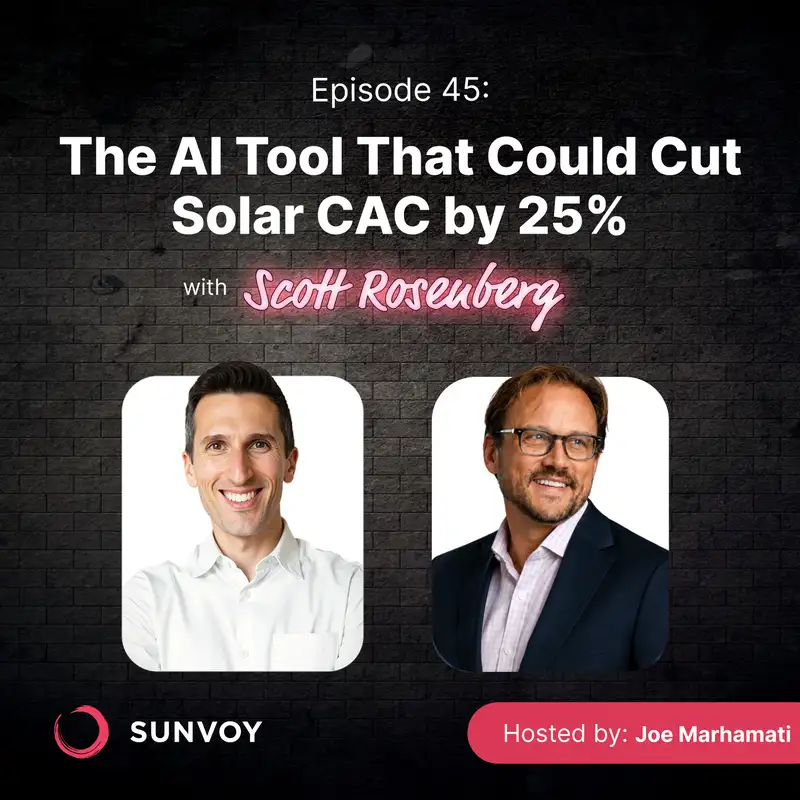
 Episode 45
· 32:59
Joe Marhamati (00:00)
Welcome everybody to today's edition of What Solar Installers Need to Know. I'm happy to have the co-founder and CEO of 257 Scott Rosenberg here today. We're going to hear about his journey from about a decade at Roku getting into the solar industry. Welcome to the podcast, Scott.
Scott Rosenberg (00:17)
Thanks, Joe. Great to be here.
Joe Marhamati (00:18)
You know, I knew I wanted you on the podcast when I kept walking by that beautiful pink booth you guys have at all the shows. I was like, this is the coolest solar booth I have ever seen. Who marketed this thing? You guys must get like twice the number of visitors to that booth of anybody else. First of all, whose idea was that?
Scott Rosenberg (00:38)
Well, so we're about a two and a half year old firm. The company is called 257. The product, which we'll talk about here is called Pink. Pink is the agentic front end to all the data and AI work that we do, which is all focused on customer acquisition and analytics in the residential energy space. The Pink, so 257 is for 257 Pearl Street. It's the first power station in North America.
created by Thomas Edison right down the street from us here in Manhattan. There are a bunch of Pearl named somethings, 257 Pearl Street is that location. So we picked the 257 part of that. And then pink, we've had brand colors of pink and yellow since the beginning. And we were designing the product and just a couple of weeks ahead of RE Plus and it still didn't have a name. So the pink.
Joe Marhamati (01:09)
you
Ha Ha ha ha.
Scott Rosenberg (01:31)
The product was coming out very pink and we just decided to call it "pink." And our second thought was this in a staid conservative industry, maybe this is a bad idea, but it's proven to be the opposite because it gets the reaction that you're describing here. People are drawn to it just because it's such an unusual color and brand name for an otherwise fairly conservative marketplace.
Joe Marhamati (01:50)
Well, I love it, you know, because our solar company had a very peculiar name too, and I was always very skeptical.
Credit to Herve that worked out well too and people never forget the name Ipsun that's for sure. So I can't wait to hear your story because it's so unique. So you spent a decade nearly at Roku. We want to hear about the role that you played there. You know, as that company was really growing up and is now a household name quite literally. And then how you parlayed into solar from your experience at Roku.
Scott Rosenberg (02:22)
Yeah, I spent almost 25 years in the media and tech space as an engineer for the first part of my career. I joined Roku at a very early stage when we were just selling hardware. We were selling little sticks and pucks that you would plug into your television. We hadn't even launched the televisions that have Roku built in at that time. And my job was to turn that growing platform into a
way of making money off of consumer behavior. So we started to take a fee on subscriptions and run ads. there's a much longer story there, but it was a remarkable company that competed amongst the giants of Apple and Google and Amazon. And I led really the revenue stream around how we ultimately took the company public. And the biggest part of it was frankly about
leveraging data to build, to deliver a better consumer experience and then to monetize all that consumer attention out the, out the backside with advertisers. I had a great run there, took the company public. met my co-founder Tal early in that venture. He was running an ad tech company called Innovid. We can come back to the origin story at 257 in a second, but I kind of reached the end of my road and was ready to try something else and had been interested in clean energy for a while. And Tal and I.
decided to go in on this together. We experimented with a couple of different business models. Most of them, I would say, looked like variations of what companies like BASE and Arbor and others are doing today, where they're pretty novel business models of placing a battery into a home and time shifting consumption or looking, trying to find higher quality customers amongst a sea of other customers. At
every one of those business models in our view, to gain advantage, we felt we needed to know more about the home than was knowable. And that for us posed the fundamental question that led to 257. We're like, why is it so hard to understand whether a home has solar, has an EV, what its energy consumption is? Is the home likely to get a battery? What kind of energy plan should that home be on? And we learned very quickly that
The data sets that inform our knowledge of homes are scattered and messy. It's a big industry and even the biggest players, the biggest utilities, the biggest solar companies have only a small aperture with which they can view the world. And we realized that we could build based on our skills in marketing and data, data science.
We could build a platform and serve that function to hundreds, thousands of companies in the space. We could give them that knowledge of how's a home configured today and how is it likely to evolve over time. So that was really the genesis of 257 was to play that role in the solar, HVAC, retail electric utility markets.
Joe Marhamati (05:08)
So if I was still a solar installer and this platform existed and get you guys started just about the time we sold our business was two years ago today, we sold our solar business. I would think, my God, this is amazing. These guys have all the data. We're just going to put all of our marketing budget into this and we're going to run ads and we're going to optimize it. And we're going to have a pretty consistent cost of acquisition. And then we're just going to scale it from there. Has that been your experience? Are you working with some of the smaller vertically integrated companies that want to scale?
but haven't had the resource like this to be able to do it? Are you working with some of the larger big box companies or is it just kind of everybody?
Scott Rosenberg (05:43)
Both yeah, so let me break down our offer in the solar space. So our industry, the solar industry has obviously gone through a fairly substantial set of changes in just the last three to four months with the ending of the IRA. But at the same time, a bunch of new great stuff coming online related to batteries and VPPs. And so our core offer in the solar space is to use our data to help you find homes that are
high propensity, a good fit, high likelihood for solar, for a battery, for a VPP plan. And we do that in a couple of different ways. One is we bring hundreds of features or attributes to the table on every home in the country. We call that a digital energy twin. That's actually very hard to, it's very hard to arrive at a coherent view of every home in the country because of that underlying data set is a pretty bad mishmash
of attributes and you've got to clean it up and there's features that are missing. So we bring a ton of data to the table and then we run machine learning really for two different purposes. One is to clean up that view and arrive at an understanding of how the home's configured today. And the other much more important thing that we do, and I'll take it, I'll apply it here specifically to solar is we look at everybody who's already adopted solar, already has a battery, already has an EV. And we build
effectively look-alike models. We say, what homes look just like today's solar homes? Not just like the building attributes, but the people in the home and where those homes are, what utility they're plugged into. What homes look just like today's solar homes, but for the fact that they've not yet gotten solar? And we call that a solar propensity model. We do it for batteries. We do it for solar plus batteries. We do it for generators. We do it for heat pumps. So
we, because we're looking at every home in the country, we're aware of four or five million current solar homes, half a million, three quarters of a million current battery homes, millions of EV homes, 20 million heat pump homes. And that is the seed from which we then train this lookalike model that we can then apply to every other home in the country. The way that plays out for an installer is we can put a pin on every home in your service territory.
that scores very highly on that propensity score. That's ultimately where, whether you're a, to your other question, Joe, whether you're a small regional installer or a big national vertically integrated player, you come to us and you're, the first thing you take off the shelf is that propensity score. And then you might apply other filters on it. Maybe you're chasing California SGIP incentive dollars, or maybe you're chasing a utilities VPP incentive program, or maybe there's an income qualification or
Maybe you have other things you've learned that you want to further constrain the targeting with. But the first thing you start with is that machine learning, that AI driven propensity model that's core to what we do.
Joe Marhamati (08:28)
So if you've got an installer that's kind of, let's just say 1500 to 2500 cost of acquisition right now, which is kind of the sweet spot of what I've seen. know, some of the bigger guys are 5,000. Some of the referral based businesses I've seen are $500. But let's say you're in that 1500 to $2500 cost of acquisition. What could an installer expect to see in terms of their reduced costs of acquisition by having access now to all this data? Cause I can imagine if you can send mailers and paid ads to folks,
Scott Rosenberg (08:35)
Yeah.
Joe Marhamati (08:56)
that just got an electric vehicle or just got an electrical upgrade or are the types of people who would be the highest propensity to go solar, you could significantly reduce your cost of acquisition.
Scott Rosenberg (09:07)
Yeah, that's a great layup. appreciate you saying it like that. Those are exactly the numbers that we see as well, by the way, is $1,500, $2,000, $2,500, sometimes as you say more. And of course, all those costs are just like flowing right through to the consumer. And all of us in our industry, especially with the loss of federal rebates, need to be thinking about how to do acquisition.
or cost effectively. if I could deliver an install with less soft costs than my competitor and put you in a whatever, a nine kilowatt system at 20 % less than my competitor, I'm going to win that all day long. Right? So that is exactly how we goal ourselves. We look to deliver a minimum of a 25 % reduction in customer acquisition costs. So we want to take that two grand acquisition cost, like what you'd spend on Meta and
on Google, in direct mail, and we want to knock it down to say 1500 bucks. And we're so, such strong believers in the role that data and AI can play in helping you precision target and personalize your outreach to a consumer that we have a business model where we only get paid on an outcomes basis. So we typically get paid a fixed fee on an appointment set or a sale and not before.
And you can use our platform to your heart's content for analysis, insights, building, targeting, whatever. You still only pay us when we actually deliver an appointment set or a sale for you.
Joe Marhamati (10:37)
That's amazing. mean, the businesses that do performance based pay are obviously the most impressive ones because they're putting their money where their mouth is. But if somebody's, know, maybe running Facebook ads today, running paid ads, and they're using lookalike ⁓ audiences from Facebook, and maybe they say, hey, actually, these guys, they have more data than you, they have more data than anybody, and they know who our target customer is, why do we need to use you when Facebook has all the data of everybody in the world?
What's the layer of value over and above what they might already be doing?
Scott Rosenberg (11:05)
Yeah. Well, first of all, it's good to not bet against Meta and Google. They do sit on enormous amounts of data, but it's also important to remember how they come into that data. What they know about you is based on the information you give them and the sites you visit and your searches. And that's very powerful data, but it's typically devoid of information about your home, importantly, like including some very basic stuff like, do you live in a single family home?
Where you own your roof, right? Do you own other things like an EV that might suggest that you're a good candidate or thinking about electrification? Did you recently move? So those big platforms are exceptional, as you point out, at behavioral and interest-based targeting, but they really don't bring to the table knowledge about the physical structure you live in, the utility that you buy your energy from.
and your other energy assets. And this is true also in our other categories like HVAC. Our typical HVAC client cares very deeply if you've got a furnace that's 15 years old or an end of life air conditioner, because that's the moment they want to be talking to you and building a relationship right before it fails. And you just cannot find that kind of intel on the big platforms. That's the role that we play. But importantly, it's not a
Meta or 257 or Google or 257. The way our platform works is you build that target audience. High solar propensity homes, you know, in the Dallas, Fort Worth metro area with a battery where they've had a recent power outage. And it's making that that criteria up. When you build that audience, you can then deploy it into any marketing channel you use. So you can push that target
that list of people you want to go right out of our platform into your Meta account, into your Google account. You can send it to your favorite direct mail provider and you then as a marketer can pick up that audience and use it and run an ad campaign on Meta using all the other tools that are amazing about Meta, Snap, Trade Desk, I mean really do any digital platform out there.
You use those tools just as you do today with the only difference being that 257 has armed you with precision targeting that includes knowledge of the home.
Joe Marhamati (13:16)
Okay, so I've got to ask you then, what's the number one predictor of going solar? Is it someone that just bought an EV? Is it somebody that just, you know, went to a heat pump or had an electrical upgrade? What do you think is the number one predictor of somebody being ready to go solar?
Scott Rosenberg (13:32)
⁓ Well, I'll give you like a simplistic answer and then I'll give you the fuller answer. So when we were first starting in this business two years ago, a lot of our early solar clients would say, can you help me find homes near other homes that have solar? And so we thought, well, we know where most solar homes are and we have a lat long location and we can actually measure.
how proximate any home in the country is to other solar homes. And so that's not actually the number one influencer on the machine learning model, but proximity to other solar homes actually proves to be quite important. Other forms of electrification are very influential. The type of home you live in, the utility you're plugged into are also heavy factors. Of course, economics are a factor. Many of our clients now, of course, are coming to us
you know, focused on who would qualify for a lease or a PPA, a TPO type system. And so economic factors come into the mix as well. The short answer with machine learning is it's never just one factor. And it's often not just singular factors, but factors in combination with each other that influence the predictive quality. And that's the power of machine learning is we really
as humans should not be in the business of saying, I want one of these and three of those, two of those. like, you know, setting weights on some rules based targeting, like the old school way of marketing. The right way to do it is, is a machine learning approach where you say, what homes are proof positive that already what homes in my sample already have solar? What's everything I know about them, I'm going to run them through a neural net that's going to tell me in the face of these factors, who's likely to get solar. That's our approach. And it's
It's multi-factor and quite complicated actually. Not something that you can write down as a simple rule.
Joe Marhamati (15:14)
And so how has AI and machine learning changed the platform, changed the reliability of the platform, changed the ability for solar installers to get more value and reduce their costs of acquisition since you started up? Because AI has changed a lot since you started this company. Is it just that its predictive technology is that much more reliable? Is it exponential? What have you noticed in the performance of the platform as AI has become more powerful?
Scott Rosenberg (15:40)
Yeah, let me, I'll break this down into a couple of different pieces. One is there's a more traditional machine learning approach, which we all in tech have been using for years. So we used it at Roku as much as 10 years ago. This is neural nets. This is sort of precursors to large language models, transformers, and a lot of the stuff that's garnered a lot of interest and excitement. And so we use that technology extensively. It's very efficient.
well-known techniques, lots of tools out there. And it's part of how we wrangle huge data sets and render them down to this precise digital energy twin for every home. Now the LLMs are powerful as well. So when you log in and create a free account on Pink, that's our product, pink.257.co, you're interacting with a front end where you can say, find me homes in...
the Boston area that have had a recent power outage that don't have a generator or solar or battery, you could write it literally like that. And then LLM helps translate that into like a query against our database. And so we're using LLM technologies there. And that's quite powerful. And then we use a lot of more LLM type technology on the backend because we have billions and billions of documents and often very complex information about a home.
And we'll use some of those technologies, do a lot of tuning in the adoption of them to help interpret what we're seeing about a home. The last factor that I put out there is just the requisite cloud infrastructure to run these technologies at scale and at low cost has changed very substantially over the last couple of years. And that just means that as a startup,
like us, raised a little under $10 million. We're about 12, 15 people, depending on how you count. Our ability to operate at scale and go fast is remarkably accelerated by not just these technologies, but the availability of Google Cloud, AWS, other technologies that help you run this at scale at low cost.
Joe Marhamati (17:41)
And so what are some of the most creative, powerful ways that you've seen solar installers use the platform? Like, can you send a mailer to 10,000 people where every single mailer is unique to their exact situation or hyper-personalize every digital ad? How have you seen installers maximally leverage the power of your tool?
Scott Rosenberg (18:03)
Yeah. Well, first I'd say our top two platforms by far are Meta and Direct Mail. Now, because Google is an essential part of the mix for any solar installer, but that's typically LSA, you know, search engine marketing. You know, if somebody's out on the web in your market searching for solar, you need to be there. But in terms of pure new customer prospecting, our clients use a mix of
I would say meta and direct mail first and foremost, and sometimes in combination with each other, because we build an audience once and you could use it and hit the same households with a meta ad and the direct mail ad. This is another one of the benefits of using us and building an audience independent of meta and Google and these other platforms as it exists and then you can deploy it. But where you're going, I think, is the next frontier. You're alluding to it. So just want to put a...
spotlight on your point around personalization. Personalizing direct mail is very expensive. That means you're asking the printer to print something unique to each household. But in digital, this is much more practical, much easier. And we have a handful of clients that are experimenting with semi-personalization. Maybe it's a neighborhood attribute or it's a categorical attribute. And we've had some clients ask about household level personalization. We have the
data to empower them to do that. We don't do the creative, but we can help them not just target, but segment within who they target. And I think we'll start to see more of that going forward. Right now, the industry, in my opinion, is in a very primitive place. It's what I would call spray and pray marketing. And so there's so much efficiencies to be gained by using a platform like us, even if you don't change the creative yet. Just stop mailing people who already have solar.
who don't own their home, who score at high propensity. Like there's so much, you know, I say our stated goal is a 25 % improvement, but we often achieve 40, 50 % improvement just because we're pulling enormous efficiencies out and helping them get to households who are actually real candidates for the products they're selling.
Joe Marhamati (20:06)
So when you look at your experience in TV and in Roku coming into clean energy, obviously you see this big, ripe, nascent industry that's just ripe for disruption and lower costs. But do you feel like there's one particular lesson from your previous life that if just applied to this new industry is going to bring the costs down and proliferate solar all over the place? Or do you see that there's something unique to solar that makes it
uniquely difficult to have the same cost curve as some of these other industries.
Scott Rosenberg (20:37)
⁓ I love the question. So I'll answer it in two ways. One is part of what brought me to this space is a belief that these are amazing products. mean, solar is just an amazing product. Put all the politics and everything aside, like it's the original original, the OG of OGs of energy production, period, right? The precursor to fossil fuels starts with the sun.
We've just done a remarkable job as a world, as a global economy at driving the cost of that down. And I just think 10 X the number of people who have solar today should have solar. Like it's just a remarkable product and batteries are right behind that lithium ions gotten so much cheaper and the ability to flex your home's consumption in response to what's happening on the grid to save you money and do a favor to the grid and get, you know, get paid for it. These are remarkable technologies. And so part of, part of my drop heat pumps and I could keep going.
Part of my drive is a belief that these are amazing products that most households should have, period, full stop. And we're just letting the customer interface and how we outreach and talk to consumers get in the way. It's a terrible consumer experience because we're not doing it in the way that every other modern consumer product is marketed to consumers.
That's the more generic statement. The first one is about a fundamental belief in the products that we all are selling. And the second part is like, if we can bring modern data science and marketing technologies to the table, we can help connect this awesome product with consumers who will benefit.
Joe Marhamati (22:02)
So I'm asking Scott, not asking the co-founder of 257 anymore. Tomorrow you're the marketer of a $25 million rooftop solar installation business. You're the CMO and you've got a 5 % of your budget, let's say, is in marketing. How do you divide up that marketing budget from billboards to the pink product itself to, you know, sponsoring the little league team and referrals?
Scott Rosenberg (22:06)
Yeah.
Joe Marhamati (22:27)
How do you think about the referral stack of how you would stack that budget?
Scott Rosenberg (22:30)
⁓ Look, mean, marketing is a complex science and art, and it's always hard to value that Little League sponsorship, but it's important and it works. It works for some businesses. So I'm not here to talk anybody out of Little League sponsorships. My kids benefited when they played Little League. Look, we are very focused on paid media as opposed to earned or community type investments. And I think that
our clients, everybody in the industry, if they want to be successful and out compete their competitors needs to just be very mercenary about their ad spend. They need to weigh, you know, either do it internally or if they don't find a good agency who can help them and just hammer on those soft costs, like $2,000 of customer acquisition costs to sell a $20,000 system is not acceptable. We all should do better when we have to
bake $2,000 of costs into our system. We're passing that on as two or three or $4,000 to our customers. so our view is that you should test your way into different media mixes. We see every day that direct mail and Meta and Google and other open web advertising work well, but you should be using a platform like 257 to both target
and then on the back end to measure efficiency. And you should be ruthless about it, really. I mean, we're ruthless about it. Like if we don't deliver performance advantages, we want you to fire us, because that's like, that's our job.
Joe Marhamati (24:02)
So what are you seeing out there in the post big beautiful bill world with the incentive, the federal incentives gone in terms of solar installers trying to adapt? Obviously customer acquisition is what you and I are focused on getting that cost down, but it's not the only cost that needs to come down. Obviously there's hard costs, there's soft costs. And I see these debates online among folks in our industry and in solar executives about can we really get to $2 a watt in the U.S.?
Scott Rosenberg (24:16)
Yeah. Yeah.
Joe Marhamati (24:29)
Or is it just constructed such that that's not going to happen without a lot of other big changes that are out of our control? And that, you need 250 plus a watt in order to pay your people appropriately and provide benefits and so forth and so on. So what do you see an installer's do out there to practically get the cost down over and above your platform?
Scott Rosenberg (24:50)
That's a good question. I'll be careful here, just because it's a little bit out of my league to speculate on what's going to happen to panel costs and labor. There are a couple of organizations, Tesla included, who've put out great cost stacks that I think are quite compelling and where the squishiness is in that stack. In terms of the other part of your question, the
The tactics that we've seen play out that clients are bringing to us since the dissolution of the IRA are a couple fold. One is we have a bunch of solar service companies who want to go find people who've got solar systems that are older, or maybe they were installed by a company that's not around anymore and they want to get in with a service contract. That's one. And they want that service contract sometimes as a loss leader.
So they can then talk about upsizing that system if the home still has spare roof space and has brought home an EV or gotten a heat pump. We have clients who are prospecting to upsell a battery into a system that already has solar, but maybe it's in an area where there's growing costs or a new time of use plan or more outages. So we have battery cross-selling. And then we have a growing crop of
battery VPP clients where they have another side of their business model where they're monetizing the install of a battery either at the ISO level like in California or at the utility level. They're feeding on incentives from, you know, that can be monetized in ERCOT. Eversource in the Northeast has got some interesting programs where they'll incent you if you put a battery on a congested feeder line. We have a whole crop of clients coming to us
looking to sell batteries into existing solar systems or sell batteries alone into homes where they can collect an incentive and share some of that incentive with the consumer. It's a really persuasive programs where it's $0 or $500 upfront for the equivalent of a Powerwall or two Powerwalls and then 50 bucks a month thereafter.
and then they're monetizing to the tune of thousands of dollars a year with the utility in a VPP program. So those are the, don't know, Joe, did I miss anything there? And based on your experience of other tactics that are in play, that's what we're seeing among our clientele.
Joe Marhamati (27:12)
Yeah, I mean, think that the industry is just starting to think about how it can innovate its way out of this problem and really falling off a cliff ⁓ overnight. And it's only been a few months, but let's take off your CMO hat now. Now you're the chief AI officer. What would you be implementing in a solar business, creative uses of AI of how solar businesses can become more operationally efficient?
Scott Rosenberg (27:19)
Yeah. Yeah.
Uh-huh.
⁓
I love that question and I also want to tie it back to Sunvoy and your business as well. So I think a couple of fold. One is we do this as well as understand your current customers and leads. Like we can profile everybody you've ever served in the past. And there's enormous, especially if you have some scale, there's a lot to be learned from who you've sold to in the past. That's a first point. A second point, which I know is Sunvoy's focus is
We always like to say in marketing, the cheapest customer to acquire is the one you already have. So cross-selling services and upgrades to people you already know and have a relationship with is one of the best ways to monetize that intellectual property called your CRM. And I know that's a big focus of, Sunvoy. And I think AI there can play a role as well. Like we can take the same propensity scores that we apply to the outside market and we can apply it inside of your CRM and tell you
who's a good candidate for an upsell. We have a big solar installer in the Southeast who's got a new HVAC business and we've helped them cross-sell HVAC heat pumps into their existing very large customer base. So that's another use of AI. And then I think there's a lot of exciting stuff which I don't frankly know well enough around customer service and follow-up and proposal generation coming that I think is very exciting and stands to improve the consumer experience.
after first contact. We're about, we're focused on getting to that first contact, but after first contact, AI could play a pretty powerful role in improving the, further improving the customer journey.
Joe Marhamati (29:01)
I love that answer. You know, I tell installers every day and I'm glad you mentioned that your platform does that because, know, we have an eShop now in Sunvoy where all of the customers and old and new can see all the products and services being sold by an installer. And there are so many folks out there that went solar 10 years ago that don't know that their installer is selling batteries. If they even remember the name of their installer, don't know they're doing EV charging or service plans or panel cleanings.
And it's a huge untapped market. I say that there's more money on the table after PTO than before PTO because there's just so many additional products and services being sold by traditional solar installers today than five, 10 years ago when a lot of those folks went solar. So that's actually really good to know that your platform can also look internal to existing customers that might've gone solar 10 years ago.
and suggest to those installers what they should be promoting to them.
Scott Rosenberg (29:55)
Yeah. Yep.
Joe Marhamati (29:56)
I love it. I think, you know, there's a few tools out there in solar software that really have significant potential to reduce cost of acquisition. And that's what we need right now. Scott, where can people find you if they want to get a demo of the product or learn more? Where would they go?
Scott Rosenberg (30:11)
So the easiest thing you can do if you wanna get to know us is to go to pink.257.co and you can create a free account and you can tool around in the platform, see what we know about households and people in your service market. It's a fun way to get going. There's no ⁓ cost. You can ask the tool, show me.
Homes that would be a good fit for solar in my neighborhood. You can test out all these different theories that have had a recent power outage that own EVs. And then have a call with us. We've got an account management team. And the best way to get started with us is really two things. One is we can profile your historic customers and leads. It's fun, it's fast, it's usually got some surprises. Our typical customer thinks they know
who their customers are, but it's got some surprises. And then the other thing is we offer free pilots. So we'll let you run, we'll let you use us to run a campaign. You got to still buy the media. You're still running the ad campaign, but you can use our part of it for free. We love tests. If you want to run us head to head with what you're doing today, that's even better. because that's a nice benchmark. When we win a test, we always get hired. So we like tests and we usually win tests.
That's the other thing is a free pilot.
Joe Marhamati (31:20)
Love it. I can't wait to see that pink booth grow and grow and grow in size at the RE+ show and have you guys see great success. I think it's one of the most innovative and compelling ideas in the solar industry and I wish you guys great success. I appreciate you taking the time out to be here today.
Scott Rosenberg (31:34)
Yeah, thank you. And it's wonderful to talk to somebody in the space who's as focused on marketing and efficiencies and customer experiences as you, Joe, and the Sunvoy team. I appreciate the talk here is great.
Joe Marhamati (31:48)
Thanks, Scott, and thanks everybody for listening today. This has been the latest edition of What Solar Installers Need to Know. We'll see you next time.
Listen to What Solar Installers Need To Know (by Sunvoy) using one of many popular podcasting apps or directories.
