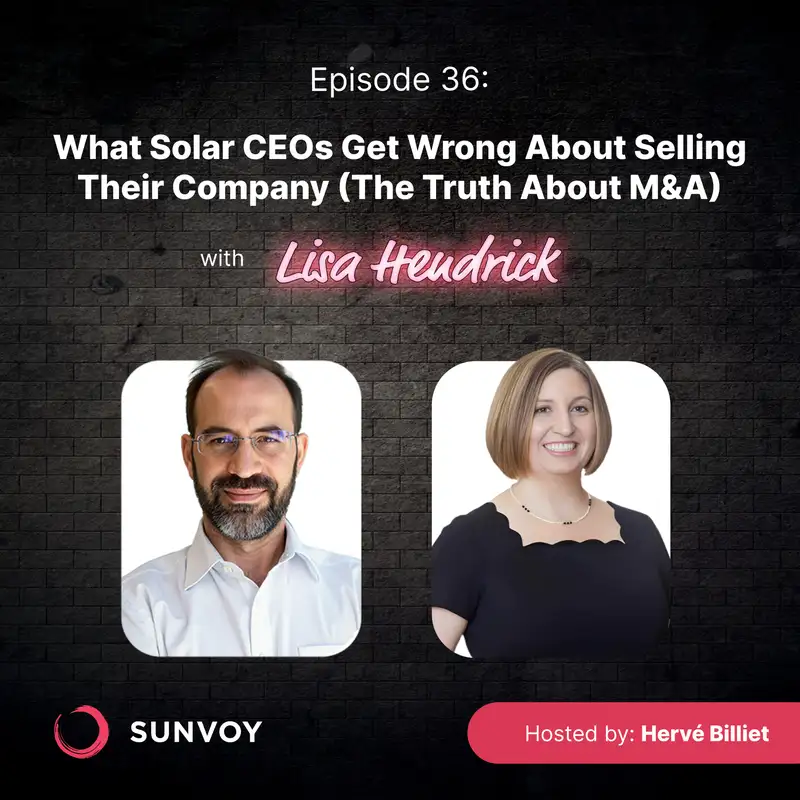
 Episode 36
· 33:19
Herve Billiet (00:00)
Hey everyone, welcome to another episode of What Solar Installers Need to Know, where I invited Lisa Hedrick. You are the M&A attorney with a Hirschler. So Lisa, please introduce yourself.
Lisa Hedrick (00:12)
Yes, Hi. Thank you so much for having me. So as you mentioned, I'm an M&A attorney at Hirschler, which is a mid-size law firm, headquartered in Richmond, Virginia. And I primarily help people in buying and selling businesses. So I work with privately held companies, never do any public company work, ranging from a million to over a billion dollars, and in all sorts of industries, and really help buyers and sellers sort of navigate
the selling process.
Herve Billiet (00:40)
Lisa, we work together. You helped us with the sale of Ipsum Solar for all legal matters, we cannot speak about the details, but we can use it a bit as a use case in some instances. But so my first question to you is lessons learned over the years about M&A in general, not just solar or not just what you learned with Ipsun Solar, but in general. What are some
key elements that you've learned over the years with a M&A transactions.
Lisa Hedrick (01:06)
Yeah, I I think the thing that I try to remind myself regularly of and other attorneys that I supervise is that every deal is different. And certainly as with any industry, there are customs and there are practices, there are terms of art that we use in the M&A context, but nothing's sort of cookie cutter. And so when I'm dealing with a new seller, part of what I'm trying to understand is their motivation for selling and their
concerns about selling me so that we can try to provide better protection. And the concerns that you may have as a seller would be different from someone else's a seller. And that's shaped by their experience and otherwise, but really trying to understand that there's no sort of one cure all agreement can't pull something off the shelf and sell a business that it is very customized.
Herve Billiet (01:52)
Maybe that's my ignorance, but tell me more like how is the motivation of somebody selling having an impact on the legal text?
Lisa Hedrick (01:59)
Yeah, so, you know, some people who may sell, they want a legacy. They want to make sure that their employees are taken care of, that their folks that have been working for them for 20 years still have the ability to be employed. And maybe they're willing to take less money because they can find a buyer or a situation that's going to take care of their employees in the future. Other sellers may say, well, we just want the biggest dollar. I don't care because I'm going to take the money and I'm going to...
run off and retire and it doesn't really matter to me. And so it just, it does depend on kind of what that person's temperament is in terms of what they plan to do after the closing. Are they going to stay with the business? Are they going to transition to something else? And you have to negotiate that. So someone who may be working in another business, maybe more concerned about their non-compete and willing to give up on certain other terms because they want, you know,
less restrictive non-compete. So you just kind of have to weigh those and kind of figure out what motivates that seller for and what their plans are.
Herve Billiet (03:00)
Well, I only sold one business for a real business. so what I learned is in going in part with what you mentioned is like everything is up for negotiation. It just depends on what you value. There are so many P's in our business that had to be negotiated. So it's not like go on AI or get a template of how to sell the business everything is different. So what companies we had, warranties and guarantees that we made over the years to our customers.
Lisa Hedrick (03:09)
Mm-hmm. Right.
Mm-hmm.
Herve Billiet (03:29)
And I really remember that we had a competitor that went through 10 years of protection warranties. Like, went through 10 years. And then we had somebody at 15 years. And my salesman was like, we should match 15 years. Like, whoa, hell no for a moment. Why don't we go to 12 instead of 15? And then we had competitors in Maryland going through 20 and 25 years. It's like, that's nuts. So we were at 12 years for four
Lisa Hedrick (03:44)
Mm-hmm.
Herve Billiet (03:54)
for the majority of our business. We didn't go further. But those 12 years became a very real number. It's not just some monopoly number, monopoly money. It's like real warranties that you put on your books. And it was part of our negotiation. I remember that. So there's a lot of pieces that in the business you may not take for granted. But in the time that you are exiting the business, it's only become this real negotiation points.
Lisa Hedrick (03:56)
Mm-hmm.
Mm-hmm.
Herve Billiet (04:22)
Although you mentioned every deal is different, do you have some generalities about M&A about what to do or what not to do?
Lisa Hedrick (04:24)
It is.
Yeah, so sort of self-servingly, I would say get your attorney involved as soon as possible. Because I do think even when you're negotiating a letter of intent, which is sort of the first kind of term sheet or document that you put together, there can be items that get put into that document ahead of time that will save you time and money in the future and negotiation pains. Like you can get those agreed to upfront. I think,
the more you can prepare for a sale, the better. So sometimes with closely held businesses, there may be affiliated entities, right? Maybe you also own the real property that is used in the business in another entity. Well, is there a lease in place? If not, consider putting one in place because that shows the buyer, maybe the buyer that assumes that lease and doesn't put in their own lease or
Do you have people on the payroll that are family members that aren't maybe working in the business? Should you remove them from the payroll? So just trying to clean up the business to make it a little bit more sale ready. Because those are things you'll likely have to do as part of the sale process. But if you can get them taken care of ahead of time, that's one less thing you have to do when you sell.
Herve Billiet (05:36)
And to me, counter argument is that you're not always sure that the sale is going to happen. In my case, wasn't until the very last minute that it was going to happen or not. So you don't want to have to do all that work. You took an example of family members, not that we had that, but you don't want to have that conversation if there is no sale happening. I understand people that would kind of, it makes perfect sense, but in reality, you kind of want to delay it.
Lisa Hedrick (05:41)
Right.
Right.
Herve Billiet (06:00)
That's a good piece of advice. What about timeline of selling companies? Do you see some general rule of terms?
Lisa Hedrick (06:06)
Yeah, so mean, most companies I would say sell in the 30 to 90 day range. Some can go faster, some can go slower. Now this is from letter of intent. And that's usually when I get involved is when the letter of intent is being negotiated. If you engage a banker to solicit offers for your business or find buyers for you, it's probably three or four months ahead of that letter of intent process. So I plan on a good half year to sell.
Herve Billiet (06:11)
that's fast.
Lisa Hedrick (06:31)
And I will say that in the past probably year or so, sales have the pacing has slowed down. And so it is taking longer for deals to get done. And I think some of that is just buyers are raising more diligence concerns and really digging into the financials, really digging into sort of contracts and making sure that the financials sort of hold weight. And that's sort of slowing down the pace of deals.
Herve Billiet (06:56)
Does that mean that before people care less about financials? Like is it because of the economy was booming and people making tons of money like doesn't matter if you make a bad deal? Or like what's the reasoning behind that?
Lisa Hedrick (07:04)
Yeah. So
I think there was a little bit of that where you had a much bigger demand than there was supply. And so sometimes you would see deals get done on an express time frame and buyers were sort of doing diligence, but not maybe digging as deep. And I think now buyers are maybe slower to do that. And especially
I think when you move to smaller companies, there's a little bit less competition for them. And so they can take more time. There's not sort of a market grab as much going on. Now we'll probably get back there. this will, you know, after a couple of years, we may be back into the speedy race again, but right now we are seeing a slowdown a little bit in terms of timeline.
Herve Billiet (07:49)
In your career, have you seen those ups and downs kind of like a lot of activity, little activity? Is it related to the state of the economy in general or is it maybe one industry like, I guess, you know, we both in Virginia, a lot of data center activity or or is it like industry related or is it microeconomic related? Both.
Lisa Hedrick (08:03)
Mm-hmm.
You know, it can be both. I will say, you know, sometimes it's driven by interest rates. So when interest rates go down, buyers can borrow more. And so that can sometimes help drive pricing. It can help drive demand because they have more ability to pay. I remember, I think it was the end of 2012, we had a huge surge of deals because the tax laws were about to change. They ultimately, Congress ultimately didn't change them, but the capital gains rate was supposed to increase.
And so everyone was trying to get their sales in before the eclipse of the lower tax rates. And so there was a huge surge on that and people were really trying to sell businesses with private equity. Sometimes you see it where they just need to sell because they have money they have to deploy and stats out there are that there's more dry powder, meaning
funds to be sort of deployed in investments than there ever has been. There's more now than there ever has been before. And so I think that drives some of the demand. Certainly there's hot industries. I mean, will say tariffs have hurt manufacturing and distribution companies a fair bit because there's a lot of uncertainty. And so buyers are not sure, you know, do we want to invest in these companies? Because maybe if the tariffs...
stay in place or go up, like that changes their financial modeling, right? So right now, businesses that are wholly domestic, that don't have a lot of reliance on foreign goods are very, popular right now. Services businesses can be very popular right now, because again, it's not reliant on sort of goods, tariffed goods. then, their financials are a little bit more predictable. Lots of different factors impact
things, definitely stuff on data centers. You are seeing a lot of that right now. cause that is the new hot thing.
Herve Billiet (09:54)
What is a typical buyer of companies? Do you see like only like professionals do that? Or mean, at some point we were thinking about expanding in different markets, Geographic, Sunvoy came along, like, we do that? They're like HVAC, but there was a moment where we were looking at acquiring other solar installers and just grow that way. So now I don't think we would have been like serial buyers. Maybe we started one and potentially others.
Lisa Hedrick (10:14)
Mm-hmm.
Herve Billiet (10:20)
So do you see like a typical people that do M&A's, is it just like one-offs or is a vast majority of people doing an M&A's? It's kind of their strategy. It's like an equity partner that just buys, buys, buys. Or what's the typical, I guess your typical client is like a repeat or client or not.
Lisa Hedrick (10:40)
Yeah, so I work with a bunch of different types of clients. So I do work with some private equity. So they're serial acquirers and serial sellers. So they're going to do a lot of buying and selling. Some of them do the buy and build where they're going to buy a bunch in a certain space and sort of aggregate them together. So that's a very common strategy. I've worked with companies, you know, that are owned by a couple of founders who just want to expand into a market and have decided that it's
quicker and more affordable for them to acquire an existing business, maybe one that is transitioning because someone's getting ready to retire and their children don't want to assume the business. And if, you know, so it could even be a competitor, but one that's sort of a friendly competitor that, hey, the owner wants to retire, you want to get into that market, you know, and you reach out and you kind of do a combination. So I see that. And sometimes, you know, companies will,
acquire multiple sometimes like you said they just acquire one and and they're done and that's enough. And then I do some work for public companies so I don't do any public company M&A like the M&A that's you file with the SEC but I have worked with public companies who are acquiring smaller companies to bring into their portfolio and sometimes the motivation for a public company is to diversify their product offering so maybe they don't have
In your example, a solar company, they're a construction company, but they don't have a solar aspect to it. So they want to add a solar platform to help them build out that sort of revenue stream. So that's a possibility as well.
Herve Billiet (12:10)
For solar CEO is listening and like well, maybe I'm interested in acquiring a competitor or if you want to go to another state instead of like starting a warehouse and an office and sales and so on just acquiring somebody else like what are some first steps that you would commence they do?
Lisa Hedrick (12:22)
Yep.
Herve Billiet (12:27)
Any advice?
Lisa Hedrick (12:27)
Yeah.
Yeah. mean, I think, initially making contact to sort of see if the other party is interested in engaging in discussions, usually entering into a non-disclosure agreement because there's going to be information going back and forth. Usually the seller will be giving more information to the buyer, but the buyer might be giving information to the seller, particularly if you structure it as sort of a joint venture or if that seller might own a piece of equity in buyer for a period of time.
So you want some sort of confidentiality agreement. And then I do think digging into the financials, sort of getting your accountant to look at the books and records of the seller and sort of verify that they've kept good accounts. Because a lot of that is how value is driven is what their revenue stream is, what their backlog is, you know, what their assets look like. And if you don't have a good sort of set of financials, you could get further down the road and realize
that the company's not as worth as much. And now you've spent all this time and money when you may not be interested anymore.
Herve Billiet (13:25)
Before going to the valuation part of a business, I have a question about NDAs. It is tricky to call a competitor and like, you know, can we talk about this and then exchange information, even though draw some NDA sign. I remember when we did like all our prospectus about Ipsun, we did see some competitors being interested in supposedly buying or taking over Ipsun, but it did
Lisa Hedrick (13:29)
Mm-hmm.
Herve Billiet (13:53)
felt a lot like you probably have zero interest. You're curious to see the numbers. So do you know of cases where this actually becomes a real legal issue? it's actually like that data sharing is misused. Is that a real something to be actually worried about or only happens in movies and not in real life?
Lisa Hedrick (13:56)
Mm-hmm. Yeah.
Yeah, no, I do think it happens in real life. And I think one of the downsides is it's really hard to prove a violation of a non-disclosure agreement. Because usually a non-disclosure agreement says that they can't disclose the information, nor can they use the information. Well, how do you prove non-use? It's really hard to show that they've used the information directly in their business that is in violation of this agreement.
And so usually my recommendation to clients, if you're, if you have a competitor that's bidding on you is to restrict the amount of information that you give. So if you're going to give information about customers, blind out the names of customers, say customer one, customer two, customer three, and, maybe aggregate by geographic location, or just to sort of get them started and see if they express interest. If they continue to express interest and you believe it's sincere,
you're eventually going to have to show them the more detailed information, but you can sort of prevent people from doing just sort of the looky-loo, just trying to find out data by sort of staging the diligence and requiring them to spend dollars to see if they're really interested. Because if they do hire an attorney and they start marking up an agreement and they put in a bid, that's going to cost them money.
But it shows that they're more serious than somebody who's just like, no, I just want your list of employees. And then you can also put things in your NDA like a non-solicit, so that it protects both parties from the other party soliciting employees because they may not know who all your employees are, who the key employees are, but they're going to find that out as part of diligence. And what you don't want them to do is find out who your key folks are and then poach them. So that can provide some protections too, but
really limiting the information is your best protection.
Herve Billiet (16:00)
Because I think there was some general business strategy information like, let's go, I'm interested in company in Delaware. And they're like, well, it's a huge market. It's way bigger than I expected. That kind of information is interesting from a business point of view. Now, just because you have an idea, you still need to execute, right? The business, the value, I think, now that we speak about value, is in execution. You have an idea, it's worth, it's not worth much, but there is still some...
Lisa Hedrick (16:07)
Right.
Herve Billiet (16:27)
valuable information you can get out of that. So about valuation, what have you seen over the years where people really put value and want to protect when they buy a company, want to make sure that things stay in place? What are some key values that you recognize?
Lisa Hedrick (16:42)
Yeah. So, you know, a lot of times buyers are going to look at the management team and they're going to want to see that there is sort of a more robust management team than a single owner. Because the problem is, is if you have a single owner and that owner goes away or something happens to him or her, they die, they become disabled. The value of the business probably has gone down if everything's sort of reliant. So businesses that have a succession plan, who have other key managers that could be involved,
Herve Billiet (16:46)
and their goals.
Lisa Hedrick (17:08)
particularly because when you have an owner who sells, they're getting a big chunk of money and they may not be as motivated to stay as long as they think because it is very different to go from being your own boss to now having to report to someone. And I do find that a lot of owners after a couple of years are like, you know what, I don't want to be involved anymore. And it's not because the buyer is a bad person. It's just, it's a different way that they've approached the business, right? Before they got to call all the shots and now they don't have that same
luxury and it's maybe they want to start another business. Maybe they're just done and want to spend time with the grandkids. Both are fine. You know, all these reasons are fine, but a buyer is going to be wary of somebody who wants to just get out the door because they need consistency and stability that helps keep employees there. It helps, you know, keep the business and the customers there. and so that's going to be something that's going to drive value. I think workforce is really important now
just making sure that they've got a happy and content workforce. So I think value drivers are going to be, are you treating your employees well? Do they have good benefits? Those types of things. Do they have maybe incentive, like stay bonuses, whereas they get bonuses on a change of control or a sale of the business, and then if they stay there a year. So those, think, can help drive value. And then I think customer stickiness.
How long of the relationships with customers? Do you have long-term contracts with your customers that can't be terminated? If everything can be terminated on a short notice, that's going to be a harder sell for a buyer, because if the customers don't like the buyer, they're gone, right? So I do think some of that stickiness is going to help drive your value.
Herve Billiet (18:45)
And what you mentioned there, if I can translate it like if the customers are happy, we had MPS scores. And so they looked at the MPS score, which is a metric of if your customers are happy. If your employees are happy, yes, they ask employees, are you happy? But you the employee sees a person they don't know, it's like they're not sure what to answer. But one of the metrics they looked at is like, how long have they been with the business? If high turnover, that is a...
Lisa Hedrick (18:52)
Mm-hmm. Yeah.
Right.
Mm-hmm. Yeah.
Herve Billiet (19:11)
indirect metric or indication that something may be off or something. So, that the years they stayed. So for us, people stay many years in business. So that was that was an advantage, which brings me to culture. You may write long texts and contracts. How do you deal in M&A's with culture
Lisa Hedrick (19:21)
Yeah.
Herve Billiet (19:32)
match or mismatch? Have you seen some situation that you feel like they're going to sign, they're going to blow up the next day or like how do you deal with cultural differences and make sure there's a good match between the teams?
Lisa Hedrick (19:33)
Yeah.
Yeah, so that definitely sort of transition and culture is huge. So, usually, I think that you have a better luck of keeping culture if you can keep the owners or the CEO, like the key management on board for a certain number of years, right? So they can help provide that stability, familiarity for the customers, for the employees. So I think that's helpful. I also think that if you're a seller, it's good to do some diligence
to talk to other sellers that this buyer has maybe purchased from. And that may not be possible, right? If it's just a single buyer who's never bought anything before, you may not have that luxury, although you might be able to interview other employees. But it's helpful, I think, to sometimes interview folks who have gone through that transition before and ask them, like, how has that worked for you? I did a sale last year where that's what the owner, she did, she reached out to other people who had sold
businesses to this buyer and said, well, what do you wish you knew then that you know now? And so because of that, she was able to better prepare herself in the negotiations of things she wanted to make sure were put in place for her employees or things that she wanted to be able to have say so as she continued in the business on their behalf. So I do think doing some diligence on that can help even having your lawyer run a
a litigation search to see how litigious the buyer is. ⁓ That can actually be helpful just because if you have a buyer who's very litigious, they may get upset at a minor squabble and then sue, and you don't want that. So that can be helpful diligence to help that culture. I think, unfortunately, sometimes cultures are going to change.
Herve Billiet (21:09)
Yeah.
Lisa Hedrick (21:28)
because you have a bigger organization. So some of the things that maybe a smaller business could do, you can't do in a larger business. It's just not feasible. And so I think, you know, trying to negotiate with the buyer of like, hey, you will continue the Christmas bonus program, or you will do something for a period of time to help ease, you know, the transition. I think you can try to do some of that too. I do see that often, but I have seen things go terribly awry where employees have
mass exodus after a sale, ⁓ not usually the next day, but usually over a couple of months. And so in some ways, sometimes a buyer will want to put what's called an earn out into the purchase agreement where basically a portion of the purchase price is not earned until certain metrics are hit after the closing. And that could be certain revenue thresholds or it could be staff retention.
Herve Billiet (21:58)
Like the next day or a week later.
Lisa Hedrick (22:20)
I have seen that where it's like, you have 100% of your staff still employed in six months, then you get a bonus. If it's 80%, you get of that bonus. So again, usually you don't want to lock to 100% because there's normal attrition in any business. But that is definitely something to give some thought to is how is this business going to sustain itself? And some sellers are very concerned about that because they've
worked with these employees, like you said, for decades and they don't want them to sort of be out, you know, out of a job.
Herve Billiet (22:52)
I have a cool story about a transition. the day of the sales, employees knew about everything happening. But there was a moment where we actually transitioned. ⁓ And I made it public. There was still a video cam and some people in the office. And I prepared. I knew it was going to be emotional for me. But I tried to make it funny.
Lisa Hedrick (23:03)
Mm-hmm.
Herve Billiet (23:13)
So I told the new owner, like, here is all the keys to success. And I handed over the warehouse keys. And then I said, like, we've been drinking our Kool-Aid for many years. So here's a water bottle from Ipsun Solar to keep drinking the Kool-Aid. You need to be very stubborn to be running a solar company. So here is a hard hat. And so I kind of like, you know, after five or 10 people are like, OK, here, maybe get the message.
Lisa Hedrick (23:21)
Ha
Right,
right.
Herve Billiet (23:39)
I thought about that and making it, but it was a real transition where I asked my people to, give the new management team, a serious chance for three months to make a judgment early, stay on. And I really helped. And then also my role was to stay away, right? Once it was is happening, people kept asking me questions and then I had to force myself to not respond. It's not my role anymore. I'm stepping down.
Lisa Hedrick (23:42)
Yeah.
Right.
Yeah.
Herve Billiet (24:02)
Please address this question to somebody else. Because I can easily see that if I kept playing my role as former CEO and make decisions, things would go really bad real fast. I had to.
Lisa Hedrick (24:06)
Right. Mm-hmm.
Right. Right.
Herve Billiet (24:14)
to follow the decision on me to exit the business. It was really hard actually on me too. But, what you mentioned there about people exiting or having a payout based on that and earn out, I have another story about that. So I had a friend that had a very successful website company like 20 years ago, and he sold to a publicly traded company. It was a Belgian company. And massive earn out, but...
Lisa Hedrick (24:16)
Yeah.
Mm-hmm.
Herve Billiet (24:39)
if you tie yourself to a very large company, it's a safe bet. So he received some money at a transaction, basically everything was in shares of the larger company. Well, a years later, that company went under. And so he basically sold his business and got not much to show for it. So that was very painful lesson.
Lisa Hedrick (24:43)
Right.
Hmm.
⁓ mm-hmm.
Yeah. Yeah.
Herve Billiet (25:02)
So, that is why for us, If I'm not in control, I don't know what, what's going to happen. Even though, for example, 100% we know it's not possible, but even you put 80%, 60%, if you're not in control to keep employees, to keep the culture the way it is, then you know, you put yourself at an earner that you don't have any control over. I thought I've always been against that. Like if I'm in control, I can take some risk and bet on myself, but betting on
Lisa Hedrick (25:04)
Right.
Right.
Yeah.
Herve Billiet (25:27)
something that's completely out of your control is well might as well go to Las Vegas.
Lisa Hedrick (25:31)
I mean, earnouts definitely don't always pay out. So you have to be mindful
Herve Billiet (25:35)
I'm talking about employees, let's speak about the customers. What have you seen with how customers respond to M&A's and is there a way to protect customers in contract?
Lisa Hedrick (25:39)
Mm-hmm. Yes.
Yeah, so I I definitely think a lot of times customers don't realize when there has been a sale of the business. So I have clients who won't announce the deal because they don't want to alert customers or suppliers to the sale. And a lot of times if the same sales folks and the same management folks are in place, nobody really knows, right? If they're, if the same people they would otherwise ask questions to or the same folks they're asking of before the sale.
A lot of times it goes unnoticed. And so I do think from a buyer perspective, you want to have as much consistency as possible with that. Now, sometimes you don't have that luxury. Sometimes the owner is the key salesperson or has these relationships and has had them for decades and the owner is now going to exit. So usually you're going to want to negotiate some sort of time period where that owner is going to help transition the employee relation or the customer relationships to other employees. And you'll want to build that into
the purchase agreement or the employment agreement that you put in place. In your customer contracts, you as a seller want to avoid any sort of anti-assignment or anti change of control provisions, anything that would require you to get their consent in order to have a new person take over the contract. That's not always possible, but usually you want to try to avoid that because that makes it so that you can do this transition
without having to tell them about it or without having to get their consent in many cases. And that can help because again, I don't think a lot of customers are paying attention if they have the same contact person.
Herve Billiet (27:17)
Yeah. Well, I know you've done at least one transaction in the solar industry. Anything remarkable or anything special about the solar industry or are we just another construction, part of the construction industry and deals are just the same as anywhere else?
Lisa Hedrick (27:31)
So I don't think deals are just the same as anywhere else, right? I think every deal is special. I do think the solar industry has some challenges and advantages that other construction companies don't. I mean, in my experience with solar, sometimes it's a lot more consumer based, right? Sales, you're not always selling. Sometimes you have commercial clients, but sometimes you're selling to individuals or your customers may not be as repeat customers, right? Not recurring customers as often as maybe a construction company.
Also, usually with a construction company, the sort of RFP or bid process can be a lot longer than maybe in a solar because the projects could be bigger. Again, that's not true for all of them, but those are certainly things to think about as, you know, when you're positioning yourself to a buyer is kind of what your pipeline is because they're going to want to make sure that you've got regular recurring customers, given that you may not have a lot of repeat customers.
But also in the solar industry, as you mentioned with the warranties, that's certainly something to give thought to because that is a little bit different than construction. And also to the extent you provide ongoing maintenance or service that again might be different than a construction company and, but could be a good source of revenue for the company of how you sort of stabilize your revenue stream because yes, you do these installations, but then you're continuing to service or, you know, provide metrics or other
oversight for these programs. So I do think it's unique. It's a fun industry to work in, certainly as laws are changing and different states have energy programs that can always maybe help or hurt perhaps. But I think it's a fun industry and will just continue to become more popular because I do think energy is a crucial factor for a lot of folks that they're thinking about.
Herve Billiet (29:13)
Yes. Thank you for saying that about the solar industry. It is a fun industry. Now, since we're born in Virginia, a lot of data centers here, let's speak a moment about energy and AI. So in a larger view, how is AI impacting the legal industry in general terms? What do you think is happening?
Lisa Hedrick (29:21)
Mm-hmm.
Mm-hmm.
Yeah. Well,
so AI, think is a great tool and it can be used to help perhaps shortcut certain things. I think you can. It's a great research tool. It can sometimes be used to sort of shortcut like how do I find an answer to something? I think you have to be very careful though, because I often will get a client who will call me and say, well, I just asked ChatGPT this question and this is what it said.
And I caution people about that because ChatGPT is a very powerful engine. It's pulling from a lot of different sources, but it's not always right. And in fact, there's lots of cases out there, including cases where lawyers have used AI and gone to court and the court says this case doesn't exist that you cite to in your brief. And they've pulled it because of ChatGPT. So it's not perfect. And I do still think that there's analysis and
also sort of industry nuances that ChatGPT isn't getting right. In M&A, we have a way to talk about certain things or a way to frame things in agreement different than somebody who does trust in a state's law. And if you have somebody who's not an expert in that field, you're going to miss items or you're maybe going to emphasize things that aren't as important. And I think that's where ChatGPT or AI could also lead someone astray. So again,
I think it can be a good way to look at things. It could be a good way to get started. It could be a good way to brainstorm. But to me, nothing replaces sort of having a good solid M&A attorney if you're trying to buy or sell a business.
Herve Billiet (30:58)
Yeah, well, I think AI can be confidently wrong about stuff way too easily. And I think AI, not just for legal, but like we're not a software company, we use AI all the time, but it enhances people, people that can code, not can code better and faster. But if you don't know anything about coding, it's not gonna empower you a lot. It's gonna make you kind of a danger.
Lisa Hedrick (31:02)
Yes.
Mm-hmm.
Yeah.
Right.
Herve Billiet (31:20)
And I think also in M&A, there is an entire aspect of an emotional aspect to it. So you had to deal with that, but you have clearly the aspect of like legal stuff, but there's an impact also. So handing everything over to AI is not quite there. I want to thank you, Lisa, for handling our transaction and going through it. So I was extremely happy with all of that went.
Lisa Hedrick (31:25)
Mm-hmm. Yeah.
Right. Sure.
was
Herve Billiet (31:43)
And the professional, and many times he said, no, this is how it works. And so thank you for guiding me through that. So I'm not sure AI could do any of that.
Lisa Hedrick (31:46)
I'm
Well, good. Yes. No, that was a fun transaction and you know, let's work on another one in the future.
Herve Billiet (31:57)
Yeah, we'll see. Lisa, thank you so much for speaking about and representing your entire legal industry for M&A's, speaking about your past experience and also about impact of AI on all of us. So thank you.
Lisa Hedrick (31:59)
you.
Yeah, happy too. Thanks for the invite. Thanks.
Herve Billiet (32:13)
Thanks, Lisa.
Listen to What Solar Installers Need To Know (by Sunvoy) using one of many popular podcasting apps or directories.
