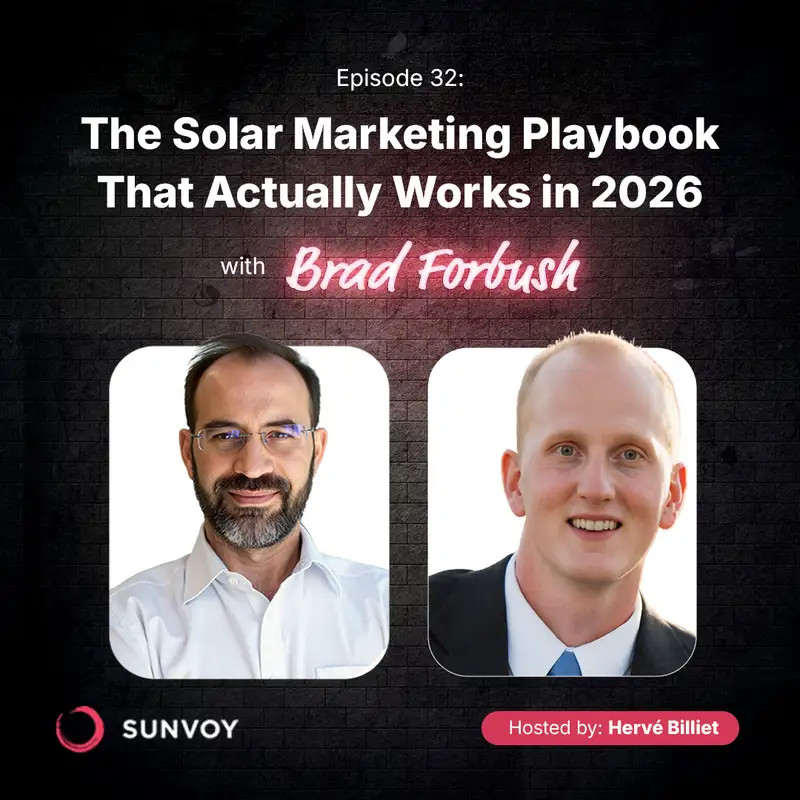
 Episode 32
· 32:22
Herve Billiet (00:00)
Welcome everybody to another episode of What Solar Installers Need to Know, and I have the great pleasure to invite Brad to our podcast. Hey, Brad.
Brad Forbush (00:10)
Hey, how are you? Good to thank you for having me on.
Herve Billiet (00:13)
Absolutely. So Brad, you and I, worked together when you were at Shine Solar. I've always been very impressed by your work. You are the director of marketing and now you run a company. You're the founder and CEO of Growth Pros. So tell us more about that.
Brad Forbush (00:28)
Yeah, good to connect again. I usually just bumped into you at all the shows. It's like annual meetup, you know. But yeah, Growth Pros is really a growth partnership. So I think fractional CMO for home services companies where I go in and my team goes in and we build the whole marketing team out on your end and make sure everything's aligned and working.
We really build the strategy and then kind of reverse engineer like, you know, it's all very prescriptive. So what's happening in your business right now and what were the holes, you know, we fix and that's what I'm passionate about. I love looking under the hood of all these different businesses.
Herve Billiet (01:09)
So you took what you've set in place at Shine Solar and you replicate that model.
Brad Forbush (01:14)
That's right. it's kind of, you know, what are the best practices that we, you know, kind of employed and what are the things that, you know, didn't work as well, to watch out for when you grow from, effectively zero to 100 million plus. There's a there's a series of levels of growth in there that are all very different and it changes quite a bit. So it's like all those things that
we saw firsthand like implementing those into everyone's business is kind of the goal.
Herve Billiet (01:46)
So let's get something out of the way immediately. You worked together at Shine Solar - I was very impressed by that company. Can give us some numbers, how much revenue you mentioned around 100 million, how many employees? Give us a sense and I will speak about what happened.
Brad Forbush (02:03)
You bet, yeah. to back up even further, just briefly, I had a marketing agency before Shine, and Shine was my client. And so I was building funnels and doing ads and all this kind of stuff for them and really loved the team. So,
they convinced me, we started talking back and forth, like, what would it look like to actually run this thing together and work together on a more significant level? And they convinced me to shut my agency down and kind of focus on Solar. And it was awesome. It was great. I love the team. I think we, very incredibly talented group of people,
and people with heart and conviction and really wanted to build something to last. And so we went from, you know, I think the first year they did a million bucks and I came in about six months in roughly to the business somewhere in there. That second year, I think it was 12 million and, you know, somewhere in the 20s and then somewhere in the 40s and 60s. it kind of went, we were growing about 20 million a year,
year over year. And I think our top line revenue at the height was 115 million, right in that range. And, if 400 ish employees at the top, so big, big company doing all of our installs, like we weren't just the sales organ.
Everyone on the call will know there's different business models within solar. We were under a hat on being, vertically integrated. We did everything in house. So that was shine.
What's happened over the last couple of years. Shine is one of the casualties of many, I think if the rest of the industry were just
cruising and crushing it. And I'm sure some of the people on the pod are crushing it that's awesome. But there have been many companies at a certain size and scale that are just really, really hard, I think, to make it work at that scale. And so if there's anything I can share that would be helpful as far as like, what should I avoid? I'm a solar CEO or manager or business owner in this space right now,
What should I avoid? And if you had all the other executives on, you know, I was the CMO. I maintain and held everything that, you know, touches the customer and lead acquisition and customer acquisition as far as the lead side goes. So, obviously there's finance and operations and, you know, there's a lot of other things.
I think a couple of things happened. We all know interest rates played a role. And at our size, we had a couple of things going on internally where we making a decision. Do we sell or do we scale? Like that was the conversation going on. When we made the decision not to sell and to double down, well, we had kind of made the decision to not stay stagnant.
And I think in a lot of ways, that was detrimental to us because we were starting to think of, we got to scale now, right? We've got to go grow instead of stay flat if we're not selling. So I think we had a shift in approach of like, well, let's go scale, let's go grow, grow, grow. And that all happened at like the worst time possible, frankly.
Like we got into long-term leases and new geographies and all these new things that you can't really, when things go tough, you can't scale a lot of those things back, right? There's enough you can do. There's things you can do, hindsight's always 20-20, right? It's a lot easier to look back and go, oh, we shouldn't have done that or this. In the moment, it's like, you never know if it's like you have one bad month, right? It's like, is that going to be two or is this just a slump?
That's the constant kind of battle with us as entrepreneurs and business owners is like, what's the environment looking like? And I think we just made some bad calls on growth there.
Herve Billiet (05:55)
All right. Thank you for asking those questions because I it's not easy. So let's speak about marketing. So maybe let's start about what do you think marketing is? What is marketing for you?
Brad Forbush (06:05)
First of all, it's like a passion of mine. I just love it. I don't know why it just every I'm kind of an entrepreneur as well. So I've done different projects and had different businesses and every new business that I start or do is like I always need marketing and good marketing. Like, OK, I've got this great idea. How do I get it out to the world?
And so that's a massive component of marketing for me is just like awareness of your product or company. But it's this combination of art and science as far as like, it's this perfect blend with art and science that just fascinates me. So there's the analytical side of like what's happening. You have this assumption, you put together a marketing campaign, a hook, an angle, an ad, you know, whatever you put it out into the world.
And then the market tells you what's happening, right? Whether or not it was good or bad. And that combination of being able to look at the data and making decisions based on that data is, I think, what I love about it. So, to me, marketing is that perfect combination of art and science and really letting your company know or your market, your audience know about your product and why
making a compelling argument to why your product exists in the world and how it can help people.
Herve Billiet (07:22)
Did the marketing change together with the Shine evolution? Like the marketing spend must have changed over time. Your team must have changed over time. What are some things that you learned maybe all the when you were like kind of had a big budget, big team is like, well, we could have done this five years ago. So are there some quick wins that you have in mind?
Brad Forbush (07:30)
Yeah. Yep.
Yeah!
Looking back on the growth of Shine was we built the company largely off the back of Facebook, like Meta. That's where, you know, we were victims of the Zuckerberg slot machine. It was we definitely grew the bulk of our leads early on out of Meta. As the company grew, we always did Google. But from a volume standpoint,
Herve Billiet (07:55)
you
Yes.
Brad Forbush (08:10)
Meta was definitely the winner.
Herve Billiet (08:12)
We spent a lot of time and effort into it and our leads were just horrible. Just horrible. I mean, it was that but then again and again again, it's like we could not figure out Facebook at all. Just like no more. Like it was a banned advertising for us.
Brad Forbush (08:26)
Yeah.
Yeah.
And that's, why I call it the Zuckerberg slot machine because that the platform's always changing. Like from the first couple of years to the last, like the approach was very different from a tactical, like how to set campaigns up and how not to, and all these kinds of things. Today it's even more different, right? So it's just constantly changing. And that's why I think,
if you're spending money on the platform, you have to be aware of those changes. What works today is not going to work tomorrow. And it's just constantly evolving. So, there are marketing principles that never change, right? Psychology and all those things, but the tactical stuff, that's what does change. And so we found a lot of success there. But to answer your question around like beyond that, what
continue to change as that growth came, we just started to diversify more and more. Those ad budgets grew, media budgets grew, and as those grew, we needed places to put that money. And so that was largely my role is when it goes from spending, literally it was $100 a day, initially, to
know, million dollars a month, you know, ad budgets. Well, Facebook isn't going to, you know, they'll take that. They'll take all your money. Sure. But your results are not going to, you know, stay the same. And so we did everything. We did traditional TV, radio, everything. Native advertising and all sorts of stuff.
That's really direct mail. The team grew, right? In order to place all that media in a productive way, it's a lot of work. But that's what we did.
Herve Billiet (10:09)
Are there some channels that you know were like always underperforming no matter what you did and it was just throwing burning money and like just throwing it away like
Brad Forbush (10:17)
Ironically, YouTube was always hard for us the same way you found Facebook hard. YouTube was very difficult. We spent money there. We did some TikTok ads. made that work.
But I knew people crushing it with YouTube, lead gen, but I think that platform needed a level of testing and iteration that, now the platforms need that. And we weren't keeping up with that as much on that platform.
Herve Billiet (10:46)
I'll do two examples. I can give you, tried one local magazine, a luxury home magazine, something. Well, it's right. We tried it and we got a sale out of it. Like the first person, like a week later called us, in a magazine. So you know where it came from. Not always video marketing that the person exactly remembers already saw you. And he closed like a few days later. He's like, this is amazing. So we tried the magazine. Never again, he began it at the end of that magazine, but just happened.
Brad Forbush (10:51)
Yeah.
Yeah. Yeah. Yeah.
It was amazing.
Yeah, yeah,
we did it and it was the idea of a marketing manager that I was a teammate of mine and they really wanted to do it and I am a huge like test everything. if any marketer should that should be their approach, right? Test everything and protect your downside but you know, and it did not like not one single lead.
Herve Billiet (11:27)
Mm-hmm.
Brad Forbush (11:36)
We had a similar experience to you with newspaper. We did like a really small newspaper buy. I was like, let's see what the newspapers have these days, you know? And it was like, I think it was like, I committed to like three months at a hundred bucks a month. It was like a handful. Like I was really aggressive with the sales guy just to say, I don't know if this is going to work. Let's see what we can do. We spent a hundred bucks. We got like,
three leads, one of them closed and it was a big deal. It was a $100,000 deal. And I was like, this is incredible. Like $100 CPA on this. Like newspapers are the best. And then from there it was really hitting this. Like we always did it like, cause it's so cheap that it actually penciled, but you get those wins sometimes that give you a lot of confidence, but it doesn't always hold.
Herve Billiet (12:25)
My son is in the YouTube and he's been doing this for several years and now he makes videos and gets millions of views. Like like, I got two million views more than since yesterday.
Well, let's go back about marketing and speak about lessons learned. So you try different channels. You tell people, like, make sure you try a bit of everything. How do you drill down into one channel and become an expert in it? Do you as a manager still do that? Or do you have people on your team that you say, like, you're to be YouTube, you're going to be doing this. Like, how do you divide and conquer a larger marketing team?
Brad Forbush (12:57)
Yeah, that's the other thing that we did at Shine as we grew is, we worked with the way we approached growing into a specific, you know, channel that we weren't on before, unless it was something like a newspaper that was like, pretty sure, you know, it's copy. It's good advertising that way. It's traditional. But if it was more technical and we hadn't done it before, I had done...
a lot like I bought because I had an agency before on virtually everywhere. Doesn't mean I'm an expert at it, but I was familiar enough with most of them that we could get going on a lot of them. We like to kind of pit agencies up against each other, if that makes sense. And as an agency owner, I'm like, you know...
Herve Billiet (13:36)
Mm-hmm. Perfect.
Brad Forbush (13:40)
I tell my clients to do that too. it's like you have to compare. Like if you're working with one agency, you're getting one result. Well, it might be working, but you might be able to get a better result. And then the other thing that happens is it keeps the agency honest, right? Like, it's the same way when you're dealing with a supplier, right? Like you don't want to put all your eggs in one single supplier and then something goes wrong with that and now
you don't have any solar panels coming in for two months and now you're in trouble, right? So similar stuff to that with agencies. And we did a fair bit of that. We'd seek out experts. We hired consultants. We understood that we didn't know everything and we could learn something from everyone.
Herve Billiet (14:21)
Hmm. Is this something that you know you will never do again? Like we spoke about what to do. Is this something you said never again?
Brad Forbush (14:28)
Yeah, local
magazines, I guess, be the best thing not to do. That's a good question. Outside of that, I said, I'm a big test everything kind of guy. And I think that's another thing that was the success of Shine in a lot of ways early on, is we had a very
a growth mindset around, hey, you know what? If we lose some money on something, not the end of the world, like just don't repeat that over and over again, right? But like that's a very healthy environment for a marketing department to operate in. Because if you have the opposite, everyone's too afraid to take a chance on something, and they can't, hey, let's try this or that.
That's why I love the team so much, is because it was very much collaborative in that sense.
Herve Billiet (15:13)
What are some trends that you see in marketing or you also don't work just in solar, HVAC and other home improvements. So can you share maybe some trends or things that work now that are maybe kind of a newer?
Brad Forbush (15:28)
Yeah, I think there's the obvious answer, which is AI, right? You got to be aware of what's happening in AI and how that relates to marketing and the different tools out there. I would also kind of type into that would be back to the Facebook conversation around Andromeda and, what that means. I don't know how familiar, your audience would be unless they're
a media buyer, but Andromeda is this new AI that it's their algorithm that Meta uses to identify an audience for an ad. So traditionally before you would build an audience of, I want to target 25 to 40 year olds and in this specific geography and in this thing.
Herve Billiet (16:18)
Yeah, that's what I'm familiar with. So now you don't have to do that anymore.
Brad Forbush (16:21)
Yeah, should still audience. Geography is important because you can't, if you have a solar company in Detroit, you're not going to sell something and whatever. So that right now what's working is really broad audiences. Just focusing on the geographic constraint.
And then your creative is what's doing the targeting. So, Facebook needs a ton of ad creative right now, like a ton of ad creative. And you should focus on that ad creative of identifying who is the primary audience for this. Who do I want to target? So instead of telling Facebook in the ad platform, this is exactly who we want to target. You do that with your creative now. And so
If your agency's not doing that, I would say you should probably have a conversation with them. Now, I just got off the phone today with another media buyer saying, hey, I'm testing the old way of doing things and he's seeing some success. So it's not to say, again, test everything. But by and large, the main thing that's working right now is a lot of creative and using the creative to nail down your specific audience.
That would be a big change that I would stay ahead of.
Herve Billiet (17:38)
All right, let's see how you do things. So you have your own company. You are looking for clients that are B2B, I guess, or other companies. So how do you find them? What do you do? How do you set up your own company for success?
Brad Forbush (17:52)
It's a newer agency. I, of course, have a ton of, lots of background experience, but the agency itself is new. So a lot of it's word of mouth, warm contacts or initial clients that come in. And then, you know, I'm starting a lot of content. Like there's nothing out there for me right now, but content is big.
I think that's an area that a lot of solar companies overlook. It's really hard. It's hard to say like that, why would a consumer follow a solar company? It's kind of a boring, like it's not like some flashy thing that, people want to go like peruse, like scroll through. But your audience is a buyer would, right? And so I think
content is super important these days. And so that'll be coming for me, then, a lot of cold outreach, and then ads will come after that. It's B2B is different than business to consumer. With B2B, it's really smart to do cold outreach. You guys probably get emails all the time from people saying, hey, we'll do your marketing for this or that. And it still works and it's really good to test your offer,
and your funnel on that channel, when you get something that works, then scale to pay that.
Herve Billiet (19:05)
So you mentioned content for solar companies. A lot of people that we work with, sometimes they just like already wrote a post about the best solar panel to buy and the best inverter of the year and so on. Like they kind of sometimes get stuck about what to write about. And I think what people may sometimes forget is that a new person, they didn't look at your website the previous month. They just got to your website now.
And so it's a story that you tell at that moment. I think having a strong marketing, a strong brand means that you can ask whatever price, you know, don't abuse the trust of course, but if you don't have that, you will need to give the lowest price to the customer because you don't have any option. So I think value is really important. So how do you create content? If a solo company would knock on your door,
knock on your door like a door knocker. My point is like, if you would have a new solar company as a customer, what type of content could they create without having, what are some ideas?
Brad Forbush (20:05)
Yeah.
So I think everyone when thinking about content, everyone automatically thinks Instagram and Facebook and maybe TikTok or something like that. And they think, no, like my customer's not on TikTok. They sort of they promise they are. And so you really have to repurpose content across all platforms.
And the other thing I would say is don't sleep on Google. Like Google my business, your map listing. Man, I would say that there's a lot of low hanging fruit. That's something I do for my clients because it's like, it is so important in the home services space to have good reviews and a profile that looks
that looks like a real company that, hey, like I'm to call and get a response. All those things are really important. And what a lot of people miss out on is posting, you know, jobs and pictures. They don't have to be polished or even that great. Just the fact that, we did this job today at this, you know, house and that's enough. And regular posting will help Google My Business as well for rankings and stuff like that.
The other thing I'd say as far as what to post outside of just jobs, like every install, you should have a picture that should live on your website and Google My Business and on social.
Herve Billiet (21:32)
Yeah, we had a rule
before you drive away of the job site, you need the money picture. Like you need a picture of the system fully like nice looking, not with the, you know, so wires hanging and like wheels sticking out. Nobody likes that. Like the money shot. So it was quite...
Brad Forbush (21:38)
Yes.
Right, yeah.
Totally. Yep.
Yeah, super important. And it's one of those things that's like, it's not hard to do, but with your installers, it's one of those things that you just got to continually talk about, right? It's like you got to continue, because then it starts to stick over time and they need to be reminded of it. The other thing I'd say as far as what to post is, man, there's so many good AI, you know,
things that you can use, not necessarily.
Herve Billiet (22:11)
What are you saying,
Brad? You don't have to do the install anymore now. You can do it in the morning before going out.
Brad Forbush (22:15)
Yeah, that's right.
No, what? Yeah, just post a fake install. No, that's not what I'm saying. What I'm saying is not even like creating the content itself, but the ideation. Like use ChatGPT, use Gemini to ideate on, and this would be a sample prompt. It would be act as a professional social media manager or act as a
direct response copywriter and give me 10 ideas for the content that I can post this week. So I'd categorize content in a couple of different ways. There's news. So what's happening in the solar space right now, and you can get Google alerts and stuff like that for news that you can just pull from and repurpose. There's installs, so that we already talked about. There's culture.
So what's happening inside your business, your employees, your, looks like a real company. Like people like to do business with people. So you should show people. And then like how to an informational and educational, like those are the handful of buckets there's a ton of content in each one of those veins. And I would cycle through that content and one person can manage that.
Like one person can handle all that. And one of the things we did at Shine too, I'll kind of plug one of my clients, Align, we had a great team out of South America in Peru that for roles like this, it's fantastic. 100 % English speaking, they're awesome. And it's like, here's what I want you to do. You teach them how to run that system and you hand it over to them. And then, you you stay in touch with them and help them along the way.
But that's certainly something that can be done. I know it's busy, right? Everyone on this podcast is like, one more thing I got to do, right? But it can be done with a system like that.
Herve Billiet (24:09)
It's funny when we spoke about AI can help you come up with ideas. feel like I just aged because I did that. It was on my mind that was in the previous company and there was no AI at the time. yeah, I'm pitching. Now what I did and I told my people a couple of things is that when you answer a question to a customer once, twice, don't answer a third time the same question. If you see a same question coming up across customers, then just write in a blog post. It doesn't have to be super long. Just write it, put it on your website.
Brad Forbush (24:14)
Yeah.
We're trying, Yeah. ⁓
Herve Billiet (24:39)
And next time you just refer to that. Gets more traffic to the website and then they maybe search for other things instead of having just an answer to that question. And about pictures. So at some point, I forgot how it happened. I think it happened organically, but we asked money shots and some people came up with kind of creative pictures and then we kind of created a challenge, kind of like who's going to have the best picture this week.
And I wrote a weekly newsletter to the company about what's happening because marketing doesn't always know what happens in ops and the salespeople don't know what got installed and so on. So it was like a newsletter about what's happening in the company. And I shared some of those best pictures and it became kind of a challenge of like, I mean, there were some very artistic, like beautiful pictures. If I would ask my guys like, and I want you to take beautiful pictures, you won't.
Brad Forbush (25:09)
Yeah.
Herve Billiet (25:28)
it wouldn't just happen. I forgot how exactly, but think as a CEO, how you can make it fun for your team to actually want to take pictures instead of like, we forgot a picture and now we need to drive back. Otherwise, be angry. So that's another piece. And the level of type of pictures that we got, once they actually wanted to take pictures, it was, it was beautiful. And involving good homeowners, right? It's not just about like,
Brad Forbush (25:40)
Absolutely. Yeah. Yeah.
Yeah, that's awesome. Yeah.
Herve Billiet (25:56)
seven kilowatt systems of this panel and so on. Like that's solar installer stock, right? But the homeowner reads that, that doesn't mean anything to them. To them it's just storytelling, that's important.
Brad Forbush (26:01)
Yeah. Yeah.
Yeah, absolutely.
That's a great point. The other thing with those, with the homeowner in them, man, I remember one of our best ad creatives was a picture with a homeowner. she had a little sign and it said, this home powered by the sun through Shine Solar or whatever. That ad did so well. And then the other one was a guy just like,
Herve Billiet (26:26)
Mm-hmm.
Brad Forbush (26:33)
basic guy, know, nothing flashy about the picture or anything like that, but standing like right behind him was a Tesla Powerwall. And that just did incredibly well for a long, time. So you can repurpose a lot of that content for ads as well.
Herve Billiet (26:48)
You spoke about AI, one idea, one way to use it is to create ideas, maybe not generate all the pictures to post, but how else do you use AI in a marketing agency or what advice would you give about how to use AI?
Brad Forbush (27:02)
Yeah, there are some ways to do it for creative, like for actually making content. I mean, Nano Banana from Gemini is incredible. Mid Journey is incredible for creating images. There's a ton of tools. I could go deep on this topic, just creating content, because it's amazing what you can do.
And it can, the number one rule for content is, like I said, either educate, entertain, or, you know, entertaining is like making people laugh and, and, know, stuff like that. But if you're educating or entertaining, those are the two main things, but also like in order to do that, well, you have to catch their attention. AI is so good at creating these like hooks that get people to like, Whoa, what was that?
You you need a good editor to pull that off in video, but there's a ton you can do there. The other thing you can do for informational purposes is long form stuff like this. Opus is a tool you could use to repurpose long form content. It cuts it up for you. It already gives you a bunch of clips that you can repurpose.
Man, AI can be used for automations and if there's a process within your business, you can create workflows and automations that can accomplish things. Now you can overdo workflows and automations with everything.
Herve Billiet (28:20)
If you had a magic one is something that you wish in the marketing industry or for your company for 2026?
Brad Forbush (28:27)
For the marketing industry, I would say, well, can I answer it for the solar industry, actually? I think if I could like wave a wand and change anything in the solar space, it would be one of two things. It would be either, you know,
Herve Billiet (28:33)
Absolutely.
Brad Forbush (28:43)
changing the incentives from a government standpoint, like making the solar offer more appealing. I just think with the ITC going away, it's obviously a challenge. There's PPAs and all these things that you can do still. But coupled with that, I would say I would love for the technology
to continue, for AI to actually create like a leapfrog in technology that would make it so you don't need an ITC, that the technology is so good and the cost comes down enough that it would be a win-win-win for everybody. And I think that is coming. Like I would have Perovskite be here. I don't know if you've heard of that, but that's like the new stuff.
They've been saying it a long time that they're working on it and it's coming and it's going to be amazing and cheaper and more efficient and all that kind of stuff. If they can figure that stuff out, think those would, if I could make a magic wand and have that all be here, that would be incredible because it's like, I love the solar industry and it's just, it's too bad to see like the politics get kind of muddled
Herve Billiet (29:29)
Yeah.
Brad Forbush (29:52)
the water, I guess, with it, because it's an amazing industry with great people, and I would just love to see it thrive.
Herve Billiet (29:58)
I'd love that if you could have like a panel of like, let's say a 20,000 watt panel, just one. And not that the size is the same, right? You just plug in one panel, man. You would have smaller warehouses too. The install time would be shorter too, so.
Brad Forbush (30:04)
Yeah.
Yeah, totally. Yeah,
a lot easier install. All that kind of stuff would be amazing. And I think AI will play a role in the technology increase. There's smart people working on this stuff. And man, it'd be a fun time to be back in the industry when that stuff happens.
Herve Billiet (30:30)
I mean, even look at when I started, think two 90 Watts panels on my second solar company. was, I think the very first one was 150 watt panels, something like that. The second one was like I started in 2016. That was like two 90 watt panels at a time. I mean, why now we had four 50 Watts going up. So they also make the panels bigger. So it's a bit of cheating, but yeah, like you can only imagine what we're going to be in like in another
Brad Forbush (30:42)
Yeah.
Yeah. Sure. Yep. Yeah.
Herve Billiet (31:00)
for years that would be.
Brad Forbush (31:01)
Yeah, I could be good. Yeah, I'm optimistic about that.
Herve Billiet (31:05)
Brad thank you very much for sharing your knowledge about marketing, what you've done at Shine and what you do now with your company at Growth Pros. So, thank you very much, Brad.
Brad Forbush (31:14)
Absolutely. Hey, thanks a lot. Appreciate it. Bye.
Herve Billiet (31:15)
Thank you.
Listen to What Solar Installers Need To Know (by Sunvoy) using one of many popular podcasting apps or directories.
