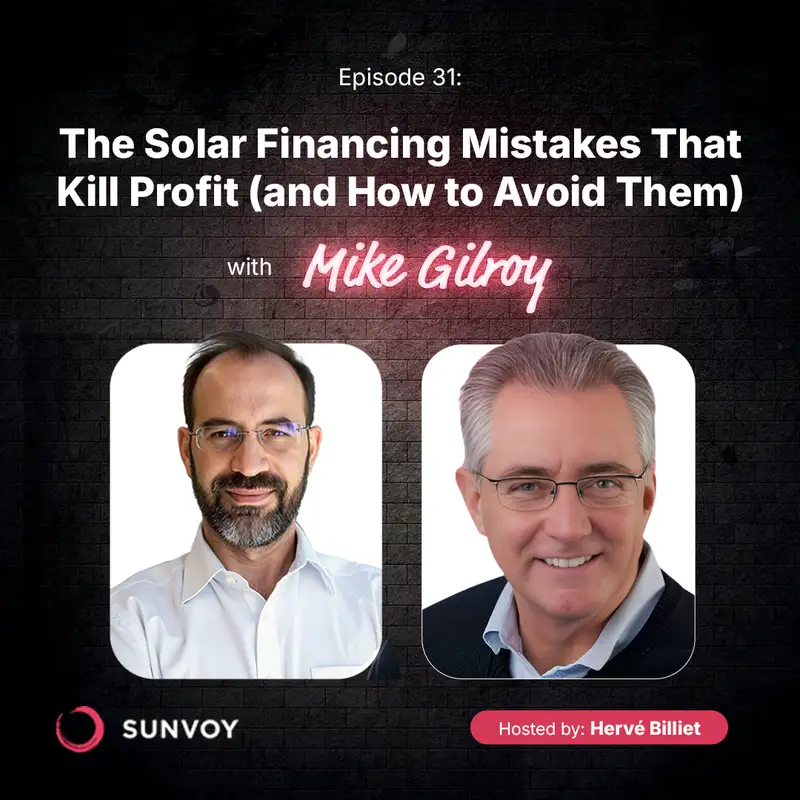
 Episode 31
· 31:23
Herve Billiet (00:00)
Hey everyone, welcome to another episode of What Solar Installers Need to Know. Hey Mike, how are doing?
Mike G (00:06)
Good. Hey, Hervè. Thanks for having me today.
Herve Billiet (00:09)
Thanks.
It's been a pleasure. Thank you for joining the podcast, Mike. So we have Mike Gilroy. You are the CEO of Sungage Financial. And maybe if people don't know about Sungage Financial, this is not the right podcast for them. But in the situation where you kind of forget what Sungage Financial does, give us some history. What do you guys do? What have you been doing for nearly 15 years?
Mike G (00:31)
Sure, I'd be happy to. Yeah, it's been a journey. Sungage was founded back in 2011, I want to say 2011, 2012, about six months before Mosaic actually, by a woman named Sarah Ross, who was trying to build a house out in Western Mass, wanted it to be renewable and green and put solar on her house. And she just found it to be incredibly difficult
bank didn't want in the construction loan, the mortgage people didn't want it in the mortgage, and she finally ended up having, she jokes, pull money out of her kid's college fund to pay cash, but thought, boy, there's gotta be a better way. And I think she looked into leasing and she was savvy enough to understand that, the tax credit goes to them if I do a lease, that doesn't seem right, you know? And yet, actually purchasing it without a financing vehicle just isn't an option for most people. So,
Herve Billiet (01:15)
Mm-hmm.
Mike G (01:21)
that was really the genesis of the whole thing. And she started out working with the Connecticut Green Bank, just in the state of Connecticut, a little bit of Western Mass and eventually the digital credit union and went nationwide. Well, it really went into about 14 states. And so, you know, it was a slow buildup. A lot of the other fintechs and solar were run by finance people
who are a lot savvier, quite frankly, about the finance and fintech part of it. Sarah is really a policy person, a greenie, a solar person. You know, she's very passionate about all of that. And so we were the tortoise to everyone else's hair in a lot of ways, you know, throughout the early part of the last decade. In 2018, Sarah's founder wanted to go off and pursue other things and
I had met Sarah along the way in my prior life and become an investor and a board member. And at the end of 18, Sarah asked my partner and I if we would join the business as part of the management team. That was really my introduction to Sungage back, let's call it the beginning of 2019. And we were still in 14 states and relatively small compared to our larger competitors. Fast forward a few years and
these years we're in 44 states, I want to say. And at this point, I think we're arguably the largest provider of solar loans in the country. We financed over a billion dollars last year. And, you know, that's been partly through our own growth and partly as I think everyone knows the demise of an awful lot of our peers. And that's, you know, that's been an interesting
scenario watching all that unfold. I think as many of us have seen in solar, there have been a lot of situations where people grew really quickly or got over their skis. There's been some really large installer organizations that have blown up for different reasons. And so I think, you know, it's always been a bit of a cautionary tale, right? Everyone wants to grow and be profitable and, you know, but on the other hand, prudence is also a virtue.
And I like to think that Sungage has thread the needle on that. We haven't gotten out over our skis. A lot of our competitors that aren't with us anymore are getting into liquidity problems and things. We're balance sheeting lot of loans and that gets risky at some point. We've tried to de-risk our business as much as we can every step along the way. Some of that's just a commitment to our employees. Some of that's a commitment to the business, just wanting to be
positive force and solar over time.
Herve Billiet (03:55)
Tell us a bit about de-risking your business. What does that mean in practical terms? What are some decisions you to make?
Mike G (04:01)
Well,
It's interesting, I don't want to get too nerdy and geek out about the financing back part of things, but there's different ways to fund loans, right? You can do forward flow where you sell a loan directly to a depository like a bank or credit union. The other major way is to securitize, right? And securitization, depending on where you are in the business cycle, sometimes allows for better margins.
Herve Billiet (04:16)
Mm-hmm.
Mike G (04:26)
Over time, arguably the best of all worlds is to have a mix where you have some forward flow partners and you have the ability to securitize and you can kind of play the field. For a variety of reasons, not everybody chose that path. You know, people like Sanova and Mosaic really leaned over to the securitization end of things. And the problem with that is that to securitize, you have to accumulate a big pile of loans, typically 300 million,
400 million. And that takes a while, right? Depending on how fast you're originating, it might take you six months or nine months or 12 months. And so all the while you've got these in a warehouse line, you're paying interest on that line. You're getting some interest payments from the borrowers, but particularly in 2022 and 2023, those interest rates on the loans were pretty low. They were lower than what you're paying on the warehouse line. So you're losing money the whole time you're waiting to securitize.
And then depending what's happening with interest rates, when you go to securitize, maybe it doesn't look as good as it did six months ago. Maybe now doesn't seem like the best time to sell. But on the other hand, the longer you kick the can down the road, the more liquidity problems you have. And in both those cases, I think they just got to a point where they had so much in their balance sheet and so much financing behind the curtain that it was vulnerable and unfortunately fell apart.
So, you know, it's been interesting, all the different reasons why people have run into challenges, but we've tried to risk our business by not being a bank. You know, we sell our loans out the back door every couple of weeks. And so it's a very continuous flow. And that doesn't optimize our margins, but it optimizes our stability, right? It doesn't tie up a bunch of cash
in a liquid form. And we feel like that's a good trade-off because that means we'll be here to fight another day. We make enough margin, but we don't go for the, you know, swinging for the home run because that adds risk. And that's not good for our partners and it's not good for our employees.
Herve Billiet (06:29)
Couldn't agree more. Well, thank you for being a stable party in the solar industry. Well, to do risk of business, I've done that with Ipsun Solar, we're trying to do different things. And at some point we also were selling PPAs that we just owned ourselves, put it on balance sheets and...
Mike G (06:33)
That's how you stick around for 15 years.
Herve Billiet (06:51)
You know, at first it's fine. And then after a while, you realize that we really have to stop doing this because there is no money coming in. You fund upfront everything. We mainly did any Washington DC, by the way, where you have like very high SRECs. But you still need to install everything, register the SRECs, and then they start coming in. Now we're looking on a graph. It's nice to be cumulative, like after a while. But you have to...
be able to run through the cash flow. But after a while, you have all the money coming in. We're not having to do any more. That's the beauty. But at the beginning, it's kind of hard to do. So we tried all types of financial trickery to be just diversified, to do different things.
Mike G (07:33)
It's great when it works, but it's more complicated. It's a little harder to execute, adds a little bit of risk. And then you're a little bit subject to the environment around you with what happens with interest rates and how available financing is and things like that. So we've seen some real gyrations over the last few years, right? Especially since the middle of 22 and rates started going up. The world really changed for banks after being stable for an awful long time.
And I think that caught a lot of people by surprise.
Herve Billiet (08:01)
Well, let's speak about a changing world. In the end, the entire solar industry still runs on the sale process and growth, depending on how you want to see growth, but it still depends on sales. So let's speak a little bit about sales and what do you think about selling a cash deal compared to a loan, a lease, a prepaid PPA, and maybe the other versions that I haven't mentioned there. So what do you think of all of that?
Mike G (08:30)
Sure, yeah, it's been interesting times. As I alluded to, in the middle of 22, interest rates started to move up. at that point, I would say the industry was probably 70% of the financing was loans versus 25 or 30% was a TPO or third party ownership. And from that point on, gradually that started to shift and entering or let's say exiting 2025,
Herve Billiet (08:44)
Mm-hmm.
Mike G (08:58)
that it almost flipped, depending on whether you talk to WoodMack or OM or which data source you reference, somewhere in the 55, 60% third party ownership versus ownership, cash and loans. So pretty big change in the world. And I think the challenge for the industry is to really step back and be honest about what are we trying to do here, right?
Just as with automobiles, most homeowners like to own their car. That doesn't mean people don't lease cars. Most people who lease cars don't necessarily understand their lease. Most people just the comfort of owning and controlling an asset that large in their lives financially is important to them. And when you look at at least the 70 % of people that were financed in 2022.
Their average FICO was around 760. They're obviously all homeowners. And this is a pretty high end group of consumers relative to the whole market. And I think if you lay everything on the table for them, all things being equal, most of them would choose ownership over third party ownership. But there's influences on that, right? For years in the world under the tax credit regime.
One reason that a third party ownership, a lease or a PPA could be better for homeowners, they don't have enough tax liability to qualify for the tax credit, right? Maybe their credit's not great and they're not really that bankable. It's easier to get approved for leasing or a PPA. So there certainly was a place in the market for that product. But I think if you look at a upper 700 FICO homeowner,
their bias is gonna be toward owning things. That's what they're used to. Enter the not so beautiful bill in 2025 and things started to change, right? The government put their thumb on the scale and now coming into 2026, no more tax credit if you want ownership. And so I think the industry throughout the second half of last year was like, if you're ever gonna do it, do it now as it relates to ownership and loans,
and assume that going into 2026, we're going to sell leases. Everybody gets a lease.
And I think there's reason to be a little careful about coming to that conclusion. At the end of the day, if you want referrals, if you want to play this game for the long haul, you want to think in terms of referrals. So you got to be mindful of anything that's going to jeopardize those referrals down the road. And I think, you know, depending on how much experience people have with TPO in general,
then I'm always mindful of some of the things that can bother a homeowner after the fact. And that's just something to be aware of. I also think that generically, a consultative sale is the way to go, right? Present the options, educate the customer, listen to what they say, you know, be a consultant to them as part of the sales process, build trust. I mean, this is salesmanship 101, right? So anytime you come into a selling situation,
strongly biased in favor of one solution, you're already straining the relationship with your customer, right? You know, instead of giving them what's best for their needs and desires, you're sort of saying, you know, this is better for me. I'm going to help you like it. And that's, not really a level playing field, right? So, I mean, I think we got to be careful at this point in the industry, because I think there's a lot of that going on where honestly,
Herve Billiet (12:16)
help
Mike G (12:26)
maybe you can make a few thousand more in commission selling TPO versus a loan. That's not true for everyone, but there's certainly situations where that may be the case in the short term. So understandable bias, but on the other hand, this has been a very uncertain world. We've certainly seen instances of sudden price increases that weren't expected on signed deals with TPO the last six months.
We've seen AVLs narrow four and five panels. You know, if you're selling alone, you've got about 43 panels to choose from. So supply chain concerns, I think is something that everyone needs to be mindful of. Everybody's talking a good game. Don't worry. We'll have plenty of supply for you. But I think by the time we get to the second quarter, you're going to see a game of musical chairs where the music's going to stop. Some people are going to have their Fiat compliant materials and some people aren't. So I
I think having a portfolio, if you will, of projects, some of them are ownership, some of them are third party ownership, is the wise move to protect yourself. Because you go all in on TPO and a supply chain problem hits you. Not going to be good. Well, let me just point one other point. It's just the other thing about the bias toward ownership that I was talking about is the idea of control.
And I think this is a nuance that doesn't always get surfaced in the moment when the decision is being made. But down the road, if you've got an affluent homeowner who's used to controlling the major things in their lives, and then they find out, I bought an EV three years from now that I wasn't planning on buying. I should have some panels, shouldn't I? Well, no, you can't do that. This is a lease. It has to stay exactly the same until year six.
My utility comes out with a VPP program. that's exciting. I should get involved with that. Well, no, you don't own the system. The finance company does. They get to get the benefit of the VPP program. Well, I bought this system with batteries for resilience, right? Am I okay that way? Well, actually they decide whether to let the utility tap into your battery and how much and whether they could do it right before the snowstorm.
So these are just little things that, I think if someone didn't understand the lease in the first place and they really were an ownership customer, but you kind of sold them a lease. This is how you jeopardize your, your referral base. And so I just think that it's a time to be careful in the industry with what you're presenting and why, and to make sure, that your sales team is listening to customers and offering them the solution they're interested in.
Herve Billiet (15:05)
I think you speak again about de-risking your business, but you have done in your business, think so installers need to do the same and putting all your eggs in one basket is inherently dangerous. Totally agree. Once the ITC went away that we all understood as an industry, like, this thing is gone. What have you done to adapt? Is there any decisions that you made or any new products that you launched?
Mike G (15:31)
Yeah, quite a few things actually. I imagine most of the audience is aware, a number of the solar fintechs really pivoted pretty hard toward home improvement. Many of them eliminated their 25-year term, for instance. Many adopted what we call a flat amortization loan, right? No deferred payment portion anymore. The first month payment is the same as the month, the year 20 payment, right? Just same all the time.
And that's the more normal format for installment loans broadly in consumer finance. So not surprising that they did that. We chose to double down on solar quite frankly and solar ownership specifically. October 1st, we adopted a product that we think of as a post ITC product. We call our Bright Start loan and that offered a deferred payment portion. It's a 25% deferral. We made it deliberately different
than the ITC because we wanted to try to avoid confusion. And the goal of that product was to do a couple of things. We wanted to continue to offer an accessible first year monthly payment. And actually the deferral period for the Bright Star loan is three years. So it gives a low monthly payment for the first three years. And presumably in most locations around the country, the utilities are increasing their rates over that time.
So whether the homeowner is able to make some prepayments, you can make prepayments on our loan at any time with no prepayment penalty. Or whether they simply wait for three years, enjoy the savings, and then yes, in year four, the monthly payment's gonna jump up. If you look at the average utility increase and you look at that increase in year four, the lines get right back where they were. So it's really a chance for the homeowner to enjoy some early savings,
have the opportunity to pay it down, but there's no tax credit to pay it down with. We all acknowledge that. But that was a loan format that I think is very familiar to the industry, and was more similar to what everyone was used to selling. So we thought that would be a good option to offer. Now that Bright Start product, you can go into our portal and zero out that deferred payment portion. So if you don't believe in having a deferred payment portion and you want to sell a straight flat amortization loan, you can do that with the Bright Start product.
We were trying to offer options for those who really wanted to offer the control and peace of mind of ownership to their homeowners. This past week, we introduced another product we call our Sunrise product. And this is a different format that quite honestly mimics the payment structure of a lease or a PPA. And by that, you start out with a low attractive year one payment.
And then every year after that, the payment's going to go up by 2.9%. So it's an escalator loan, if you will. And again, this is a loan that acts a lot, looks a lot, feels a lot like a lease in terms of the payment experience, but it gives you control from day one as an owner. It gives you the lowest possible monthly payment. And we've got a graph where we can show you, here's what the payment stream looks like on.
The sunrise product going up constantly. Here's the bright start where it stays low and then jumps. Here's a flat amortization. So you can visualize what the payments look like in each case. And with the way utility rates are increasing, they're all pretty good deals. And particularly in the out years, the savings become significant. And there's no question there's more savings over the life of the system with ownership than there is with TPO. And there just is.
There's a reason why the finance companies involved with TPO, right? So we thought that was important to give the industry options that felt more like the traditional options, but still gave a path to ownership.
That was our intent with those new product rollouts.
Herve Billiet (19:23)
Nice now when you do a product rollout How do you reach all your your customers are sole installers that sell to the homeowner, right? I don't think you go straight to a homeowner So how do you get all the nuances of those different loans? How do you get it across to all the different people selling your products? If you you said you you did like a billion dollars in last year That's a lot of people having to sell a lot of different deals. How do you get all that training to people?
Mike G (19:51)
Well, I mean, typically we start out with a product introduction email that goes out to our entire network. Pricing will go out to the pricing administrators and owners. You know, the sales team will get notices about the product features and what they look like. And then typically we're working with each of our installer partners to set up sales training meetings and to talk with ownership about pricing.
And so, you we have a team, a sales team that will work over the phone primarily with our installers to provide that training. We've got videos, we've got slide decks. it takes weeks, you know, certainly to roll it out entirely, but more than happy to do it. And then it's important to have a dialogue with the sales team so that they understand the nuances. We get a chance to talk about some of the compliance things to the pitfalls to watch out for,
and we help people understand how to position the products.
Herve Billiet (20:45)
Now, do you have bad customers? Like an installer, like do you have like a list of like, we do not want to work with certain installers, or put differently in a more positive light. What can so installers do to have a strong relationship with you? Are there some behaviors that you feel like, this is great, we want more of this compared to some bad behaviors of installers?
Mike G (21:07)
Well, it's funny, you know, again, that idea of de-risking our business. When we think of risk management, which in solar, let's be honest, is mostly between the channel and the FinTech. You know, I always joke that even I could underwrite a 760 FICO homeowner. That's not the hard part of the business, right? But it is important that you understand each other in terms of the installer and the FinTech in terms of what's important.
I always joke like that MasterCard commercial, not getting letters from attorney generals and regulators is priceless. Right? So, so we really put a lot of energy into not being on the wrong side of the regulatory issues and making sure that things are being presented properly at the point of sale. So we emphasize that in our training, when we're rolling out new products and all, we monitor very carefully, whether it's complaints that are inbound, we're all over.
Herve Billiet (21:40)
You
Mike G (22:02)
you know, online reviews. We monitor financial metrics, know, if an installer partner suddenly, you know, has a judgment against them because they owe a distributor a bunch of money, we're gonna know it within days. So I mean, we're watching for financial stability and we're watching for good behavior at the point of sale. I mean, that's really what it comes down to, all we ask of our installers that they present the products as they were
trained to present them, you know, and we also, as I think most of our competitors have done traditionally, have a process where we reach out to approved homeowners and do what we call a welcome call. We've used technology to automate that to some extent, kind of an omni-channel approach. So, you know, if you're 85, we're probably going to want to talk to you on the phone. But, you know, if you're 45 and you just soon do it online quick, whenever you get around to it,
you can go through a self-guided process to get the same information. At any point along the way in that process, you can click, you know, I want somebody to call me. And traditionally what we covered in that was mostly, you realize you just took out a loan? And unfortunately, the answer isn't always yes. Do you understand that the tax credit's not a rebate? Unfortunately, the answer wasn't always yes. That's gotten a little simpler now, quite honestly, with the tax credit out of the way.
And I think that's going to be a good thing for the industry over time. think it's going to be a good thing for our business over time. It's a little discouraging that the government put their thumb on the scale and gave leasing an advantage for four years versus ownership. I don't see the policy rationale for that, but here we are. So, you know, going forward, we are in a situation where we've got this FEOC, non-FEOC world.
But I think that's gonna sort itself out too. Ownership is still gonna appeal to a large slice of homeowners. And I think the savvy installers are going to recognize that and present both options in an even fashion.
Herve Billiet (24:03)
I think there's a question, Some companies, some solar companies have grown so fast. And I think it's inherently easier to sell a $200 a month compared to a $20 or $60 solar project. So selling a $200 a month, it's just an easier conversation, I think. If you don't look at the larger documents to sign. But yeah, I think without ITC, it becomes an easier conversation. You don't have to
speak about tax credits, which a lot of people kind of like, what is that? And so on. So you avoid entire piece of the conversation. The question is, will that market of people that are going to own this solar system keep growing like it was before? What do you think of that?
Mike G (24:44)
Well, I think if you look at ownership versus what utility rates are doing, the system's pencil now in virtually every part of the country. It's certainly a non-issue in the Northeast and the West Coast. The South utility rates are a little cheaper, but I think we're rapidly headed into a place where, you ownership is going to be advantageous. So then you're into, well, do I want ownership or do I want...
TPO. And I think that's where it gets a little more nuanced, right? As I said earlier, I think you got to be careful that you don't sell something that's fairly rigid to a homeowner that actually is used to having control because there's pitfalls there. Selfishly as an installer, you got to keep an eye on your supply chains because an AVL with four or five options versus one with 40 options could really catch you short
in terms of supply. You got to trust your finance partners, whether they're lenders or whether they're TPO and you want to make sure you're to get paid on time. So, you know, there's a lot of considerations, but you know, as you were saying earlier, I think having all your eggs, one basket is rarely a good idea. So selling people what they're interested in, in buying, is always a good idea.
Herve Billiet (26:02)
That's a good idea. Now, have your AVL changed? Your, your, you fund, has that changed in the last months?
Mike G (26:10)
Not a bit. We continue to expand it actually. So there's a tremendous amount of flexibility within our AVL, just as there has been traditionally for loan products. It's really the change has been on the TPO end of things. And the final guidance hasn't come out from the treasury department. So yeah, everyone's saying everything's fine. Don't worry. TPO is great. But the truth of the matter is the rules have not been clarified for FEOC,
FEOC, Foreign Entity of Concern, what compliance with that really means. And so everybody's putting a brave face on it, but there's some nuances there and it's more than domestic content. And domestic content is the simpler concept. And for now, Treasury did say, we'll follow the rubric for domestic content in terms of the way we think of the different percents of a system that the different components represent. And so you can back into
what percent ownership is domestic or non-FEOC, But it's not crystal clear. So there could be some surprises later in the spring. And I think there's gonna be supply chain challenges to be honest. We've already seen pretty dramatic pricing shifts. mean, the distributors supply and demand. If you want the FEOC stuff, it's compliant, it's gonna cost you. And there's a lot more product out there that is
not FEOC compliant, admit it right up front. Yep, this doesn't meet the rules, but it's 35% cheaper and it's really good stuff. I mean, again, I think you want to be savvy in terms of your own business on, do you want all your eggs, one basket? Do you want to keep your options open? You know, I would want my team to be comfortable with both options in case I need to veer one way or the other based on a change in the industry. And how many times have we seen that happen?
Herve Billiet (27:59)
You place the orders, so yeah we've seen that but just to be clear so you fund you leave the decision on what hardware to install and to sell to a homeowner kind of up to the installer
Mike G (28:10)
I mean, you know, does have to be a product on our approved vendor list, but that approved vendor list is a pretty broad list. It includes every major brand.
Herve Billiet (28:19)
Okay, Thanks, Mike. Maybe one last question about managing a financial company for 15 years. You've seen the Solar industry going through to ups and downs, but more like question about management. Do you have any advice to other people that have been running companies and aspire to run a company for 15 years like you have? Do you have any advice about how to manage people and motivate them or be inspirational or
how to keep the team together.
Mike G (28:48)
Well, I mean, it's obviously there's a lot to unpack there. I think if you're planning for the long haul, it's important to share with your team what your values are and to make sure that you build a team that shares those values, you know, and by that, simple things like integrity and looking out for your customer and having your employees backs, building a team that,
respects each other as individuals. Those things sound like motherhood, but they really help you when things get tough. We've been through some real ups and downs. Our business went through tremendous gyrations in 22 and the interest rates went up. We've gone through layoffs, we've gone through salary reductions at times and the company was really up against it and we've had remarkably low turnover.
And I think it's because, you know, we treat people right. We bring people on that share values and that are bought into the mission and really want to see the homeowner end up with a great experience. And our partners do well. I think we're known in the industry for being good partners. We believe in win-win solutions. We treat people fairly. We're true to our word.
You know, so all of those things, again, sound like motherhood, but they're the bedrock of how you build a company. And regardless of whether you want to be an installer or a FinTech or a manufacturer or distributor, you know, it really comes down to the people and the values and the mission of the company. So I'd say that in a nutshell, there's a lot more to it, of course, but we'd need another program.
Herve Billiet (30:17)
We do. Mike, I want to thank you for all your wise words and your view on the solar industry. And thank you for presenting what Sungage does.
Mike G (30:26)
Thank you for having me.
Listen to What Solar Installers Need To Know (by Sunvoy) using one of many popular podcasting apps or directories.
