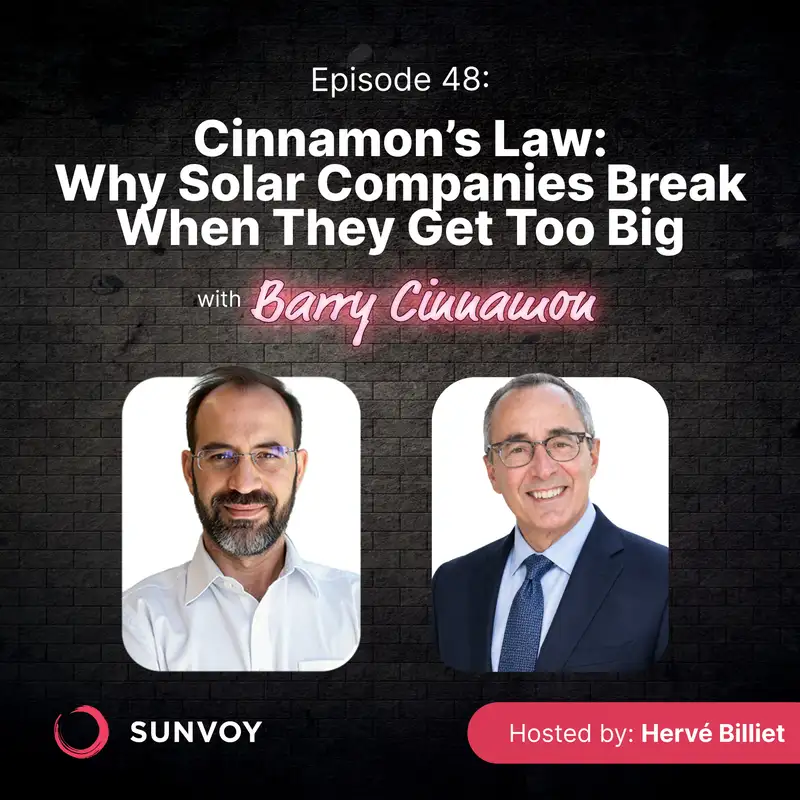
 Episode 48
· 44:38
Herve Billiet (00:00)
Hey everyone, welcome to another episode of What Solar Installers Need to Know. My guest today is one of the true originals in American solar. Barry Cinnamon founded Akeena Solar in his garage, took it public, did over 10,000 installations, invented integrated racking and AC solar modules. Lobbied Congress to uncap the solar tax credit, thank you very much Barry for that, hosted a weekly show about energy for years and is still installing solar in Silicon Valley today at Cinnamon Energy Systems, which he's been running since 2001.
Barry, welcome to the show.
Barry Cinnamon (00:30)
Thank you very much for inviting me, Arvay.
Herve Billiet (00:32)
Of course. I remember we had a SIA podcast a while ago together where they asked us questions about how we run our business and cost of acquisition and a lot of different things. I think that's where we met the first time. Well, since then, the ITC is gone. And I'd like to ask you the first question about going back in history about Akeena Solar. How did it kind of get started in your garage? But how did you
grow it?
Barry Cinnamon (00:57)
It was, I had just come off a kind of a internet hangover because my software company just couldn't get the funding it needed. This is in 2001 during the internet crash, which unfortunately, hopefully we don't re-experience with the AI crash in a few years, but that was kind of stressful. I said, gee, let me just go back to my college days and my post-college days and see how the solar thing's working. And I ran through the numbers and this is when PG &E went bankrupt and there was the Enron crash.
Electric rates went up, there was incentives and I said, gee, let me just crunch through the objective economics for solar in California. I was living ⁓ outside of San Jose in Saratoga, Tobago. And the numbers were pretty good. And then I said, well, gee, let me just get a few installers to come by and see what would be involved in putting in solar on my roof. And it was just kind of a lot of people that were just coming down from the mountains, the Santa Cruz dudes, they come over with an old pickup truck and a dog and kind of just estimate things.
And I got three quotes and it was like, gee, nobody's really running the economics for me because the economics are pretty good. So I started doing that. I said, this might work out well. I created a website and I came up with a way of automating the process of gathering all the information, doing an economic analysis, presenting the business case, putting the proposal together. And then, you know, even way back when this is in 2001, filling out all the forms in an automated way using PDFs and Excel at the time.
And it just started growing and they put solar on my house, on my neighbor's house, and then, know, friends and started advertising. So we started growing in the San Jose area. then I said, grew up in New Jersey and I said, well, gee, I wonder how solar is doing in New Jersey. This was 2003. And the rebates were even better there. And so I said, well, let me just call some friends up and fly out a few times and start up an installation company there too, which I did. And, you know, we grew pretty nicely in New Jersey.
Then I expanded to New York, Connecticut, Pennsylvania, doing installations on the East Coast. And by then we had opened up a bunch more offices in California. And it just kept growing. It was all based on cashflow. tried to maintain, we always maintain profitability. And then I decided just for kind of a wild-hair crazy thing, said, well, let me just take up a friend of mine offer to go public. Kind of it was with
something like a SPAC at the time. So we raised some money. was not the particular company. We did a reverse merger and we went public and it did really well. It was a surprise. Couldn't raise venture capital money at the time. Nobody was interested in the boring side of solar. And we just kept growing. ⁓ Once we were public, we were able to grow even faster. Opened up offices in Colorado, did some work in Hawaii, had seven offices in California. Just kept growing and growing.
Herve Billiet (03:06)
Nothing.
Barry Cinnamon (03:30)
But one of the things that, well, and we were also developing some technology along the way, but one of the things that we really tried to do a good job of, and this was like 2005, 2006, 2007, was really automate everything. My view was with technology, we would be able to regain the efficiency that you would lose by operating 20 offices around the company, the country. And so we...
did our best to do that. And then it turned out that the bigger we got with it, in spite of all of our efforts, the bigger we got with offices all over the place, the more money we lost. And one of the problems was that the incentives would kind of come and go in states. So you'd open up an office in New Jersey, it'd be great for two years, and then you'd have to close it for a year because then there was no incentives. Happened, I opened up offices twice in New York, twice in Connecticut, twice in New Jersey, twice in Colorado. And after that, I kind of realized, gee, this isn't really working that well.
And it's something that I coined as Cinnamon's Law, which is in the solar business, the bigger you get, the more money you lose. And we had to kind of retrench and focused on the technology we had developed. And I ended up at the time also partnering with Westinghouse and created Westinghouse Solar, combination of companies and names. And I eventually sold that whole business to a company in Australia. And I got back into solar in 2012 after I sold Westinghouse slash Akeena, just installing solar.
you know, following what I learned, which is I'm going to stay local this time, not get too big. But by 2012, 2013, the market in Silicon Valley was pretty big. So we were able to build a growing business once again, profitable there. And I just kept turning the crank on that doing more marketing, doing more sales, building the office up and building infrastructure up. So that worked out pretty well. And we're still kind of crunching along with that. But then again, you get you get hit with the solar coaster. So
we experienced the end of net metering, which was pretty traumatic. And then we experienced the end of the ITC, which is even more traumatic. And so we're kind of looking at what solar 3.0 is going to be and kind of figure out how to thrive with that. if you like solar, if it's in your skin or you've got electrons in your blood, it's a great business. It's absolutely clearly without a doubt the future. And that's when you include batteries. But it's going to have its ups and downs. And I think those ups and downs are going to continue. ⁓
you know, for the next dozen years or so.
Herve Billiet (05:45)
You mentioned a lot of different things. I have a lot of different questions about you just mentioned. Maybe one is the cinnamon rule. So that cinnamon rule, was it only applicable in the past or is that still applicable today? I mean, you see the largest companies going under. It's kind of scary. is it like, did you actually make any calculations or any empirical evidence for that? Or how
Barry Cinnamon (06:11)
Purely, I mean, I came up with this back in 2010, purely empirical. I mean, we truly tried to do our best. And I saw the same thing happening back in the other solar companies. And then it's absolutely positively continued with zero exceptions, absolutely zero exceptions. 25 years after I founded Akeena Solar. And the only company
Absolutely. The only company that's really managed to thrive in multiple states is Sunrun. And they're not really thriving on the basis of being an efficient installer. They're thriving based on financing. So if you're really, really good at managing your installation side, if you have really good financing techniques, I think you can build a viable business there. But it's really hard. And you ask the other finance companies that tried to do that.
like Vivint and like Sunova and there's that longevity and a bunch of others, they weren't able to do it. But Sunrun's doing an okay job. When you see the companies, mean, Freedom Forever is the latest one to crash. By the way, Sunpower's in there too. But Freedom Forever is the latest one and they had a very efficient, great operation, but they were operating in a lot of states and when the economics turned sour, you just can't downsize fast enough to survive. But if you're in one particular area and you're building your business
gradually, steadily, based on doing quality work with a good brand name. And you can kind of find hundreds of companies all around the country, all different states that have that philosophy. They're just plugging along, growing steadily. That's a stable situation. And then you kind of say, well, are there any other contracting analogs to that? And that's the same way the HVAC business grows, the roofing business grows, the electrical business grows. You do not see any national footprint
home contracting companies, they just don't exist. Unless it's a franchise model, maybe like Roto-Rooter, lots of private equity companies are trying to get into it. That's a challenge. There's a lot of HVAC roll ups, there's been solar roll ups, but I still don't see a national brand. And I think that's not gonna change.
Herve Billiet (08:10)
What do you think is the main roadblock or the wall that prevents national plumbers and electrical companies and a direct companies or solar companies? What do you think is the main roadblock?
Barry Cinnamon (08:23)
The biggest roadblock is the overhead goes up faster than your purchasing and your operational savings go up. So I went from one office in my garage to a bigger office down the street, but ultimately when we were in five different, six different states, I had to manage like 20 offices and there's a very, very inefficient. so you'd have a mid-level.
layer of management to manage the salespeople and all those, a lot of traveling involved, a lot of logistics involved. And in the solar industry, we're very, very dependent on local regulations, local utility rules. So you weren't able to get any economies of scale by doing the same thing in every different place. You had to actually have the separate rules for every single jurisdiction. And we kind of had a big database and we were trying to be really efficient with that, but you know,
you know, we were doing a job in Nutley, New Jersey, and six months later, we did another job in Nutley, New Jersey, and it turned out that the rules changed. So our plans were wrong, and we had to make a lot of changes. So very, very hard to keep track of that. But if you're just focusing in that one area all the time, like right now, it's cinnamon energy systems, we probably cover about 15 cities, one utility. I don't have great things to say about the utility, but they are really helping us generate business because they keep raising the rates. But there's only one utility. So it's very, very simple.
Herve Billiet (09:36)
you
Barry Cinnamon (09:38)
to kind of figure out how agonizing they make the process. And we don't have to duplicate that process 10 different times with 10 different, nine other agonizing utilities.
Herve Billiet (09:47)
I think we also underestimate how you learn about what's going on in your market. Like the market constantly change on new rules, new age, it's chasing up rules. And you hear about that through your vendors or distributors or customers telling you, some of your customers may be on the board of some other entity that lets you know about something's changing. So you learn quickly what's happening in your market.
You said you you opened other offices in different places. You kind of explain the kind of casually We at some point we try to make a very strategic point We were in Northern, Virginia We want to go to Richmond and our strategy was like as I've always done first to sell once reason of money then you have money to Get the warehouse and all of that and so start selling more into Richmond sold a few The problem is we didn't sell enough so we didn't take off and so I never had enough sale to really kind of like
Okay, we have an off sale, it's working. Let's open your office, hire locally and get started there. So how did you start those different offices? Did you kind of take like some risk and say like, let's hire and see if we can sell there or you first sold and then open an office?
Barry Cinnamon (10:54)
It's the same thing as you did. I mean, I have a diagram that I had on my wall, which is basically just turning a cranky. You start some marketing, you get the sales, you do the installations, you handle the service, you handle the back office, then you get some more cash and then you do more marketing and you just kind of crank it, crank it, crank it. And that's what I would do.
In the solar industry, you can go fast if you're aggressive with customer acquisition costs. If you do a lot of advertising, you buy a lot of Google AdWords, you're doing a lot of social media stuff. But that's expensive. You can do door knocking. That's what some of the other companies, they send fleets of people out to harvesting fields like locusts. That's expensive and you don't get referrals. But the way you get referrals is by gradually building your business and making sure you do.
quality work with consistent branding and trucks that all look the same. I kind of tease people. It's like, I only have one truck and we just drive it all around Silicon Valley a lot. But there's really like 20 trucks and that just really, that branding really, really seeps in. So if you're growing slowly, say 10 to 30 % a year, you can grow in a way where you're building those customer referrals, you're getting customers that way, and you're not
losing money. But if you want to grow really fast and people will lend you money for that, it's dangerous. And that's something that I tried to stay away from.
Herve Billiet (12:08)
Yeah, me too. Me too. Trying to take two big loans or lines of credits. It's dangerous and having a lot of investors sounds amazing. You can have a press release, then dozy versus stay and ask you to grow even faster than you're comfortable with. So it's a slippery slope. Want to ask about like the uncapped ITC.
Barry Cinnamon (12:21)
Yep.
Herve Billiet (12:26)
In kind of preparing for this podcast, I saw in your bio that you had an uncapped ITC. I didn't even know it was capped before. So how did you achieve that?
Barry Cinnamon (12:36)
In 2006, regarding the ITC, federal government had a $2,000 tax credit for homes and an uncapped tax credit for commercial customers. And I was on the board of CA at the time, going out to Washington, D.C., traveling to the East Coast too.
And it was very clear to me at the time that if we could somehow get that on CAP, just like the commercial tax credit, it would really open up the solar business throughout the country. So ⁓ we were public, we had some money to spend, we hired a lobbying firm, we worked with an issue and a local lobbying company called Canyon Snow. And we worked really, really hard with partners with some other installers like Sunrun. Actually, not Sunrun wasn't a part of that effort.
But ⁓ working with some other installers and we managed after a two year period to finally get that tax credit uncapped. And it's very fascinating just in terms of history that the quid pro quo for getting the residential solar tax credit uncapped was allowing oil and gas companies to export refined petroleum products.
So the oil and gas industry was not allowed to sell gasoline or any refined diesel or whatever overseas at the time. And that law changed in 2008. And the quid pro quo for that was uncapping the solar tax credit. And that got uncapped and then we had a a 18 year run until, or 17 year run until Trump killed it.
Herve Billiet (13:54)
Wow. I remember that that's only those patrol companies could export. I didn't know it was related to you.
Barry Cinnamon (14:00)
me. was just the whole team and then Rone Resch and Cia was working really hard on it and a lot of other companies were working really hard. But endless meetings in Washington, DC. And the pushback that we got was that there's a lot of commercial entities, business entities that are pushing really, really hard for the tax credit, but there's not a lot of homes, not a lot of residential customers doing that. And then the story that was coming back from some of the people that were opposed to uncapping is they said, well, the homeowners are going to cheat on their taxes.
So we don't want to do this. The cheating is probably orders of magnitude bigger for commercial customers. But really, the beauty thing about the tax credit is it was just super, super simple on a scale. We're in the heat pump business also. doing HVAC. And there are no really good tax credits for heat pumps right now. And that's one of the things that I'm pushing for now is both for heat pumps and ultimately solar again.
Herve Billiet (14:28)
Really?
Barry Cinnamon (14:49)
Making sure that there's a really simple uncapped tax credit and it works, it just worked phenomenally well. And the fact that it works so well is why the oil and gas companies are going to be very, very opposed to both solar tax credits and heat pump tax credits because they want to keep pumping out and drilling for oil and gas.
Herve Billiet (15:07)
Yeah. Well, tell me like not at IDC is gone today. How things going with your company? Are you kind of on a diversifying kind of bandwagon trying to do heat pumps and other things? Or how are you doing with your referrals that are so key to lot of companies? Like what are you currently doing to generate more sales, more continuous interest of clients?
Barry Cinnamon (15:31)
That's a good question. And I wish I had the answers for it. But the reality is we started diversifying with heat pumps about five years ago. That's growing slowly. We also diversified doing batteries and electrical upgrades and things like that. But our solar businesses is down at least 30 % right now. I think it might be worse because we're not seeing the normal seasonal uptick again. The heat pump business is growing kind of steadily. But I'm looking at the first down year we've had a long, time.
Herve Billiet (15:38)
Wow.
Barry Cinnamon (15:58)
So it's stressful for a company to downsize and we had to cut back the number of crews we had, we had to cut back our overhead, we cut back on advertising. mean, a lot of stuff has to get cut back because the alternative is failure and that's not acceptable. I've also been very careful about not taking on any debt. The only debt we have is just, you know, to the credit card companies in which we pay every month and to our distributor.
And that's it. So it's pretty clean, but we're watching everything very carefully. I don't like to buy vehicles on leases. I buy used white trucks and then wrap them like a yellow jacket B. And that's kind of the cheap, easy way to do it.
Herve Billiet (16:36)
I did the same. I all our vehicles, actually. And we tried to buy all types of vehicles from like the of the strange little shop on the corner to like the very fancy brand new vehicles. We tried it all. But I was wondering about the AC module. In the bio I read about you, also invented a new AC module and racking. Tell us more about that.
Barry Cinnamon (17:00)
Well, that was when we were, before we went public, I was always interested in technology that would simplify installation. So we came up with the concept of integrated racking. ⁓ you know, I was, I was up on the roof myself and doing these installations back in 2003 or 2004. We were working with Kyocera at the time and basically, you know, carrying up these long pieces of aluminum extrusion and bolting aluminum extruded aluminum frame modules to the extrusions. And I said, well, why don't we just make the frame of the module the same as the racking?
And then that way we can mount the racking, the module directly to the roof. I took that concept to Kyocera, I think in 2003 or 2004, I met them in Japan. We were using Kyocera modules, which were, you know, I think still the highest quality modules I've ever seen. And I remember very distinctly meeting with the Kyocera engineers, showing them a mockup and saying, well, why don't you, instead of using your, your extrusions, use extrusions like this, which would basically double as the racking system. And they were really polite.
They actually bowed a little bit and they said, that's a very good idea, but then the cost of our module would go up very slightly. And we're trying to minimize the cost of the module. That was the story of integrating racking kind of all along. But we used it. It worked out very well. worked with SunTech was our OEM at the time. They were the biggest manufacturer. That worked out great. And then we had some competitors and that dwindled. But then the AC module was the next step.
And I had found this inverter company that was just kind of coming out with a prototype called Enphase. And this was in 2008, 2009. And I said, well, you we'd love to use your inverters, but we want to bolt them on the back of our module. And so we signed the first OEM agreement with Enphase and we started developing that module. And that worked out pretty well. And obviously, you know, then we had a newer version that used a trunk cable and the whole thing was assembled to China, which was a cost-reload. So it was something that really made a lot of sense.
But then again, it kind of came back to the same thing as that we as a local installer at the time we no longer national, we just didn't have the volume to justify ramping it up. And other companies like SunPower did that and Enphase had their modules. And right now Q-cells has AC modules. I'm still a very, very big fan of that concept of an AC module if you want to use an AC based system. obviously the more you can integrate into the solar panel, the better off you're going to be.
⁓ You just have to make sure that you can manufacture at volumes that are high enough so that it would be cost effective. When I started up Cinnamon Energy Systems, I continued to take that technology a little bit farther with something called SPICE Solar, which was another integrated racking module. But once again, we were making like a megawatt or two of panels and we would get a price for that. But the manufacturers were making 100 megawatts. So we would end up
at a high price and we weren't getting the premium sales and things like that. it's not something that I was really able to continue at Cinnamon Energy Systems. So right now we're just, we kind of sell to high end customers and we're looking for the highest efficiency modules we can with the best systems. we've really, well, we've always been like this, always narrowed down our product offerings and with batteries it becomes even more important because the more variety you have in terms of what you're installing, the less efficient you're going to be. And we're very, very happy that we're
very efficient with just two or three module, three battery system manufacturers and just a couple of module manufacturers. That's kind of all we need right now.
Herve Billiet (20:14)
Yeah, the more systems you use, you become less efficient. We just looked into all our installers that we work with. On average, it's six different inverter brands per company. That's on average. that is the average. And some of them are like 15. very curious people that try everything out.
Barry Cinnamon (20:27)
six different inverter brands. ⁓
It's going to be very.
Herve Billiet (20:37)
But Barry, I'd like to go back to the heat pump.
At some point you made a decision five years ago to like, let's explore heat pumps, but you actually succeeded and it's part of your business now. So did you use the same model as when you opened different branches, like you first did marketing and sales, then installation, O and that kind of feed it back in or how did you, because a lot of solar companies now also have a downturn, especially Wessie and people are looking at different ways, what they can and cannot do. so diversifying is one thing. So.
Can you go back to the moment where you were looking into heat pumps and you actually, how did you get started and started the division?
Barry Cinnamon (21:14)
a good question. And it was a very deliberate process. the deliberation was all around finding more things for us to sell and finding ways to cross-sell different products. So it was something that worked out well. we kind of, in an overall branding standpoint, we call it electrification. And this was, we started putting the word electrification on our trucks like five years ago. Nobody understood what it meant right now. Now it's becoming a little bit more mainstream.
But I figured anything we can deliver through a wire would be really useful. I didn't want any polluting gas. I didn't want to be a plumber. I don't have the physique for that either. But it's something that when we started, said, how are we going to do this efficiently? And basically the way we did it is we did some marketing and we have the back office for marketing. We know how to do that. We have the back office for accounting too. The marketing resulted in leads. So I hired a sales guy once I knew I could get the leads.
I did that simultaneously. And then once we started selling, I worked with a local HVAC company just to do the installations for us. So he did what, you know, it was basically white label. We basically at best broke even with that because he had to mark it up that we had to mark it up. But that indicated to me that we knew how to market and sell. And so the next step was starting to hire our own crews. we're into about the third year of having our own
And that's working out really well right now. And now there's a lot more interest in heat pumps. And so it's nice because we can go to ⁓ one of our existing solar customers and try and let them know that we also do heat pump water heaters and heat pump HVACs and split systems, which is good. And then sometimes now we're getting solar customers because they buy a heat pump and now their electric bill went up. So it works out very, very well. The more things you have to sell to a customer that you can do efficiently, the more effective your diversification efforts can be.
Herve Billiet (22:58)
Your cost of acquisition goes down because you already paid for it once. So you start with sales to get heat pumps out the door. But who were the first people trying to sell heat pumps? Did you do your own research and learn about it and kind of get going? Or did you hire somebody that was doing that before and say like, come sell this but not in house?
Barry Cinnamon (23:19)
Well, ironically for me, back in 1982, when I lost my first solar job after college because the company went bankrupt, I ended up getting a job in Billerica, Massachusetts with the little company that was making the very first ground coupled heat pumps called Megatech. And basically the R &D concept was we'll drill a big hole in the ground with a well drilling company. We'll put a heat exchanger in that. And then we'll
create something which at the time was called the GeoPump. And they hired me because I had connections through the same college. And I was the R &D engineer. And so I'm here drilling holes with welling crews and doing the HVAC. So I learned HVAC. Also, I kind of had a pretty good thermodynamics and heat mass transfer background in college. So it worked out really well. And we were basically drilling these deep holes, putting in heat exchangers. I was measuring the temperature, et cetera, et cetera. And it was a great concept.
except, and we're doing this in Billerica, Massachusetts, so in the winter it was kind of cold, but that's something you have to deal with. When I was looking at all the numbers from the half a dozen first batch of customers we had, it became apparent to me that the cost of the installation of this ground source heat pump was the cost of drilling the well. And the key to getting an efficient ground coupled heat pump, at least with this design, was
making sure that the heat exchanger was in water, you hit an aquifier, and the more water that was going through that aquifier, sometimes you have the underground steam, the better. And so you didn't know when you got to somebody's house if you had to drill 100 feet or 500 feet. And if you had to drill 100 feet, the payback would be good. If you had to drill 500 feet, you'd never recover your costs. And so you just couldn't tell.
Herve Billiet (24:57)
you
Barry Cinnamon (24:59)
⁓ And creates all kinds of liability problems also. So I remember I was very, very specifically, I met with the CEO, the guy I was reporting to, I said, ⁓ Mr. CEO, this is not a profitable business because on the average, based on our experience, this is never gonna pay back. He didn't like that answer, so he fired me. That was kind of life. then I ended up doing a lot of energy ordering work. And after that, I went to...
business school and when I graduated from business school I was still looking for another solar business so I couldn't find it but that's a long way of saying I kind of understood heat pumps so it was a natural thing for me. When I moved into a house seven years ago here in the San Jose area in San Jose actually I decided to completely electrify this 50 year old house and so I kind of went through the buying process of getting quotes for the heat pumps I put in obviously I put in solar I put in batteries I put it in induction cooktop I put in a heat pump water heater
So the whole house was electrified and basically negative usage. We got a check back. And that gave me the experience. so basically we started marketing that. I kind of eat my own dog food. So I would be able to communicate pretty effectively to do some of the initial sales and then train the people who coming on. And right now, it's...
One of the things I'm studying for AERA is I need to take the C20 HVAC contractors test. I think I'm a little old for taking these tests, but we're using another company's license temporarily. But once I get that, I'm taking another test. it is very complicated. And I can tell you from someone who took the solar contractors test 25 years ago, that wasn't very hard for me. The electrician's test was a little harder. The builder, the general builders was even harder.
Candidly, the heat pump business, the configurations, the training, the tools and everything you need, much more complicated than solar and batteries. So, when I hear you say that some companies are using five or 10 different inverter companies, we're only using one manufacturer of heat pump and we just want to get really, really good with that. And then we will honestly say to somebody that, hey, we're using Mitsubishi and if you want to get carrier,
we're just not going to be efficient installing it so we don't carry carry or at this time, maybe in the future, but for now we're just going to focus on being really good with one system.
Herve Billiet (27:08)
I did something similar. So I took my HVAC license and I passed and then like, I'm supposed to know how to install those. So I installed a few myself to same as you like know what we are getting ourselves into. I wanted to order the Mitsubishi but a distributor close by that I got to know they only had LG. So like, fine, give me LG, why not? And so installed a few, yeah, learning on the spot.
Barry Cinnamon (27:12)
you got- okay.
Herve Billiet (27:33)
But I never really started a full division in the company because at the same time I started Sunvoy and then I had to make a decision and I just went with Sunvoy. But my understanding was that there are so many more parts and pieces and you also have distributors that you can go to and just buy everything. But there is more complexity and but you can also just hire people with like 10, 20 years of experience doing just HVAC, which I guess now in sort of you can start doing that too. But 10 years ago you couldn't.
But so what are the similarities or the differences between HVAC and SOAR for the people that want to get into HVAC? What should they know?
Barry Cinnamon (28:06)
There's one very big distinction, and that is for solar, you're gonna save money. Very few people do it for lifestyle reasons, but some. So it's an economic decision. Fundamentally, for most people, it's an economic decision. For HVAC, it's a comfort and a necessity. So when your air conditioner breaks, you gotta find something fast. So there's also a very, there's a timing difference.
The turnaround time for HVAC service and HVAC installations has to be measured in matters of weeks. Whereas solar, if it takes two or three months, it's OK. That's fine. But with HVAC or with heat pump water heaters, which we're installing a lot of too, mean, that's even faster. It's like, I have no hot water. What can you do for me tomorrow? And so you've got to get really fast at doing that.
Herve Billiet (28:49)
you do your marketing? Because with Solr, especially with Sunvo, we give like a customer portal and people track their projects, see the energy and the battery all in the app, long-term relationships. If people call you and you want Solr water the next day, you don't have all that marketing baggage. Like, how do you market to people that need a track?
Barry Cinnamon (29:10)
You can market in a very expensive way by advertising, or you can market in a much more cost effective long term way, which is you market to a list of your existing HVAC customers. The problem is if you're new to it, you don't have that big list. So you're going to be at a big disadvantage compared to that HVAC company down the road that's been doing it for 30 years. So it's kind of tricky, but we're investing in that. We have a service team. all this one guy does is he just has service. So if somebody says,
My hot water heater is broken or my air conditioning condenser is broken. You're going in there very first to say, let's see if I can fix it. The answer is usually no. And so they're going to buy a new one from you if you're quick. And so that's the way the marketing is. It's very, very different. Only the manufacturers and some very, very big private equity based companies are doing a lot of advertising on Google. Most of them are just kind of local companies mailing to their list and dealing with
the seasonality that you have in the HVAC business, which is when it gets hot in the summer, you need a lot of air conditioners, and when it gets cold in winter, you need a lot of furnaces. There are also incentives here in California where there's big incentives for heat pump water heaters, although the gas companies are trying to kill that. ⁓ And then there's also, there were very big incentives for HVAC systems, then, well, the oil and gas companies managed to kill that too as part of the OBBB.
Herve Billiet (30:29)
You mentioned incentives several times plus the uncapping of the ITC. I'm still wrapping my mind around myself around, should we have incentives in the solar industry or not? Now that the ITC is gone, if you had a magic wand, do you want to have it back?
or you're more on the camp of like, well, without government incentives, you wouldn't have those variations. Remember how like you open different businesses multiple times because incentives changed? If there's no incentive, it would be a more steady market, maybe a smaller market, but at least a steady one to run a business on. So if I gave you magic one, would you want to have the ITC back or not?
Barry Cinnamon (31:07)
You have to have the ITC back. There was one big financing company whose CEO at one point says exactly what you suggested, which is the solar industry shouldn't have incentives. No, it wasn't SunPower, but not synchronizingly. was another one that started with an S. I'm not going to say who it is, but the CEO was like, we don't need incentives in this industry. And basically the industry shouted him down, this individual.
Herve Billiet (31:15)
orders from I think Sunpower right now right wasn't
Barry Cinnamon (31:31)
subsequently built a pretty big financing company, one of the very biggest ones. But when the incentives went away, they went bankrupt. That's it, full stop. It's very, very, very, very tough for them to kind of survive. So you need the incentives. It really helps to have an economic advantage over the oil and gas companies who also have a big economic advantage. And you need that also, especially when you've got a poorly regulated utility market like we have in California.
You really need to help the homes and the businesses and the installers as much as you possibly can with incentives because the deck is so heavily, heavily stacked against electricity users. And we're seeing that in California right now. I mean, they managed to eliminate net metering. They call it the net billing tariff. You get two cents, it's the minimus. But the previous system was much, much better for the growth of an essential business.
And now, we're sitting here in California where we're putting in lot of natural gas turbines and that's kind of happening around the country. Because utilities make a lot more money by doing that.
Herve Billiet (32:26)
Yeah, I found myself this morning explaining that some utilities have like a monopoly with a guaranteed profit on top of it. So I explained that to my kid. He was like, how is this possible? Anyway, I have an additional question for you. saw how you, I think he was into solar. had a conversation with Nico Johnson about the costs of solar installers in Australia compared to
American installers and how our cost compares, which always fascinated me for years. I've been comparing Sunvore with multiple markets, multiple international countries. So can you kind of repeat your analysis of the cost of installing solar? I think it was Australia, right? And the cost in the US, what are the biggest differences?
Barry Cinnamon (33:09)
Well, this kind of goes back for me to 2006 and 2007 when I was at Echinus Solar. And at the time, Germany was one of the biggest solar markets. And the costs for installing solar in Germany were half of what they were in the US. And there was a big hullabaloo about that. And I ended up doing some research. I ended up traveling to Germany for one solid week back in 2007 with my good friend, Jeff Brown. And we drove all around Germany, sometimes at high speeds.
meeting with solar installers and manufacturers all over Germany, because that was ground zero. And it wasn't until the last day on this trip that we kept asking these installers and going up on roofs with them and their trucks, and they were all really organized. It's like, why is it so much cheaper here? And nobody really gave us an answer until I said, well, show me the paperwork you have to do the system. And they said, paperwork? What paperwork? We have no paperwork. Just sign this one in this invoice.
It was all automated. There was an automatic financing. There was an automated interconnection. It was just a simple one-page invoicing. go from there. So that was a big difference. And when I compared it to the US, I mean, there's just a tremendous pile of paperwork that we would have to go through. And that's why Germany, even though the pricing of the panels was the same, that's why we were the half the price. And then other people kind of got in the bang-wagon, especially Andrew Birch or Birchie over at Sanjevita, formerly of Sanjevita. And that resulted in,
the solar app and the big push in California and other states to come up with ways of streamlining the paperwork, eliminating a lot of the permitting costs, which has been tremendously successful. And just going back to the end of 2025, the last six months, we basically stopped installing solar in cities in the Bay Area that weren't using solar app or didn't have some kind of automated permitting. And it really saved us a lot of time. So fast forward to 2024, 2025, 2026.
And there were people that were saying, wow, solar is so cheap in Australia. It's like $0.60 a watt. We're totally screwed up here in the US. We're overspending. We're doing the wrong things. Our paperwork is so expensive. And I said, gee, if somebody were just to give me the equipment for free, it'd still be more expensive in the US. And so what I realized was
When I started, and I happened to go on vacation to Australia and New Zealand with my wife this year, and I spent a bunch of times with, the first half week of the vacation was working.
Herve Billiet (35:26)
We check all the different solar systems wherever we go.
Barry Cinnamon (35:29)
yeah. the first week, was like, Australia was, for putting in a system with batteries for the same size, it was $2 in Australia and $5.50 in the US. Solar only in Australia was really $0.60. I think it was $0.80 with a $0.20 tax credit. So it was almost a factor of four difference compared to a factor of two difference 15 years ago with Germany. And so when I dug into it, I realized it's
The problem is that our equipment and a lot of the other processes are so expensive. So I can really point to tariffs and duties. Every single thing we install is pricing is elevated because of that. The interconnection costs are insidiously dangerous as far as increasing the expenses. And there are some regulations here in the US that are worse, but the labor costs are about the same. still have, have the, permitting is the same as theirs. So most of them are comparable.
almost all of that cost difference is due to bad federal policies. That's all. So if we were to open our markets to solar and batteries and not have tariffs on those, first of all, we'd be able to start manufacturing them here better. But our costs would come down dramatically very, very fast. And then you're going to have more companies manufacturing here. I've been looking at solar manufacturing here for like the last 20 years. And every four years, there's a different president
and they change all the rules. So candidly, manufacturing solar panels is Jenny Chase at Bloomberg New Energy Finances. Manufacturing solar panels is a really bad business. And the reason is that every three or four years you've got new policy. every three or four years you have to change the equipment because you got new efficiency. And if you were to try to do that manufacturing in the US, you'd have different policies. So not only the policy changes, but your equipment. You go from crystalline to monocrystalline to.
to half cut cells and everything else and that all requires different ones. So it's very tough. If we had steady policies, they're sure price will be we can't even do that. We can't do that.
Herve Billiet (37:21)
We had some new policies. Yeah. So basically
if you are installing a manufacturing company, you think you're manufacturing, but actually you're more in the policy business, tracking policy, making sure you can influence it. Is that what you're saying?
Barry Cinnamon (37:36)
Well, that's true. you know, SIA has done, you know, as much as they possibly could. And then you've got the state state associations like CALSA doing as much as they possibly could locally. You've got very, very big opposition from incumbent energy companies, oil and gas companies, and from incumbent utilities. So it's very, very hard to win against them. And then, you know, unfortunately, what happens also is the utilities are installing utility scale solar.
So they're basically saying, we're putting in solar too, and it's really, really cheap. It's $0.80 a watt. And why should you spend $3 a watt to put it on a roof? They conveniently forget the fact that there's a tremendous expense involved in transmission and distribution. And when you add that in, actually, the utility solar is more expensive than somebody putting it on the roof. That's why if you amortize the cost of a rooftop solar system, even with a battery, it's like $0.10 a kilowatt.
And yeah, if I'm looking at my electric bill, my electric bill is 54 cents, 54 cents a kilowatt hour in the afternoon and evening and with solar, it's zero.
Herve Billiet (38:36)
So to recap what you discovered going to Australia, the price four times higher, even if you receive all the hardware for free, you said that it would still be more expensive. And your conclusion was all bad federal policies. But what about the overhead and the soft cost and all that? Do you all wrap that into federal policy? Or what do mean?
Barry Cinnamon (38:58)
Most of it I can wrap up into federal policy. The interconnection is local, in most other countries around the world, you don't have 3,400 different utilities. You've got just one. So you can come up with something simplified there. It's pretty obvious when you of carve those things out. The labor rates are about the same country to country.
The safety regulations, we have some crazy safety regulations as part of the National Electric Code. They don't exist anywhere else. Germany, you could just come down without conduit. don't know if there's any other countries that require rapid shutdown on the roof. So those were all kind of national policies that are created that could be changed on a national level, but it's not happening. So it's a difficult nut to crack. I would be delighted if we were only twice as expensive as Australia.
But that's not happening. Yeah. The other thing with Australia, and this was kind of bizarre, but there's a lot of coming back also, one of the other differences is other countries have, in addition to lower tariffs and things like that, they have big incentives. So one of the striking things that hit me when I was in Australia talking to a homeowner, and I was at a homeowner's house with an installer, and he's got his crew putting in solar and batteries. I was fine. One of the neighbors came over.
and said to the installer, hey, mate, I'd like to get a 2 kilowatt system. And I'd like to get 40 kilowatt hours of batteries. And I'm just in the background listening. 2 kilowatts, that's never going to charge up 40 kilowatt hours of batteries. And why in the world would he want 40 kilowatt hours of batteries? It's just made no sense at all. I waited till he left. I said, what's going on? He said, well,
Australia has negative, well, I think they have this right now in Sydney. They have negative electricity prices or zero electricity prices. During the day, they have so much electricity on the grid from all the solar that's installed, both residential and utility, that they're basically saying, use all the power you want, put it in a battery, charge up for free. And that's going to happen in the US too. We're not going do that, that's a smart. And then they basically say, we have huge incentives for battery systems.
The biggest battery that will give you incentive on is 40 kilowatt hours. So that's why this neighbor wanted a 40 kilowatt hour battery. And the incentive for the battery, I think, was like $280 per kilowatt hour. And the cost of the battery from the lowest cost manufacturers was $250 per kilowatt hour. So the incentive was worth more than the battery. So you would naturally put in the biggest battery you could.
So we'll see how that works out. don't know if the industry is going to gobble up those incentives pretty quickly, but it's national policy that's really going to jumpstart that business. Australia is about 5,000 miles away from Shanghai where you can get the equipment pretty quickly. So they're racking prices, dirt cheap, no tariff, their batteries are dirt cheap, their solar panels, everything's very, very inexpensive. They pay the same amount for wire. They pay the same amount for gasoline.
But all the equipment's way, way cheaper because there's zero incentives. Yeah, the freight costs are lower, but the biggest problem is that they have big incentives and no tariffs.
Herve Billiet (41:58)
Yeah, we have several clients in Australia and the type of batteries that we need to work with through Sunroy. I mean, they come up with names that I've never heard of at prices that is like, why do you even ask for the money? mean, it's so cheap. Like it's maybe more more expensive to do all the paperwork around it. of layout, Sig Energy, but I see Sig Energy is also coming on the US. So yeah, a lot of brands there.
Barry Cinnamon (42:14)
Yeah.
Yeah,
SIG Energy is the biggest one down there. They're very aggressive. But it's going to be hard for them to get into the US market unless they really figure out how to become not a foreign entity of concern. And so you can't be a foreign entity of concern if you're going to take advantage of the battery tax credit. So I know in Australia, they're really cheap. And you've got other companies like Tesla and Franklin, which are kind of on the high side.
For us, using the popular products, we're just really careful about making sure our battery system is really functional. And we track the failure rates in the RMAs on the batteries very, very quickly. even some of the better known manufacturers, they have really, really high failure rates. The equipment might be OK, but the software might flake out. To me, it doesn't matter. If I got to go service it and update the software, I'm not going to want to carry that.
Herve Billiet (43:11)
Yeah. Barry, thank you much for sharing all your knowledge and experience over those many years in the solar industry. Thank you for uncapping the ITC all those years ago, which was a big growth factor in our industry. So thank you for helping the entire industry move forward. So Barry, thank you very much.
Barry Cinnamon (43:26)
Very good, everybody. It's a pleasure being on and love to talk to you again and have you on to Mike podcast one of these days too. Thank you. Bye.
Herve Billiet (43:32)
Thank you.
Listen to What Solar Installers Need To Know (by Sunvoy) using one of many popular podcasting apps or directories.
