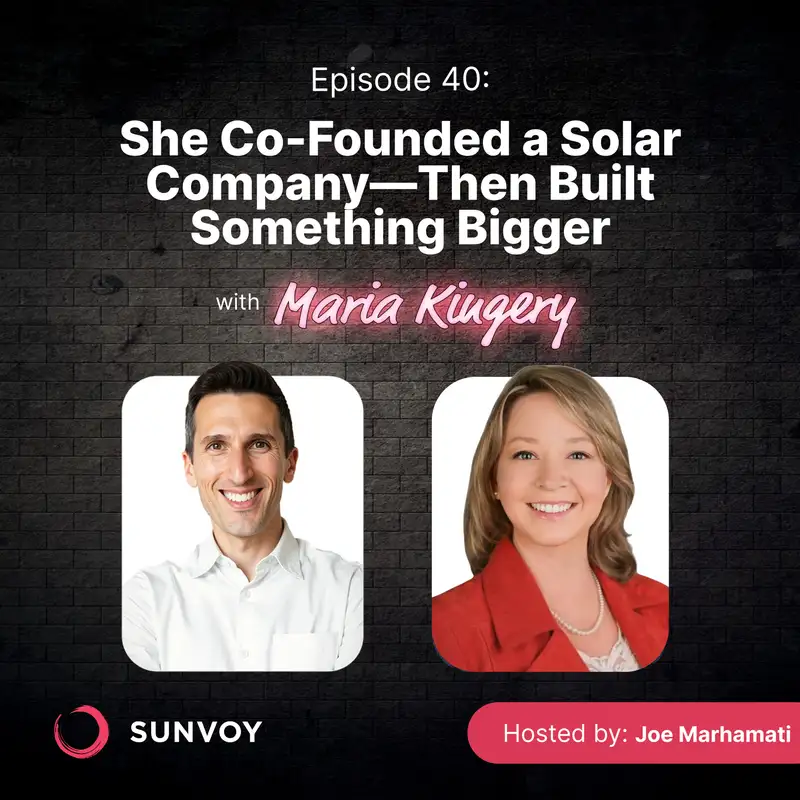
 Episode 40
· 01:18:45
Joe Marhamati (00:01.528)
Welcome everyone to this episode of What Solar Installers Need to Know. I am honored and privileged today to be joined by one of my favorite people in the solar industry, Maria Kingery, founder and CEO of 360 Impact and co-founder, and former owner of Southern Energy Management. Welcome Maria.
Maria (00:22.634)
Hi Joe, thank you so much. It's great to be here with you today.
Joe Marhamati (00:27.78)
Thanks for joining us and probably good to start out with a little bit of background about how you got into the solar industry. Before we talk about how you exited the solar industry, your experience as a solar executive and a little bit about Southern Energy Management.
Maria (00:44.536)
Sure, yeah, one of my favorite topics. So I got into the solar industry in 2001. So at the very beginning when there really wasn't much of an industry to speak of, at that time people were doing mostly solar thermal PV was, I wanna say the figure that I used that I'm not certain is absolutely correct, but that just the panels were
like $12 a watt. for, you know, reference now they're what, 50 cents or less, much less than that per watt. Yeah, exactly. So.
Joe Marhamati (01:22.722)
Yeah, 30 to 50 cents, I think.
Maria (01:27.31)
Exponentially more expensive and out of the reach of most people. And so at the time, my husband Bob and I were looking for something to do that would make the world a better place. guys, Most people, if they're of a certain age, remember 2001 as a sort of politically and globally
insecure time, I think there were after September 11th, a lot of us looked around and thought what is it that we can do to make the world a little bit better? We were pregnant with our first and what we now know is to be our only child, Zach. And we wanted to, I mean, we were just naive and foolish enough to believe that we could make an impact in the world. we, Bob had taken some solar classes in college. He was
a mechanical engineer and we had both worked for Burt's Bees when it was really really small and he actually worked there and saw it grow pretty exponentially and so we're both children of entrepreneurs all four of our parents are entrepreneurs, so when you combine it was sort of this confluence of circumstances and our backgrounds
that when we looked around at that particular moment in time, we felt like energy was at the crux of a lot of the geopolitical instability that we saw. And so we thought, well, let's give the solar thing a whirl. So that's how we got into it. And again, there was no market early on. And so within a couple of years, we sort of pivoted to do quite a bit of energy efficiency work.
So that was the other piece of Southern Energy Management. We have about 100 people that work on solar installations, commercial and residential, and then about another 100 people who do building performance work. So the mission of the organization has always been to improve the way people make and use energy.
Joe Marhamati (03:50.666)
So how does somebody go solar at $12 a watt? What are the unit economics look like there? I'm guessing that it's not a bottom line decision. It's more of early adopters kind of a thing.
Maria (04:03.693)
Absolutely. And I'll tell you, mean, not many people did, right? And as I mentioned in the early days, we were installing mostly solar thermal systems because solar water heating was more affordable and the economics of it made more sense at that time than PV. you know, I think maybe...
between 2001 and 2010, we probably installed, I mean, I'm guessing, I could go back and do the research on this, but I would probably say less than 20 PV systems. I mean, they were really unusual and...
until some policies were enacted that basically required the utilities to purchase renewable energy. The prices didn't start coming down and the market really didn't take off until that time, which is a great example of the utility really having a mandate
to modernize and evolve their systems, yeah, of course, we all wish could be much faster than it has. But it's a testament to the power because really, until that time, we were, PV was not a thing.
Joe Marhamati (05:36.172)
Do you remember like a day, a month, a week or a year where like, solar is now a good investment, a good enough investment that I would do it on my house. Was there like a point in time where it changed from being a novel toy to being something that actually was a good investment in your mind?
Maria (05:55.438)
You know, that's a really great question. I think, you know, one of the things about our journey at Southern Energy Management, we evolved many times over the 23 years that Bob and I earned the business. And as I said, we started out thinking we were going to do, you know, PV and be, you know, pioneers in the solar industry. And we quickly realized there were about
five people in North Carolina who could actually afford to install it. And then we did a lot of building performance work. And that sort of was how the company grew and, you know, doing some solar thermal here and there. But then it really started with, again, these policies. North Carolina bill was Senate Bill 3 passed and required the utilities to buy. And so those early systems were primarily commercial.
And I remember like we did the, were in the news constantly here in North Carolina because we were doing the biggest system that ever been done. And the first one was 30 kilowatts, right? Which is, I mean, there are residential systems now that are 30 kilowatts. And then it was a hundred kilowatts. And I think that we did a system down in Charlotte that was like 150 kilowatts on top of this commercial building. And when it came time for it to be
Joe Marhamati (07:09.183)
Right.
Maria (07:22.607)
inspected, they brought out the entire electrical inspection team because nobody had ever seen anything like it before. And so, that was an adventure for our team, I'm sure, to all of the inspectors at one time. And then, you know, there was a turning point where we got to partner with SunPower on a couple of the first utility scale
Joe Marhamati (07:32.405)
Wow.
Maria (07:50.616)
projects in the southeast. They were one megawatt projects and
When we did, we got the contract to be the EPC to install the first one. And our team was like freaking out, you our engineers that we've never done anything like this before, you know, and there was all the logistics and nobody in the Southeast had ever done it before. And then we got a contract immediately to install another one megawatt concurrently. Like, and you know the industry well enough folks listen to this podcast
I say the industry well enough. There's always, you know, because of the tax credit incentives, there's frequently this end of the year push, right? So everything has to be done by the end of the year. And so it was, that was a wild time. Our engineer, and I won't name his name, but our engineer at the time, again, nobody had ever done it.
And so, and his name was on the stamp and we were moving forward and everything was going well with the first one and them when they said, when we came to them and said, hey, by the way, they want us to build another one. And this was within like a couple of months. I didn't witness this, but I've heard that he went to the parking lot and threw up.
Joe Marhamati (09:17.472)
no, that's not a good sign. So how did those projects end up? Sorry.
Maria (09:21.535)
Well, mean, mean, yeah, I mean, they ended up great, right? Our team came together. We had, you know, the right.
people in place. We were extremely like we were very meticulous. We recognized at that time that I don't think we recognized how pioneering we were being, but we certainly had the awareness that we were doing something that had not been done in North Carolina or the Southeast at that time. And so we were, I mean, the word I'll use is meticulous. We were very
very,
by the book and we wanted to make sure that we did it right. because, you know, these systems last 30 years, one really cool thing, the first project that I mentioned that we got contracted for is literally less than a mile from my house. It was purchased by a company, private company here called SAS. And so every day I still drive by that project and it's like, wow, that was, and I think that was 2005,
2009 something like that maybe 2008 so it was a while, and then you know because we were We we had we were being successful. We had the opportunity to
Maria (10:49.645)
do projects up and down the East Coast, really the Atlantic Coast. At one time we were licensed, we had electrical license in 12 states and we were building, again, what was utility scale at that time. Now, know, megawatt or two projects are, they're small scale commercial, but at the time they were significantly sized. And so that was fun. And then,
you know, was told that I'm not shy about telling the full story. We got out in front of our skis a little bit and we grew really, really fast and we, with fast growth, our meticulousness was not necessarily shared by all of our partners. And we made some probably JV mistakes.
about how we were running our projects and running the company and we didn't have the oversight and the connection that we needed within the organization. And we had a couple projects that for a variety of different reasons, some contracting, I think culture driven, but we had a couple projects that went south and I call it SEM's near death experience.
Joe Marhamati (12:14.225)
Did you see any past lives or anything like that?
Maria (12:18.507)
Listen, I saw, yes, in fact, one past life that I saw was the potential that I could be living in my mother's house again. I always thought, you know, well, because you know, we, and I never took any investor money. We bootstrapped the company again. In hindsight, would we have done it that way if we had it to do ever? I'm not.
Joe Marhamati (12:28.486)
no.
Maria (12:43.852)
I'm a person I wouldn't change it because here we are now. And the balance sheet that we had did not support the projects that we were doing. We were just out there doing it.
Which again, I'm really grateful for and we were very fortunate. We found a buyer, kind of totally by accident. We were going around of trying to raise some money so that we could continue to grow this thing. And we sort of miraculously, honestly, Joe, found someone who just wanted to buy the utility scale part of the business. And we were able to.
Joe Marhamati (13:09.021)
Yeah.
Maria (13:36.589)
to divest that part of the business. All of our people that we had really invested in and were really part of the core team, there were about 50 of them, all got jobs at the new company and many of them stayed there for quite a while. So, and then we got to refocus on what we recognized was important to us, which was actually, you know,
We were certified B-corp by that time. So we had made a commitment to people playing at profit and in a very substantial way. And we were able to refocus on our team and on serving customers, our builders, know, small commercial residential customers.
So it's funny, I recognize I didn't answer your question, which was, was there a day when I realized that residential solar was affordable?
I think it really happened, and it happened at different times in different parts of the country. Here in North Carolina, have affectionately, and I don't know if this is actually an absolute true statement, but we have some of the cheapest power in the world because we're part of a regulated monopoly. So the economics for
Joe Marhamati (14:58.748)
Mm-hmm.
Maria (15:12.02)
solar here in North Carolina has as it is a lot of places but has been I would say more. I always called North Carolina, the New York, New York of solar if you could make it here you could make it anywhere. But you know when we had a state
Joe Marhamati (15:25.136)
Right?
Maria (15:30.348)
uh, incentive of 30%. And when we had a federal incentive of 35 % and I think when those two things coincided was somewhere around 2012, um, that's when it really started to take off.
Joe Marhamati (15:50.222)
And tell me more about the B Corp certification. What led you to be inspired to want to become a B Corp? When did you become aware of it? And how did it change the culture of the business or did it change the culture of the business? Was it that you already had the culture you wanted and that gave you some backing for it?
Maria (16:07.944)
Yeah, so.
I'm The story of us becoming a B Corp is one of my favorite ones to tell because like literally my friend was now a dear friend. I was at a Net Impact Conference downtown at the Convention Center and I was about to leave and this man comes running across the concourse at me and he's like Maria Kingery Maria Kingery and he's just yelling my name and I'm like who is this lunatic? You know, he's this little wiry guy, a dear friend of mine and he comes
to run it up to me and he was like, I was like, yeah. And he said, you're a B Corp. And I was like, what in the hell is a B Corp? I don't even know what that is and you're a little bit scary at this moment. And he was like, and he explained to me what a B Corp was, is.
And basically the reason he was saying you're a B Corp is because he knew that we were doing business obviously from a with solar from an environmental, had environmental positive environmental impact, but he also knew from some mutual acquaintances, our focus on our people and our customers and basically B Corp certification. It's a rather lengthy process that you go through and
answer a series of questions and provide documentation around your commitment to your workers, your customers, your community, the environment, and then how you govern your organization. so for us, the, you know.
Maria (17:55.948)
I still smile when I think about Eric Jason, we are called I'm so grateful to him for doing that because until that time, we really felt like we were or I will speak for myself. I felt that we were sort of alone in the wilderness of trying to do business in a way that was consistent with my values. You know, one of the we could go off on a huge tangent on this, but one of the the lies I
that has been perpetrated on all of us is that, you know, business, it's just business. It's not personal. As if that gives us license to just behave in any way that we think is going to serve to add value to the business. And that just fundamentally never made sense to either Bob or to me.
I mean, I really credit Roxanne Quimby and the Burt's Bees team for giving us an early vision of an organization that could hold its values at the very core and still be a profitable company.
happens that personal care products are in a totally different category when it comes to profit margins. didn't realize the construction industry had quite tighter margins at the time. That was again one of our naive things. At any rate, it has always served us to operate within
Joe Marhamati (19:23.13)
Right, right. They can afford to do that a little bit easier,
Maria (19:43.924)
you know, just doing business in a way that we can feel good about and that we believe in. And as I said, you know, we started, I've often said that SEM was a labor of love. I mean, literally, we started the company when we were pregnant with Zach. And...
He grew and we grew the company. It's very interesting. We sold the company and this was not intentional, but it just so happened that we ended up selling the company to seven of our team members the same year that Zach graduated from college. I don't know.
Joe Marhamati (20:22.361)
That's It reminds me of know, Hervé and I sold our solar business the day of the solar eclipse two years ago. And it's like, it's funny how this symbolism seeps in. I didn't realize that. But so what was that process like? You know, you and I sold our businesses around in the same year, within, you know, six, eight months, I think.
Maria (20:30.585)
Nice.
Maria (20:38.794)
and it's gone.
Joe Marhamati (20:47.833)
But we had totally different experiences because we obviously sold to a private equity firm you guys sold to your employees. Can you give us a little bit of the behind the scenes of what that was like because I'm sure there's gonna be people listening to this who are getting closer to retirement thinking about doing something like this, but just don't know where to get started
Maria (21:04.083)
Yeah, of course. Yeah. Well, I'll say about our experience. We looked at a lot of different models, right? And and.
You guys were also part of the Amicus Solar Cooperative that we were a part of. And so there are a variety of different business models out there. Like some people are governance structures. There are cooperatives. There are ESOPs. There are companies that are owned by PE. So there's all different types of ownership structures out there. And we looked at all of them.
variety of different and We actually went pretty far down the road of Esau.
Joe Marhamati (21:55.672)
Mm-hmm.
Maria (21:55.786)
that we really thought we had the paperwork, we had the trust set up. Again, Bob and I invested pretty heavily, we thought that was going to be our exit. Because again, going back to B Corp and the commitment that we made to do business in a way that honors people.
I think the phrase that B Lab uses is, which is the organization that oversees the B Corp certification process. I believe that we commit to do business in a way that honors that, I'm not getting the words right, the people and place matter.
Joe Marhamati (22:39.426)
people and planet above profit is how I always understand it.
Maria (22:42.067)
Yeah, yeah. Well, not above.
Which I think is a really important thing. It's not above. I know you heard me say this, Joe, when I was working with you guys. No money, no mission, no profit, no purpose. We deliberately did not choose to be a nonprofit. Believe me, there were days that I thought we should have been a nonprofit, right? Starting out seeding an industry. I mean, we got a couple of
Joe Marhamati (22:53.462)
Yeah.
That's absolutely right.
Maria (23:17.421)
over our entire 23 years. We didn't apply for grants and we were just bootstrapping it. We were just making our way, which I'm extremely proud of that we did it that way. But we intentionally wanted to be an example of how you could have a for-profit company that valued people,
the environment, community, all of those things that took all those things into account. And, you know, I am getting back to the ownership transition question that you asked, but I want to meander for just a minute and share. You know, one of the reasons that I think that that was possible is because we had a leadership team,
Joe Marhamati (23:58.348)
Yeah?
Maria (24:10.826)
who was 100% aligned and bought into the vision of Southern Energy Management being a B Corp and adhering to a set of core values and principles that we had been working with for more than a decade.
So, you know, for folks listening to this and thinking about, how am I going to transition ownership? you know, The biggest, and again, I cannot, I'm not going to sit here and say, 10 years ago, we were so smart that we thought we needed to build this team in this way.
That was when we did. It wasn't that conscious at the time, but what was conscious was building a company that were people, where we valued our team and empowered them to lead
by educating them, you know, everybody had different accountabilities, of course, but like on some level, we were all equal, like nobody was more, and that goes for the entire organization, right? No one person in organization is more important than anybody else, and takes us all, and we really, we created that ethos. And so,
Again, for us, like, cooperative sounded great. It would have been probably the most democratic, obviously, structure that is out there for ownership transition. For us, we, and the same with ESOP, and I'll just say plain, we didn't have confidence that in our market,
Maria (26:06.661)
And probably, right, we had had this experience of up and downs over the years. And I, you we use the term solar coaster in this industry. I'm fine to.
you know, I like to, maybe I should draw what ours look like because man, they had some high highs and some low lows. And so because of that, maybe that made us more conservative. Maybe it made us more, you know, yeah, conservative. But we didn't believe one of the things about an ESOT, for example, is
Joe Marhamati (26:26.464)
Right
Maria (26:48.168)
You know, it really depends on the success of it over the long term. Depends on growth. the company has to keep growing. The share price has to go up in order for people to get their payouts and you know, when they're ready to retire.
Maria (27:07.418)
I didn't get, I'll only speak for myself, I won't speak for Bob, I never had, I just didn't have confidence that in our market, in our industry, that we could make that commitment, that it would always be that way. I knew that, I just had a sense, and I still do, there's gonna be ups and down years, and so...
Yeah, for us we decided, and honestly we went to our team and we said, hey, are you guys interested in running an ESOP? And they were, yeah, kinda. But when we went to these people again, who had been co-leading the company with us for a decade, when we went to them and said, hey, would you guys be interested in buying the company? And.
Joe Marhamati (27:54.047)
Yeah.
Maria (28:02.571)
What was fascinating, I kind of thought what was going to happen, my prediction was that a few of them would say yes and a couple of them would be like hell no, right? And you know, I had a lot of sort of angst about even approaching it because at one time we had a stock option program, this is early days again in our naive days, where we gave everybody in the company stock options.
People who were not in the ownership group who still owned stock options from that period of time. So I was like, well, how are those people going to feel, right? Because we're not offering them the opportunity to, you know, we're, we're containing it with this, with this group. But when it ended up happening, and again, I, it made me interesting to talk with one of them to get their side of the story, but what ended up happening, at least what I observed, was they went back and
and had a conversation and I imagine that there were some reticent people but what they came back with was that yeah all seven of us are in we want to buy this company and we want to carry the mission forward and we want to we want to create the same opportunities for our families and and for our for the company that you all have created for us so
Joe Marhamati (29:18.845)
Wow.
Joe Marhamati (29:29.054)
powerful. Yeah.
Maria (29:30.57)
It was humbling.
Joe Marhamati (29:33.724)
And how did that make you guys feel? how did you, if you don't mind my asking, how did you structure that at a high level? If you've got seven folks who, you know, maybe been middle-class people that are employees, team members at your company, how do you actually transfer ownership to seven people like that? Is it financed over some period of time? If you're comfortable talking about it, I'm sure.
There's a lot of people who'd be curious to know how they would actually do the same thing that you did for their employees.
Maria (30:06.376)
Yeah, I think every situation is going to be different, right? And in our case, it was a number of different things where the money came from. so, a big part of it was an SBA loan. So the SBA, the seven owners took out an SBA loan to purchase
a good bit of the company. They all, you know, and again, all this, the finance stuff is something that I recognize as important, but it's just really, it's secondary to me. So I don't have all the details.
And nor do I think it's their mind to share, honestly. At this point, it's more the seven new owners, it's theirs to share. But at a high level, I do feel comfortable in saying, as I believe they've shared this as well, they got an SBA loan. They all had to come up with some amount of money for a down payment as well. And then Bob and I financed part of it on the backend. So, you know, where we
are not that we wouldn't be committed to their success no matter what, but you know we're committed to their success for over the long haul because we're we're no longer owners but you know we're we will our loan will be tied with them for a while.
Joe Marhamati (31:45.395)
That makes sense. And so when did you realize that you wanted to help other solar installers build the kind of operating system in their businesses that you had built at Southern Energy Management? Because I know for many years, I know because you were working with our solar company and many of our friend solar companies, helping us build operating systems, which I didn't even know was a thing you could install at a business until I met you. And it was really life changing, not just for our business. I credit it as one of the
Maria (32:07.017)
You
Joe Marhamati (32:14.973)
biggest reasons we were able to grow and succeed and really have a more functional business. But personally, I learned a lot from that process and read a lot of books, so your recommendation. When did you realize that that was something that you could bring to the world while you were already operating a business?
Maria (32:33.779)
Yeah, that's a great question. Joe, first of all, I just want to thank you for those kind words and that acknowledgement because nothing in this world brings me more joy than seeing other people grow and succeed. so just to, yeah, I just want to acknowledge like...
You open this with as an honor and a privilege, talk about an honor and a privilege to get to do that work and to have it reflected back that it's been meaningful for you on multiple levels is, I'm all tingly inside, so thank you for that.
Joe Marhamati (33:19.058)
Well, I went down many rabbit holes as a result of the work that we did and the recommendations that you made. I'm still going down some, but I appreciate you saying that.
Maria (33:26.001)
Yeah, yeah, yeah, it's never ending. And I wanna go back and close the loop a little bit on the ownership transition within the context of this question, because again, as I said, my greatest joy,
has always been helping other people to be more successful and finding the places and the ways that they can do that. And so within our own company, you know, I talked a little bit earlier about SEM going through its near death experience. know, several of the owners, most of the owners, the new owners of the company were there at that time. And so they sort of lived through that with us. They were in a different position. A couple of them had just started at the company.
an entry-level position, right? And so didn't have the full.
view, but had a different view, right? Had a view of what was happening, the struggles that we were experiencing from the standpoint of somebody in a entry level or more field level position. And that's actually a story I'd love to explore with them someday, but that's a different topic. But when we came out of that,
referred to it our situation when we came out of this situation when we had sort of made it to safety on the other side of this river that we had to cross we found something called the entrepreneur operating system.
Maria (35:12.393)
And the entrepreneur operating system, EOS, it's now, you it's famous, it's all over the world. There are other operating systems. We had tried a number of them earlier and this one was just the one that stuck.
And I believe the reason that it stuck was because it was simple. It was just like you focus on six things and you focus on these six things. And as you know, Joe, you went through the process with me as your implementer. There's a lot of nuance and every implementer adds their own flavor to it. And, you know, but.
When we started to implement that system at Southern Energy Management was when we were truly able to elevate our people who, like we had always said, we wanted to grow our leaders from within, right? And we wanted them to be able to, you know, that was one of our values. We wanted to reward the people who helped us to build the company. Well, you you can't afford to hire MBAs to be, you know, solar installers, right?
But what can you do? You can train the solar installer, the building performance field technician, in how to run a business. And you can give them financial literacy training and you can give them budget accountability. you know, So within over time, they build the business acumen and they have the tools. As you said, you you didn't know there was such thing as an operating system. Well, okay, let's agree on simple
things like how do we run meetings, how do we give feedback to our people, how do we set goals and you know how do we understand who's accountable for what in this organization. All really simple things but not easy right. What are the values? So getting now to your question
Joe Marhamati (37:12.984)
Mm-hmm.
Maria (37:18.745)
while running the company, when we elevated our current leadership team, when we referred to them as a guidance team, right? Because there, we felt that we were guides for them as leaders, and we wanted them to guide others in their growth and leadership capacity as well. Somebody said, and I forget who said it, but it has always stuck with me, you're not a leader until you've created another.
leader and I actually would I think that goes down you're not a leader to create a leader you created another leader you created another leader right and then so but you have to give people the tools and so when I was confident that
Joe Marhamati (37:49.519)
Hmm.
Maria (38:07.673)
we had given this team the tools that they need to be successful. And then at that time, you know, in EOS, there's this thing called a visionary and an integrator. And the visionary is typically a founder who has the big idea and the big vision. And it was very clear that that was my role and that Bob was the integrator. And the integrator is the one who keeps things running, right? Keeps the trains running on time, that kind of thing.
Joe Marhamati (38:28.624)
Mm-hmm.
Maria (38:37.546)
I learned the tools, worked with them for a number of years within our own company, and then it just became clear they didn't need me there day today
anymore. In fact, I was pretty sure that I was getting in the way a lot of times because my visionary tendencies of being like, but what about this thing that I can see that is, you know, has the potential to happen five years down the road? And Bob's like, hey, man, we're just trying to, you know, to get this month closed, right? And so there's like this inherent tension there that is very, very healthy, but also not necessary,
at least in our case, right, at all times. And we had the B Corp certification that was embedded into the organization as a critical part of our operating system. And then we had EOS and we had rock solid core values and purpose. So the things that I really, really cared about, I felt like they were taken care of.
Joe Marhamati (39:35.693)
Right.
Maria (39:50.665)
And because it had been so transformational to our company, like we always had a culture where people cared and you know, wanted to do a good job. But I saw like, God, we gave them the tools to actually, you know, operate as a real grownup business. And that's when things really started to take off. And so I wanted to take that to other installers.
Joe Marhamati (40:16.823)
other installers.
So who was your first customer or one of your first customers, and what was that experience like of trying to transfer that knowledge from your own company to another company where they've got their own culture and maybe they don't even know what they don't know about what they're doing day to day. Was that difficult? What was the experience like?
Maria (40:20.294)
Bye.
Maria (40:43.858)
So that's a great question. interestingly, the client that comes to mind was not a solar installer. It was a building performance company. And for some reason, that's where I got traction
the quickest, but it was a building performance company out of Illinois. And we were part of something called, shoot, EPX. That's terrible, I don't remember, but it was sort of the building performance equivalent of Amicus Solar Co-op.
Joe Marhamati (41:26.096)
okay, okay.
Maria (41:26.792)
A little bit, you know, it was a peer group and yeah, trade group. so I, you know, a few people knew me in there and so called my early clients were from that group. Well, so I was hired by this group out of Illinois and I don't think, well, I won't name their name, but
Joe Marhamati (41:29.134)
Trade group for your group, yeah.
Maria (41:50.985)
I was hired by the dad and the mom were basically the co-founders of the company. And they hired me to come in and the leadership team that I worked with in the basement of their house was the mom, the dad, the daughter, the daughter's husband, and the other daughter's husband who wasn't, that daughter was a school teacher, but she wasn't in the company. So it was five family members.
Joe Marhamati (41:57.39)
Mm-hmm.
Maria (42:21.224)
And so the experience for me was, okay, the thing that really strikes and this happened with them and it happens with most companies is this concept of who is actually accountable for what? Because in small organizations, a lot of times people are just running around and they're doing the best they can and they sort of know what their title is or maybe even their job description, but they don't really,
Joe Marhamati (42:38.124)
Mm-hmm.
Maria (42:51.218)
understand like what am I actually accountable for and how does like what I do every day contribute to the success of the business. So when I was able to get them clear on that, was, that was, was transformational for them. And then, you know, they ended up, and I still dearly love these folks. It wasn't very long after that, that the mom and dad exited the business,
Joe Marhamati (42:59.651)
Mm-hmm.
Joe Marhamati (43:19.648)
wow.
Maria (43:19.996)
the daughter was actually elevated to be CEO of the organization. And at this point I am going to say the name of the company because Taylor Schwarzkopf is the woman's name and she, their company is Energy Diagnostics. And she and her husband Chris and then her brother-in-law Matt, they were original three, along with her mom and dad
When her mom and dad exited, the three of them basically were the leadership team and they were running the company for a while until they started bringing some other folks on and growing that leadership team. the experience for me was they, and I think at the time they were like maybe in their early to mid 30s, this has been a minute, they were so thirsty
Joe Marhamati (44:15.182)
Hmm.
Maria (44:20.337)
for the knowledge
to understand like, okay, how do we do this? And they were so committed, again, to what they were doing to like helping people use energy in smarter ways. They were committed to each other. They were committed to their team. I mean, it was just a beautiful thing. And they had been successful, wasn't like they weren't successful. But when they got these tools in place, just, I,
you still keep in touch with them, and always will, hope. But they've just taken off. So the experience for me, which was the question that you asked, was, I mean, kind of what I said, it's joy. I feel...
I feel joyful and like, and it was also, you know, I'll say this too, it was liberating for me to not have to just be focused on my own little world of Southern Energy Management and, you know, caught up in the day to day of, you know, which is challenging.
Joe Marhamati (45:41.65)
Mm-hmm, it is.
Maria (45:42.075)
you know, to show up every day, especially, you know, I don't know, especially, but I will say, I will say when you choose to own a business with your spouse and...
You choose to pioneer, you know, the building performance industry didn't exist either when we started. And you choose to, you know, be early in a couple of different industries. And you choose to be early and you know, use B. Lab's phrase, using business as a force for good. It takes some stamina for anyone.
And when you're doing it with your spouse and you're living it, I mean, it was our life, you know, 24/7. And so for me to be able to take some of the skills and the knowledge and this framework that had been so for transformational for us and to extend that out, you know, into the broader industries that we worked in was the experience for me was life giving.
Joe Marhamati (46:53.868)
Well, I'll just say, know, Sunvoy actually is utilized for services and we're still using EOS and a lot of the frameworks, maybe all of the frameworks for running this business. But one of the principles that stood out to me when we first started working together, I guess it was five plus years ago now, was this idea of being above the line or below the line. And it's a great book, The 15 Principles of Conscious Leadership and the Conscious Leadership Institute
which is a book I recommend really to all humans, but certainly all business owners. in short, being below the line is coming from a place of scarcity and fear and being above the line is coming from a place of curiosity and compassion. And I'm wondering, if you ever felt like you were below the line in your own business because construction is stressful. And there are days where you look at that
2% profit margin if you do everything perfectly and you know what if this goes wrong or that breaks or this falls over and are we going to make it and and and you and I have both been in those positions where you you wake up and check the bank account and wonder if you're going to make it. Did you have any time maybe early in the business maybe later in the business where you felt like you were coming from below the line and how did you overcome that?
Maria (48:17.04)
Joe, was below the line yesterday, right? mean, so, so, you know, one of the things that I really appreciate about the 15 commitments of conscious leadership book is that it, again, it's a framework.
Joe Marhamati (48:20.489)
Hahaha
Joe Marhamati (48:34.411)
Mm-hmm.
Maria (48:34.599)
And It just gives, you know, some concepts and ideas. This idea of being above the line or below the line, other people have talked about it. It started actually with a gentleman named Steven Cartman, who was a psychologist. And he identified this thing called the drama triangle, right? Where people, which I know you remember, because I teach it, I would teach it to
Joe Marhamati (48:59.4)
Right.
Maria (49:04.553)
anybody who will listen, literally have drawn it on a napkin on an airplane because, I mean, talk about transformational, this concept that we're either operating, and Cartman, you know, he studied relationships, right? And he looked at, like, when relationships were going wonky, people were likely playing one of three roles, and it was either the bully or the hero or the victim role. And again,
Joe Marhamati (49:09.013)
Hahaha.
Maria (49:34.483)
you can Google this. There's other books as well, The Empowerment Dynamic, The Power of Ted. And a lot of people talk about this. I was first introduced to this concept when I joined an organization called EO, Entrepreneurs' Organization, and as part of our training, like before, you it's basically peer groups. But before you're even allowed to join a peer group, this is one of the things that they teach you.
And the concept is like below the line you're in victim, hero, or bully mode and then above the line it's a shift, right? To bully shifts to challenger, hero shifts to coach, and then the victim shifts to creator. And so when I often think about like,
Maria (50:35.302)
we as a society and as human beings, you ask in my leadership, was I ever below the line? I mean, of course, I was constantly below the line. I was constantly in victim mode because either you know,
Either the utility was doing something to us or policy was doing something to us or our vendors were doing something to us, right? And so it's really this this concept of and I teach it like the below the line is fear-based and above above the line is trust and love, and we could go off on a huge tangent on that but
Joe Marhamati (51:17.139)
Right.
Mm-hmm.
Maria (51:27.896)
You know, when I talk about this and when I think about this from my own experience, the thing that I've learned is that it's normal and natural that we're going to go, like our instinct, because of how we're hardwired as human beings and because of like a lot of societal influences, our instinct, we're hardwired to go below the line and to be fear-based.
Right? And like one of the oldest, you know, the most basic psychological principles, you're either moving, you know, away from pain or toward pleasure. Right? So below the line is like you're just, you're trying to avoid that pain. Right?
Joe Marhamati (51:57.321)
Mmm.
Joe Marhamati (52:14.375)
And is that something that you feel, because this is a bit of my experience, is that you have to master that within yourself, know yourself well enough that you can come to difficult conversations with curiosity and trust and love so that the culture of the business can ultimately shift rather than any book you read or any coach you work with
kind of all come, seems like it always comes back to the people at the top and that the culture they're setting is sort of a projection of their own view of themselves. That was kind of my experience after learning about all this with you was that, it actually is a self journey that you have to go on to be able to come to these difficult conversations. Cause you're right, there's a lot that goes on in a solar business that you're just not in control of what the utility does.
or the permit authority does, or the HOA does, or the distributor, or the manufacturer, or the state, or the federal government, or the president, well, go on for about an hour about all the different parties that you're not in control of. And so to be able to come to difficult moments in a low-margin construction business with trust and love, when there's all these things that are out of your control, it really takes an enormous degree of personal mastery and self-knowledge to be able to do that.
Maria (53:10.182)
Exactly.
Maria (53:18.02)
Yeah. Yeah.
Maria (53:37.24)
It does. it takes, you know, and this is sort of at the root of some of the work that I, so I left the EOS community. Gosh, I think it's been.
three or four years now ago and have gradually been moving in this direction of what I refer to reluctantly or a little timidly still, but it's more spiritually based,
not in a sense of religion or you know God with a capital G sense, but in a sense of what you're talking about about like just being aware of how we're showing up. and for me you know I recognize that my fear of
Joe Marhamati (54:24.713)
Right.
Maria (54:39.59)
And a lot of it was based in how am I going to look bad? What are they going to think of me?
if XYZ fails. And that could be if my installer shows up without a clean uniform on, as opposed to looking at a situation and saying, okay, what is actually being called for and what's in the highest service of everybody?
Joe Marhamati (55:14.62)
Mm-hmm.
Maria (55:15.076)
Right, so instead of like just to use the simple stupid example, instead of getting angry at the solar installer because he's got a rip in his shirt and that's making me look bad, right? I can look at it from his perspective or her perspective and say, and help them to understand like why that matters in the first place.
Joe Marhamati (55:40.839)
That's it matters. Yeah. Yeah.
Maria (55:43.182)
Right? As opposed to just me being worried. But okay, that matters because, you know, all the different things. And ultimately, it matters. And this is where sort of the spiritual side comes in. There's something about the way that you present that influences how you feel and how you show up in the world, right? And so, and then how other people respond.
So at the very base of all this, it's really about, I'm sure you've heard me say Joe, look, there are, and I was always very clear about this, this is one of the reasons I stopped being an EOS Implemur, there are, and now there are, I would say hundreds now, there are thousands of people out there who can lead you through the entrepreneurial operating system. That's great, great work.
Joe Marhamati (56:36.517)
Mm-hmm.
Maria (56:40.729)
It's necessary.
In my opinion though, it's not as much about what you do, but it's about how you're being in the world and how you're being with your team and how you're being ultimately as you said, with yourself. Because if you, if we are not taking the time to focus on who we want to be,
Joe Marhamati (56:51.047)
Hmm.
Maria (57:12.121)
we're never gonna do the right things. And look, as I said, I, you know, and I don't spend as much time on the mat as I would like to, right? I do, you know, have conscious practices where I spend time in nature every day and, you know, I do certain things. I don't pretend to be some paragon of, you know, spiritual enlightenment.
I'm on the journey like everybody else. And as I said, as recently as yesterday, I was in a conversation with a dear friend and she made a comment that, and again, part of it is the divided world that we live in, which I think is a total false construction. But I got hooked and I made some snappy comment back at her and then,
Joe Marhamati (57:54.726)
Mm.
Maria (58:09.112)
it was only because I, again, I've done a shitload of work.
Joe Marhamati (58:14.831)
Mm-hmm.
Maria (58:15.214)
and I saw like this micro expression on her face. And I was like, wow, I understand like that, you just, that hit you personally and that was not my intention. And then we got to have this beautiful, you mentioned difficult conversation. We got to have this beautiful conversation about like, what was the source of that conflict inside of you? And...
We have very different beliefs and viewpoints, but we were still able to come back to, again, with effort and with the willingness to have the conversation, we were able to come back to, hey, we both want the same thing, and I love and respect you, and let's focus on what we are wanting to accomplish together as opposed to what divides us.
Joe Marhamati (59:12.175)
So I know that this is a big part of what you want to do in your next chapter, at least from our last conversation, it sounds like that. And we just spoke a couple of weeks ago in our pre-interview. Has that evolved yet? Do you know where you want it? Now that you've kind of had this realization, as I have as well, that it comes down to the person and how they show up and how they know themselves and their ability to monitor their own reactivity, what do you want to do with that
knowledge with the business? Do you want to continue helping solar installers at a kind of institutional level? Do you want to go more toward helping individuals, executives?
Maria (59:53.827)
Well, you just asked me have I figured that out yet, and here's the honest truth is that I, it's evolving for me. As I said, don't, it's a combination, and they're all skills, right? It's a combination of skills that organizations and humans need to be successful.
Joe Marhamati (59:57.633)
Hahaha
Maria (01:00:24.549)
Right? And I don't know if you've done this, Joe, but you're familiar with this concept of a one-page plan or a VTO, you know, that's got your values and all those things. It actually works in your personal life too.
Joe Marhamati (01:00:38.853)
Oh, absolutely. remember, I remember, you know, these little nuggets that stick with you through life. I'll never forget you telling me that you do like a 10 year plan for your family and that you guys have like all of this listed out and what, you know, it's maybe it's aspirational, maybe it's ambiguous, but it's just the fact that you're doing that, that you're going through that exercise that makes all the difference. you know, A lot of this stuff, when you do it, it sounds so obvious.
Maria (01:00:48.815)
Yeah.
Maria (01:00:55.205)
Mm-hmm.
Joe Marhamati (01:01:08.707)
Like, yeah, of course you should know your values and you should align yourself with people that share your values and you should have a mission that everybody in the business knows and you should track these particular KPIs that inform whether the business is profitable and everybody should know their roles and stay in their lane. And it's like, wow, how did I not know all that? That all sounds obvious, but it's actually doing it that is harder than it seems. And once you do it, it really changes your life because
Maria (01:01:30.218)
Yeah. Yes.
Maria (01:01:38.017)
minutes.
Joe Marhamati (01:01:38.328)
You think you know it all and it's all in my head there somewhere. But actually the practice of doing it is not always easy and almost always changes the trajectory that you were on previously.
Maria (01:01:51.749)
Wow, I want to take that in so many different directions. First of all, you're absolutely correct in that that was the beauty, that's the beauty of an operating system. It's not complicated. It's really not. And in fact, the beauty of EOS was how elegantly simple it was. Now lots of people criticize it and say, but know, business is much more complicated than that.
Yes, and it's sort of like any fundamental practice. You actually have to do it. And knowing something and actually doing it are two very different things. And one of the things that came up for me as I was listening to you talking, I was like, okay, in terms of the future direction.
Joe Marhamati (01:02:36.708)
Hmm.
Maria (01:02:44.674)
Do I wanna work with individuals? Yes. Do I wanna work with families? Yes. Do I wanna work with organizations? Yes. I wanna help people, I wanna cultivate connection. Like as my...
current partner in this, we're launching something that we're referring to as grounded impact, right? And she has a long history in the impact investing space and sort of comes at it from a different angle. She was executive director of a nonprofit on impact investing space. But the thing that we both recognize is, as you said earlier.
And I don't know, the concept of self mastery to me, this is just for me, sounds a little aspirational. Like I don't know that I'm ever gonna get there, right? All I can do is commit to continue to try. And you know, was Bonnie and I, her name is Bonnie Malombra, fabulous human being.
Joe Marhamati (01:03:41.877)
It is.
Joe Marhamati (01:03:48.803)
Right.
Maria (01:03:57.753)
we share values. And again, our stated purpose we've set is to cultivate sacred connection. Because that's what, that's the piece that feels lost right now, is that we're all out there doing, doing, without sort of taking the pause. And you mentioned practice, right? So,
Joe Marhamati (01:04:12.609)
Yeah.
Maria (01:04:24.567)
everything is a practice, right? Things that we do repeatedly. Getting up in the morning and brushing your teeth, if you do it mindfully, can be a practice, right? You can think...
I'm honoring, you know, this part of my body. I'm putting it to an extreme. But like my point is, it doesn't have to be, just like how you run a proper meeting so that you actually understand you know, the different parts of what you're intending to do and the outcomes that you want to have, right? That beautiful level 10 meeting structure, it's nothing. It's a practice.
Joe Marhamati (01:04:47.457)
Yeah.
Joe Marhamati (01:05:03.02)
Yeah.
Maria (01:05:10.69)
Right? Going through and having intentional conversations with every team member on a quarterly basis where you talk about values and their role and where that's a practice. Right?
Joe Marhamati (01:05:25.655)
Yeah.
Maria (01:05:26.692)
It's all practices and then going back to ourselves as individuals You know one of the things I'm training something called heart math, which is a very very simple practice of just pausing and focusing your attention on the area of your heart and breathing and allowing right and and that is and I think the allowing
Joe Marhamati (01:05:46.818)
Yeah.
Maria (01:05:57.445)
is for me, and again, all this is unfolding as I'm sitting here, you know, as I'm living it, but the allowing piece...
rather than that controlling piece. And if you go back to the conscious leadership, right, the fear-based and below the line is about control and like, you know, power over. above the line is about like being present to what is becoming and allowing, which a lot of it's freaking mysterious.
Joe Marhamati (01:06:41.248)
Yeah, yeah, it's it's really it's it's a practice I think of surrendering To the forces that you can't control which I think in the western world particularly in the 21st century version of the western world is very difficult for a lot of people, particularly people that are highly motivated and ambitious trying to control every aspect of the world. I personally have found that
Maria (01:06:51.085)
Yes.
Joe Marhamati (01:07:09.25)
only through meditation have I been able to do that and at first I didn't really know why and it's taken many years for me to realize that that practice is a practice an incremental practice of surrendering to just whatever is there in your mind in the world and then over time you start to realize that you actually can just surrender to a lot of things you can surrender to
Maria (01:07:25.604)
Thank
Joe Marhamati (01:07:37.717)
the goodness of the people around you, can surrender to the fact that the world is going to be fine tomorrow and next year, and that you don't have to worry about everything. The best analogy I could come up with is like taking a stick of butter that's been in the freezer for 40 years, and taking it out of the freezer and just kind of thaws and thaws and thaws and thaws thaws and thaws and and then eventually,
Maria (01:07:59.428)
Mmm.
Joe Marhamati (01:08:05.528)
It's just easier to trust in love and be above the line. But that process of thawing frozen butter, for some people it takes years, I think for most people it takes years. They've been in that mode of wanting to control everything for a long time. I heard a few people say that they think we're going into a post-enlightenment period because
Maria (01:08:32.3)
Hmm.
Joe Marhamati (01:08:34.096)
so much of the enlightenment was about thinking that reason can dictate everything or that we can know everything. And obviously the advent of the printing press and kind of going into this highly left brain, super focused, super controlled, know-it-all version of human history, I think has led us deeply astray. And something we talked about in the beginning of the conversation,
Maria (01:08:42.276)
Thank
Joe Marhamati (01:09:04.116)
you know, talking about B Corps, I really wonder if a generation or two before, you know, the B Corp even existed in a kind of less globalized world, if business wasn't more for purpose and for community and for the people that are your neighbors, whereas now business does seem like it's more for profit first, because we live in this highly globalized
Maria (01:09:20.035)
and
Joe Marhamati (01:09:31.541)
world, we've aspirationally conceptualized as a global village that doesn't function in the same way when your village is actually your neighbors. I'm curious what you think of that because to me, think that's a big part of the issue that we don't want to talk about, that it's just very difficult to have a global village, whereas business, maybe 50 years ago, was a little bit more mission-oriented, was a little bit less profit-oriented. What do you think of that?
Maria (01:09:42.724)
All
Maria (01:10:00.708)
I wanna think about that for just a second and I do think that the...
again, this is just my perspective.
Maria (01:10:19.8)
But the capital, the capital list, like how we measure or think of businesses as being successful, at least in this country, right, is you grow, get, this is the typical trajectory, right? You get investors so you can grow faster.
And then those investors sell to different investors or they stay in or whatever, like again, the finance. What I care about is like the end goal is to have an IPO, right? And go on the stock market, right? And be listed on the stock exchange where everybody can invest in your company.
Joe Marhamati (01:11:05.052)
Right. Right.
Mm-hmm.
Maria (01:11:11.683)
And the goal there. And it was a great vision, right? I mean, it sounds great and then everybody can participate and everybody can invest. But the challenge is that I don't see it so much. I actually think that whether we are willing to recognize it or not, and it seems more...
We're more fear-based now than certainly I've experienced in my lifetime. We are globally connected, right? Financially, like the markets, like everything, we're all connected. And so again, it's way above my pay grade to understand global economics. But I do understand our interconnectedness,
Joe Marhamati (01:11:54.623)
Mm-hmm.
Maria (01:12:06.422)
at a human level. and Also like I can conceptualize it on an economic level, how we're all connected. And I think, least what it feels like to me is that the imperative for growth, right, and a lot of people talk about this, right, but that the fundamental flaw,
has been that you have to scale and you have to grow in order to be successful.
And I think that's what's caused, at least again, this is my perspective. know there are others who share this perspective. I don't pretend that it's right or wrong, but it's what feels...
Joe Marhamati (01:12:47.848)
Yeah.
Mm-hmm. Yeah.
Maria (01:12:57.027)
It's what feels like, because I know in our own company, right? We were asked, you know, in the early days, first of all, what's your exit strategy? I mean, shit, we just started the company and I'm like, what do you mean my exit strategy? I was like, I gotta build something before I think about exiting. I mean, you know? But like, that is how...
Joe Marhamati (01:13:08.68)
Hahaha.
Maria (01:13:21.771)
And I've often said to you, thank God I never got an MBA because I'd have been trying to figure it all out, right? And I'd have been trying to control it all instead of doing the fucking practice. Sorry, I just dropped an F-bomb. can... Yeah.
Joe Marhamati (01:13:27.87)
All right. All right.
Joe Marhamati (01:13:33.182)
I want to know the first person to ask the question, what is your exit strategy? Because I don't think that was a question 50 years ago, 100 years ago, I don't know, whatever. think you're right. And I see this perspective myself, and I'm very sympathetic to it. But there's these kind of two camps that is very much this camp of infinite growth,
Maria (01:13:45.091)
All right.
Joe Marhamati (01:14:02.472)
compound interest as a religion, let's colonize the galaxies and move all over the universe. And then there's the, like, let's come back to nature and not grow infinitely and be conscious and aware of why we're here in the first place and be in this moment rather than thinking about what's next. And it's super fascinating to track this.
because I presumably like most things that the truth is in the middle, but I see this dichotomy is huge. It is a huge gulf between these two perspectives. And I don't really know where it's going exactly. They've got to integrate with one another in some way just because that's the way things work. But there's a lot of people on both sides of that. And I think it has huge implications for business.
Maria (01:14:33.441)
Yes.
Maria (01:14:59.489)
It does. Well, and for life on this planet, you know, I mean, at least some at least some of your listeners, your solar installers got into this business for reasons similar to to why Bob and I did. Right. Because we wanted to.
I mean, again, I've dropped one F bomb, I might as well drop more. You know, we basically looked around and said, the world seems kind of fucked right now, and what can we do to unfuck it just a little bit, right? And so, you know, I think, you you talked about, like, there's always these paradoxes, I mean, I'm fascinated right now with paradoxes and polarities and things like that, but
Joe Marhamati (01:15:28.037)
Right. Right.
Maria (01:15:45.539)
The human, we're growing, right? There's more and more humans on this planet that this finite system needs to support.
Maria (01:16:00.703)
Everybody can see this that it is it is you know to use what has become an unfashionable term sustainability Everybody can see that it is not sustainable to for us to live in the ways that we've been living. and
Joe Marhamati (01:16:02.653)
Mm-hmm.
Joe Marhamati (01:16:22.237)
Well, not everyone. I tend to think that, I'm going to throw a hot take out here since probably no one's listening after an hour and 15 minutes anyway. I think that women are much more plugged into this truth. I think that they sense this far more and more deeply than men do. And I do think in general that men, particularly businessmen and
Maria (01:16:31.732)
Excellent.
Joe Marhamati (01:16:51.066)
Western businessmen are more of the view that we can grow infinitely and that they're really, and it's a hard question to answer because it's kind of the only thing you don't want to answer. The question is really to try and see what happens. You know, can the earth fit a trillion people? I don't know. can it fit a hundred billion? I don't know. You know, the, only way to find out is to do it. And the reality is that we're going to plateau in population, you know, maybe in our lifetime, certainly in this century. And so the answer, the question is sort of going to answer itself.
Maria (01:16:56.555)
I know.
Maria (01:17:04.002)
All right.
Right.
Joe Marhamati (01:17:20.57)
And the people that think that we should have 100 billion people on Earth, they're just going to be wrong just because of what happens. And the people that think that we should colonize all the planets and the solar system are probably going to be wrong too, because that's probably just not going to happen. But I don't think that everyone knows this. I think that you and I see this, what I think is obvious. But I don't think that everyone sees it. I think a lot of people out there really do think that we can grow infinitely.
Maria (01:17:20.674)
and
Maria (01:17:25.867)
Right.
Maria (01:17:37.729)
Yeah.
Maria (01:17:46.978)
I sadly agree with you 100% and I see that as well in talking with...
You know, lots of people I run, I try, I pride myself on having a pretty diverse group of associates and people that I listen to their perspective. I don't pretend that I can always hear it as well because obviously I've got my own filter. So my understanding is incomplete.
But the thing that I would always come back to Joe is sort of something that in that above the line below the line conversation. It's not about necessarily
having the answer and knowing exactly, again, it is this allowing and being present in a shorter, in this moment, you mentioned in this moment, to what is actually happening right now on our planet.
Joe Marhamati (01:18:51.706)
Right.
Joe Marhamati (01:18:55.095)
Mm-hmm. Yeah.
Maria (01:18:59.604)
And how do we respond to that? As opposed to how do we react and how do we mitigate risk and all this, which those are important concepts and I don't mean to sound dismissive, although I recognize I do. But for me, the more important question is how can we? And that's an above the line question.
Joe Marhamati (01:19:02.309)
Mm-hmm.
Joe Marhamati (01:19:20.645)
Hmm.
Maria (01:19:21.698)
How can we sustain, let's say we talk about at 10 billion, I don't know what the number's gonna be, nobody knows what the number's gonna be. But how can we sustain life on this planet?
Joe Marhamati (01:19:28.933)
minus.
Maria (01:19:40.478)
in a way that doesn't subjugate
anyone's you know peace and freedom and and you know I and they sound like hippie-dippy ideas and in some ways they are but they that is fundamental
Joe Marhamati (01:19:53.563)
Mm-hmm.
Maria (01:20:06.211)
to our humanity. So really the question is, know, that I'm really curious about and what Bonnie and I are talking about is we're developing grounded impact is how do we create, and we're particularly interested in people who consider themselves change makers, positive, obviously change makers, but how do we create the conditions where we can cultivate change
in a life-affirming way. Because so much of the, and I don't know, I think this is an unfashionable term or maybe even non-PC, I don't know, but I've always considered myself somewhat of a tomboy, like when I was a kid I was a tomboy, you I don't even know if we're allowed to say that anymore, but.
Joe Marhamati (01:20:58.555)
Yeah. sure. You could say that.
Maria (01:21:02.239)
Okay, but at any rate, like I've never, I've never really...
Maria (01:21:12.352)
and I see this in my husband, I see it in you. I don't think that any of us are all male or all female or have, like we have the perspectives that we have because of our conditioning certainly and all of that.
But so much of what I believe is life-affirming is, and part of it is, steeped in the natural world, right?
But being present to what is and accepting the reality of where we are.
Maria (01:21:59.156)
And from that grounded place, and let's take our current world right now, and again, I everybody's got different perspectives on what's happening, but I think most of us agree that we are in a severe ecological crisis, right? And now,
You know, the folks who don't agree with that clearly aren't listening to this podcast, right? But, but, but, but, you know, I think most people recognize that we're in a severe ecological crisis that we cannot, that our ecosystem cannot sustain life on this planet at with the lifestyle and the way that we're living, right now.
Joe Marhamati (01:22:28.813)
Yeah, that's true.
Joe Marhamati (01:22:49.721)
Right. Right.
Maria (01:22:53.695)
Which is again, but is it, but how can we? Okay, so if, and this has always been my like huge big picture vision, if energy is basically free and abundant and available to everyone on this planet, then what's possible?
Joe Marhamati (01:22:53.87)
Yeah, I agree.
Joe Marhamati (01:23:16.089)
Well, everything is possible at that point.
Maria (01:23:18.911)
Right. Then you can feed people and then you can house people, can close people. At that point, which is why fundamentally, that's been the energy piece, it's been the piece that I've dedicated my career to. Because if we take care of that, all the rest, now we ought to take into consideration human greed and all those things. But that's another...
Joe Marhamati (01:23:47.597)
Yep, yep, that's another time for another day, but I'll put in my vote for what I think Maria Kingery's next chapter should be. There's only a handful of people out there who really can help others reach their highest level of potential and their highest level of consciousness. And I do think that that is the way to a better world because I think that is what is lacking right now. So whatever you do in your next chapter, I know you're good at that because you've helped me with that. You've helped a lot of my friends, our friends with that.
Maria (01:23:48.725)
Yeah.
Maria (01:23:57.215)
Ha ha ha
Joe Marhamati (01:24:17.593)
I hope that you can find a way to do that. And when we have you back on the podcast a year from now, I'm sure you'll have figured that out and hopefully you'll be doing that. In the meantime, of course, where can people find you and are you still helping installers if they want your help with 360? Yeah. Where can they find you?
Maria (01:24:27.457)
Thank you, Joe.
Maria (01:24:37.696)
Yeah.
They can find the easiest way to find me is on LinkedIn, right? Or you can also you could go to 360impactfl.com I do have a website. I would not say it has been updated in quite a while, but it'll give you an idea of some of the things that I've done in the past, at least. And it's things that I still do. I I see this show and I appreciate your vote for like me helping to raise consciousness that feels a little high.
high-minded but I just I really I do appreciate your your kind words and recognition of the impact that I've been able to have and the reason that I named my company 360 impact several years ago and this whole concept of of was because it's about the whole
Joe Marhamati (01:25:11.062)
Hahaha
Maria (01:25:39.657)
the whole entrepreneur or the whole leader and the whole ecosystem is not just one piece. So, I will.
Joe Marhamati (01:25:49.112)
Well, I hope you keep going and I hope you can help. because I tell you, small businesses, basically have an infinite ceiling for help, growth, you know, and most of them and it's most of the economy and it's a lot of people that are just, yeah, they're hacking it, they're bootstrapping it. They don't have MBAs. They're doing what they love because it's interesting to them and it's adding value to the world and to communities. And so having people like you,
who can come in and give them that structure. I mean, it's one of the highest value things, I think that small businesses need. So I hope you continue to do that work and I hope you come back a year from now.
Maria (01:26:29.602)
I will, I will do and I will stay in touch in between now and then as well. yeah, mean, again, I'm building a massive, My goal is to build a massive toolbox that then I can meet people where they are and support them in the ways that they need. again, my own particular flavor of this whole, like how small businesses can be more successful.
is a recognition of, yes, it's very business specific, things that we would all recognize, like how to run a meeting, but it's also like, who are we being? And how are we showing up? yeah.
Joe Marhamati (01:27:17.121)
Mm-hmm.
Joe Marhamati (01:27:21.463)
It's a great way. please, finish that thought.
Maria (01:27:25.953)
Well, I was just going to say, you know, we haven't talked about this and so I'm sort of reluctant to introduce it at this late state, but well, one of the things that I'm thinking about that I have given quite a bit of attention to is this concept. I don't know if I was using this when I was working with your team, but this concept that, you know,
Joe Marhamati (01:27:34.101)
No, please.
Maria (01:27:51.233)
It's trying to break things down so it's simple for people. You do three things repeatedly. You connect, commit, and celebrate, right? And because my observation, again, every operating system out there, they really, they focus a lot on the...
Joe Marhamati (01:27:56.055)
Mm-hmm.
Maria (01:28:13.813)
commitment part, like goal setting and how are we gonna, you know, how am gonna 10x my business, you know, and, and, and like, you know, we're committed to this and again, and growth is a big piece of it and growth in and of itself is not a bad thing.
Joe Marhamati (01:28:14.944)
Mm-hmm.
Joe Marhamati (01:28:20.8)
Hahaha
Joe Marhamati (01:28:31.734)
Mm.
Maria (01:28:34.133)
My belief is you have to have the other pieces, and the connection piece is with yourself, it's with each other, it's with the mission that you have, your communities, your, ultimately the world, and then I would say life itself. And you need to be intentional about how you're nurturing all of those connections, and then from that place.
Joe Marhamati (01:28:37.494)
Hmm.
Maria (01:29:03.412)
That's where you make meaningful commitments. Right? And maybe it is. I mean, look, we need to, what, thousand X, a million X? I mean, I don't know what the X is that we need for solar installations on this planet, but it's huge. And so like that, the need for that scale is real. And then whatever is happening,
Joe Marhamati (01:29:06.71)
Hmm.
Joe Marhamati (01:29:20.49)
Yeah.
Joe Marhamati (01:29:30.548)
Yeah.
Maria (01:29:32.818)
Whatever we achieve or don't achieve, making sure that we celebrate our learning along the way and celebrate it as not achievement. we, you know, 10x our business in three years and no, aren't we great? And, you know, give us some more money so we can do it again. Right. But but celebrate again from the what are we deeply connected to?
celebrate what have we really, what's the impact that we've had and what have we really accomplished. And then that goes back to our self-connection that we can feel good about.
Joe Marhamati (01:30:12.171)
Yeah.
Joe Marhamati (01:30:17.11)
It reminds me of something I told Boaz Soifir in episode a couple of months ago, is that when I started out in business, I naively thought that business was about making a profit. And then a few years later, I thought it was about providing value to society and your community. And then a few years later, I realized what I think I still believe is that business at least ought to be about belonging, about belonging to something bigger than yourself, about
working with people that share your values that you want to hang out with and that you are celebrating victories with not just growth for the sake of growth, profit for the sake of profit, external markers of validation. And I think that's what you're getting at. And that's one of the most important things that I learned working with you is that celebrating matters because that's where you stop to actually look at the impact that you've had and appreciate the people that you're working with.
Maria (01:31:16.372)
And that, you you talked about self mastery, celebrating our selves. mean.
And in a really meaningful way of wow, I get to live on this planet at this moment in time as crazy as it is. And again, I want to, on our next conversation, I want to talk about the printing press and all that stuff because we're at a point now, like, with AI and the internet and, like, the printing press, look what it did for, I happened to study Renaissance literature, look what it did and to
terms of human development, it was nothing compared to what we're experiencing now. And we're in it, right? And so this whole concept of command and control, mean, above and below the line, I mean, you can almost throw that out the window in some ways because we're in it, right? We are...
Joe Marhamati (01:31:58.868)
Hmm.
Joe Marhamati (01:32:06.622)
Yeah.
Maria (01:32:24.801)
so deep in the evolution of life on this planet, like inside of this rapid evolution that's happening, it's no wonder we're discombobulated and we're like, of course we're going to go below the line.
Joe Marhamati (01:32:48.851)
Hmm.
Maria (01:32:49.448)
For parts of us, this is terrifying. And then for another part, it's friggin' amazing. And look, we get to be here while all this is happening. Yeah. And that's a really important word, witness.
Joe Marhamati (01:32:55.377)
Yeah.
Joe Marhamati (01:33:00.831)
get to witness it.
Joe Marhamati (01:33:06.726)
It is, it is. It's the highest level of Ken Wilber's, think, nine levels of consciousness is when you really can observe non-judgmentally. And it takes a lifetime to get there. But to be able to really just observe what's happening and not try to control can be difficult some days. But it's important to do.
Maria (01:33:32.572)
is important to do.
Joe Marhamati (01:33:34.462)
Thank you, Maria. This is fun. You know, I do the long forum podcasts where I just talk about whatever the hell I want to talk about for an hour and half or two hours. And then Herve does the short podcasts. So he's got a greater volume and he's got a lot of great conversations in case anyone was wondering how we're dividing the labor. So for me, this is just like so much fun to be able to sit down without having any time constraints and talk about solar and talk about business and talk about life and talk about philosophy.
Maria (01:33:37.418)
Yeah. Yeah.
Joe Marhamati (01:34:04.498)
And I really appreciate you blocking two hours of your day to do this for me and for our listeners.
Maria (01:34:10.528)
Thank you, Joe. I really appreciate it. It's fun for me and I can't wait to come back and talk about what's happened over the last year. We're going to continue to unfold. It's going be exciting.
Joe Marhamati (01:34:24.624)
Absolutely, I'll be an annual guest. Thank you, Maria.
Maria (01:34:27.826)
All right, I wish everyone well. All right.
Joe Marhamati (01:34:30.622)
Thank you for joining this episode of What Solar Installers Need to Know. We'll see you next time.
Listen to What Solar Installers Need To Know (by Sunvoy) using one of many popular podcasting apps or directories.
