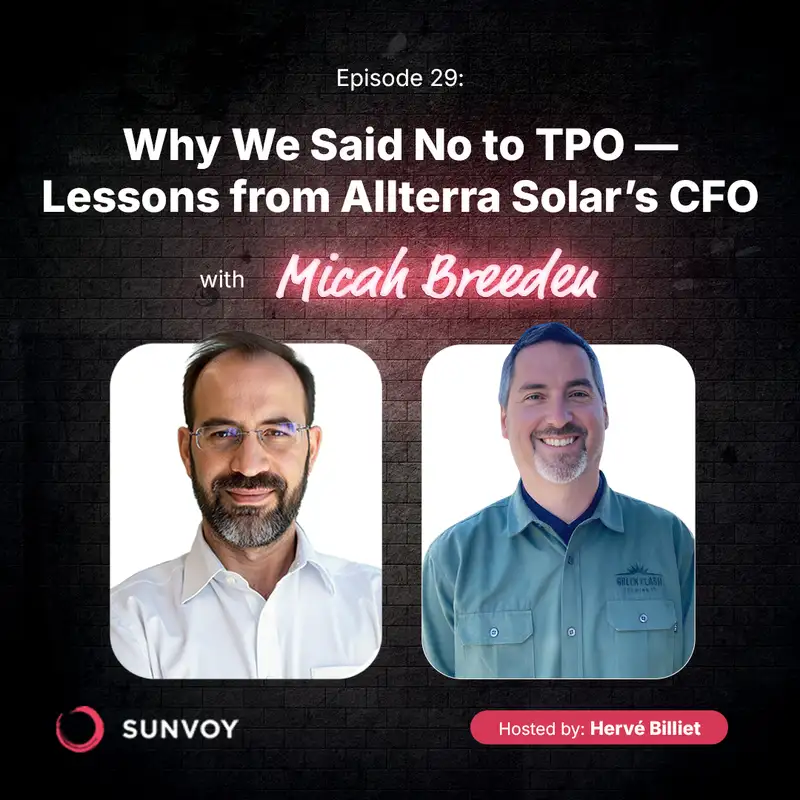
 Episode 29
· 21:08
Herve Billiet (00:00)
Welcome, Micah, to another episode of What Solar Installers Need to Know Podcast.
Micah (00:04)
Thanks for having me. Happy to be here.
Herve Billiet (00:05)
Micah, you're the CFO of Allterra Solar. You guys are based out of California and you have about $11.5 million in revenue last year or like 2025, so nearly the end of the year. You have around 30 employees. You install around 20 to 25 systems a month, which is a split between resi and commercial. So far, you have five crews and you mainly do everything in-house. Is that about right?
Micah (00:31)
Yep.
Herve Billiet (00:31)
All right, so Micah, you've been in the sewing industry for quite some time. You've been around the block a few times. So what do you think and how would you describe the current situation we're in now?
Micah (00:42)
I think it's pretty unique. know, we, over the last 10 years, there's been a lot of ups and downs. think this is, unique in that, you know, having a federal administration that is very anti renewables, is going to be a challenge. I anticipate kind of the domestic content and rules evolving and, you know, right now they're not very
clear, people are looking for guidance and it's limited. And I think it's going to be a struggle for a lot of companies to focus on that and be able to be agile and change and understand all the laws and assess that risk for each company and their customers as well. So yeah, it's definitely unique.
You know, for Allterra being in California, we stopped doing commercial a few years ago because of some of the policy changes at the state level. And we've decided to kind of avoid TPO offerings and just focus on cash sales to residential customers. So we're trying to skirt some of these policy changes on the federal level, but time will tell.
Herve Billiet (01:41)
Yeah, in the introduction, I've said a split between residential and commercial because I've known you for a while and it's true that, I forgot like you don't do commercial anymore. So interestingly enough, when the ITC goes away, it's like it's bad on one side, on the other side, that's good as well. We're less affected by policy. You can just run a business based on what capitalism is, what's in the markets, less about policy, except every item that you mentioned, every major strategy change in the business
seems to be driven by policy, less commercial TPO. Explain maybe why you not jumping on that bandwagon of TPO's. What is the underlying strategy there?
Micah (02:18)
We've used, we sold them previously probably 10 to 15 years ago in that range.
I think first and foremost is we don't believe it's the best offering for the customer and kind of we are a customer first business. So, if we don't believe it's the best offering, then we struggle to offer it. We get to the point where, maybe the demand is such that we have to offer it due to competition and factors like that. And so we always evaluate it. But
as we evaluated it this time around, the offerings were vastly more complex than they used to be. The requirements were vastly more complex. And so the thought of kind of adjusting our business operations to facilitate these offerings and solutions to our customers meant we had to put in a lot of legwork and changes and accept a lot of risk. You see some of these
Herve Billiet (02:51)
Hmm?
Micah (03:07)
companies go out of business as far as the finance TPO companies and leave smaller contractors hanging. You don't, your invoices don't get paid ultimately at some point, potentially. And so that level of risk with the investment on the internal operations staff process side to maintain compliance and complete the projects. Just our list of cons kept growing while the list of pros kind of stayed the same
is the easy way to say it, the more we looked at it. So ultimately we decided
that if we can get a jump on the post ITC cash market and that process then in two to four years when other companies circle back to try and figure that out, we're already gonna be up and running and be the leader in that field in our region. And so that was our thought process there. And we do have a certain level of luxury to make that decision based on our region being near Silicon Valley and a higher
wage demographic and less larger national competition.
Herve Billiet (04:03)
Well, you're the CFO, so I guess the cash flow is important there. Even with DPOs, so even when DPOs don't go under, it's always a question of when they pay you. You may have done all the work, but then you always get paid. Was that part of your consideration too?
Micah (04:19)
Yeah, some of the stories we've heard from colleagues throughout the industry and the, we did all this, but then we had to go back out to the site for this or go back out to the site again or again and again. And just to get this little piece of lingering documentation to get that final payment issued was, I think for us, maybe it was less about the cashflow and more about the
like disruption to our internal process of jumping through these hoops that may be set, say in March and may change in May and may change in July, depending on the financiers requirements. We've heard those stories where, you you start a project and you go to finish it like the last one, but now they've got a new requirement that you've got to keep tabs on and do something different. So it's kind of...
You don't get to build a process and let it run. You kind of always have to keep changing it based on outside requirements factors rather than your own kind of internal reasons.
Herve Billiet (05:12)
You mentioned that when we considered TPO at the time, we were going to build an entire new pipeline for TPO projects with different processes, different everything. And if you had like a second TPO or like if you have multiple ones, it would be literally different pipelines in our CRM with different stages, different requirements. It wouldn't be the same as your own project.
Micah (05:32)
Yeah, which would make sense in my view if it was a say a 10 year like a long business plan, but with the uncertain length and the short, know, two possibly four years. And then you mix in the, you got to use this equipment after the second year and maybe not equipment that we want to use that. You know, starts to, like I said, that cons list keeps getting longer.
Herve Billiet (05:53)
Now, the reason you would take on a TPO is to have more sales, to fill up your sales pipeline. But you've been around the block a few times, a solar company is always out of balance. You either sell too much and then your operations struggles or your backlog becomes really long or the exact opposite happens. You don't have enough sale and your backlog is shrinking. So I remember like your backlog was huge, was way
longer than most solar companies I'm talking with. So tell us more about what your typical backlog is and the pros and cons and how you handle that.
Micah (06:26)
Yeah, so with the NEM transition in California a few years back, our backlog did get pushed out to over a year and a half. And that was very unique in that timeframe as you were able to sign a customer up and you had three years to build them. We actually have five or 10 projects we're to build in 2026 before April that were sold in the first quarter of 2023 that are the kind of the lingering few remaining. Typically our sales have outpaced our installs. And so we have
been regularly having a six plus month backlog, where ideally four to five months is our preferred range. gives you the comfort of the backlog, but it gives you the customers like meets their kind of desire to have the system in and up and running. A big part of our focus has been on customer communication and setting those expectations from the beginning. So, so they understand
the other project's gonna take this long and for these reasons. And they chose us for their reasons. ideally we're gonna deliver on the expectations and the quality and everything that we promised. And they're gonna turn around and explain to their friends and give their referrals to Allterra for future customers.
Herve Billiet (07:34)
So the next question was about one mistake you see other solar installers make. That doesn't mean you guys make it, right? But a common mistake that you've seen in the industry that you want to talk
Micah (07:45)
Yeah, I mean for us the pain point over the last year and going into 2026, the solution we want to solve is the commissioning project process or the project closeout process. We used to install solar, you would land the breaker, you'd connect the NPAID monitoring, give the customer a walkthrough, download the app, you'd be good to go. Now you've got...
non-export systems, you've got grid battery, non-backup battery systems, you've got solar only, you've got, you know, we installed Tesla, Franklin and Enphase batteries. You can, depending on how you interconnect that, you can export battery power to the grid or charge from the grid, but you can't do both. And so there's a, we had a very limited number of settings in the commissioning process. It was very straightforward. And now we have this
vastly much, much larger configurations that need to be done accurately so that the system operates properly, the customer's accounts credited properly, their user experiences, what was expected and communicated and planned. So that's been a big, thing for us and a focus for our team
to improve that, make sure we're defining all the options, training all the staff on all the options, documenting each project and then closing it out in the manner it was designed and interconnected and built.
Herve Billiet (09:01)
Then I agree, like it's way more complex than before with more features, more possibilities. And you don't want to have a person just go install and drive off without explaining how it all works. I think it becomes more complex.
Also for selling solar people may just continuously go back to the same argument about how to sell solar. Now, can you explain what works well for you and maybe a new way of what you've seen worked well to sell solar and bring that to home?
Micah (09:30)
Yeah, so, you know, again, being in California and the recent NEM changes, the wildfires, we've been unfortunately very close to those and a lot of our community was affected and our utility has some of the highest rates in the country and they continue to rise. So we've been focusing on price per kilowatt hour. Your investment with Allterra will get you your energy at X kilowatt hour versus the utility
which is usually, you know, one and a half, two times the price and focusing on, you know, the fact that they're basically locked into an agreement with the utility at an undetermined price for their power. You know, who would agree to that? So you've agreed to it. You didn't willingly sign off on anything. You just moved into your house, called the utility connect
Herve Billiet (10:09)
It's true.
Micah (10:19)
electricity because you need electricity. You can take ownership of your power and the, what you spend on that each month by making an investment
and that will give you, say your power at 20 to 25 cents a kilowatt hour instead of 35 to 45 cents a kilowatt hour or more.
Yeah, then we, know, a big part being in California is, you know, our battery adoption rate is above 90%. A big focus of ours is resiliency and independency, especially in our, you know, environment with the political, economic and climate factors all considered.
We want to kind of stress to the homeowner, this is your opportunity to kind of take some of this stuff into your own hands and be in control of it and not be at the whims of a policymaker or investor-owned utility or things like that that can disrupt your day-to-day life.
Yeah, we're focusing our efforts on cash sales in this post ITC reality. We want to focus on making investments in our team and our processes and our operations to improve so that we can continue to provide our quality experience to our customers and continue to build on our referral-based business.
We do anticipate 2026 being a little slower, so it gives us a little time to focus on those improvements and implementing those so that later in 2026 and beyond, we can build off of the strongest foundation possible.
Herve Billiet (11:41)
I remember you had a very strong foundation of also referral base. Your company was a lot referral based to begin with, so that's quite impressive. Now, what are some two or three trends that you see in the solar industry that you think people should pay attention to?
Micah (11:57)
I think the domestic content and FIOC are at the top of the list. It's something we have to pay attention to, even if you're not in the commercial or the TPO game, these things affect the supply. The demand for specific products is shooting way up because more companies need those products to be in compliance with FIOC or domestic content.
Herve Billiet (12:17)
No.
Micah (12:17)
Just because we're not offering a TPO solution and don't need those products doesn't mean we don't have to be aware of that. And it affects our product offerings and what equipment we can or can't use because what equipment are we going to be able to get? So we have to be diligent about our forecasting and planning and working with our distribution partners and manufacturers and suppliers to make sure that we're going to be able to get what we need to build the projects
that we have in our pipeline. So I think that's a big one just because it's kind of industry wide and there is some uncertainty around it. Some of that's starting to come into a little clearer view as the guidance gets issued. But I also don't necessarily.
I guess I have a, the best way to say it, a little bit of uncertainty around how stable that guidance is given the administration stance on renewables.
Herve Billiet (13:07)
You also mentioned vendors and distributors. So how do you maintain a good relationship there? Not just that they know what you need, but then also in reverse, because they usually call you like, hey, you you need more panels. They place a sales cost to you, but in return, maybe not every distributor knows is that installers, we also want to know what they have available in the future and that if we need to place an order that that's going to be available.
How do you maintain those relationships and anything that worked for you?
Micah (13:37)
⁓ Yeah, we have some pretty long standing relationships. I've been in charge of managing those and it's been a, a focus to, you know, stay in touch regularly, have regularly scheduled meetings, forecasts well in advance. One of our focuses as a company is to limit our equipment offerings to enable us to be able to forecast more accurately and work closely with our
distribution partners and suppliers to get what we need. But yeah, think taking a proactive stance as a company with your relationships with your distribution partners is very important. Don't wait for them to come to you. Usually if they're coming to you, it's because it's something of interest to them. They're trying to offload excess inventory or they're trying to meet a quarterly quota or something like that, which is fine, but you need to...
It's on you to kind of make sure your needs are communicated in advance so that they have the time they need to get the equipment that you ultimately need.
Yeah, Amicus is a cooperative of solar companies, over 80 companies nationwide, over 4,500 employees. I think it's $4 $5 billion in combined revenue. So it's a great group of individuals and companies. There's a lot of employee-owned companies, certified B Corps. The companies are all ethically aligned, very
focus on customer service, focus on employee well-being and those kinds of things. It's been a great addition for Allterra to become a member owner. We value that relationship very, very much. The ⁓ great resources and support on the procurement side, which is a help, but more importantly is the kind of the
the breakout groups and larger meetings and knowledge sharing that happens. There's a lot of trust there and able to get different insights quickly, learn from people that have kind of gone through something you're thinking of going through or commiserate together because you've both gone through the same thing at the same time. There's always value in that. So yeah, it's been a great
Herve Billiet (15:28)
you
Micah (15:35)
thing for Allterra, very happy that we were welcomed into that cooperative and value that greatly.
Herve Billiet (15:40)
Do you always send the same people to the events or do you send different people to kind of get more people in touch with the group?
Micah (15:48)
Yeah, it depends on they have varying retreats with different topics. So, you know, they'll have sales and marketing retreats or they'll have ops and designs retreats. so it'll, involve different people depending on, who's going to most value out of, out of attending.
Herve Billiet (16:03)
I have a question for the CFO part of you. Cash flow has always been troublesome for me. I never really figured that one out. Although we spend a lot of resources in creating automated scripts that could calculate our cash flow in advance from our accounting software and so on. So have you figured out how to do cash flow accurately and with good projections? Did you figure that one out?
Micah (16:26)
I think, you know, we've been fortunate to be profitable for an extended period of time. So we've had capital on hand. we haven't had an immediate, you know, there's been a very long time since it's kind of been the stressors of, are we going to have enough cash coming in for this or that? so it's, and being more residential focused.
in our throughout our history and now being solely residential, I think cashflow management is a lot easier. think when we were doing commercial projects, even though we weren't doing that many, that always put more of a strain on everything because there's a larger outflow for everything and a larger amount of time before that revenue comes back in. you know, we ran into it, you know, this year we ran into some
Herve Billiet (16:58)
Hmm... Yeah.
Micah (17:10)
cashflow because we had to, know, with, there was some panel distributors that left the market that we were using. And so we had to buy up all of our stock by X date. And there was the issue with the tariffs. And so we had to buy up a bunch of battery stock while they were at the price they were at. And so, you know, those kinds of things put a little bit of a strain on, on cashflow, but for us, I think,
The consistency of our business over the last five to 10 years has helped us kind of know what to expect and forecast and manage that accordingly. But I think a big part of that is, is being residential focus because outside of this last year with the, the tariffs and, and need to procure inventory in advance, which we don't normally do that much of, the biggest strain was, was the commercial work that we would get into.
Herve Billiet (17:55)
Alright. And you don't do commercial Is that something that you advise other people to have a look at?
Micah (18:00)
Yeah, that's one of our goals for 2026. So in 2025, we doubled our service in O&M revenue from 2024. And so we're looking to do that again and move forward. We have a lot of systems locally that were installed by
companies that are no longer in business. So we'd like to kind of be able to take on those customers, make them our customers, install batteries on their existing solar system after we fix it, things like that.
As well as just continue our standing as a quality contractor in our community and helping our community members. But yeah, definitely. It's also been a great referral source for us. You get people that are really frustrated. They've called three to five companies and haven't been able to get anybody to help them. And you're able to help them and provide a solution and get them back online. And they're very grateful for that. And so I think it's...
Herve Billiet (18:33)
Run!
Micah (18:49)
It's some work and takes some planning to get that up and running.
Herve Billiet (18:55)
I agree. I think it's both helping people, which is good, but then also pure business. It's also good. So those two things combined makes it a good thing. That's what companies should be doing. What was the revenue this year, Do you have any idea?
Micah (19:08)
We're gonna get close to 400,000 this year. Yeah
Herve Billiet (19:12)
All right.
Yeah, those are some nice numbers. no, revenue is real from O&M. Too many companies still do kind of everything for free, helping their own customers. But there is a real business reason to take on O&M and do it well. And also, if you want more reviews or referrals, like the quickest way is do O&M, because those people are ready to pay. They want it quickly. You can go out. It doesn't take weeks or months to plan and permit. You just go out
good at the work, reviews come faster, cash comes faster, so it's great business too.
Micah (19:40)
Yep.
Yeah, think it's just, it's different from kind of the larger solar battery installs that have this big drawn out long process. so you kind of, have to have a team that has their own process defined and have that quicker turnaround and execution.
Herve Billiet (19:58)
Micah, it's been a real pleasure. Thank you very much for being on the podcast.
Micah (20:01)
Yeah, thanks for having me everybody, I appreciate it.
Listen to What Solar Installers Need To Know (by Sunvoy) using one of many popular podcasting apps or directories.
