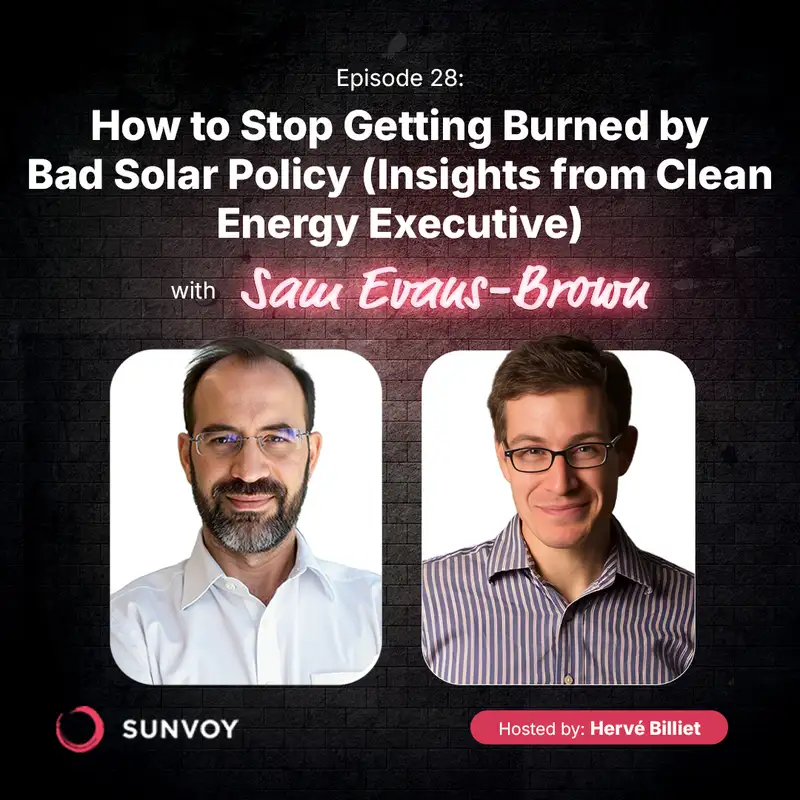
 Episode 28
· 27:43
Herve Billiet (00:01.218)
Welcome, Sam, to the What's Solar Installers Need to Know podcast. You've been leading the Clean Energy New Hampshire organization for several years, for five years, Sam. So Tell us more about yourself and what your organization does.
Sam Evans-Brown (00:14.212)
Yeah. Well, So Clean Energy Hampshire has been around for a little over 20 years. It started in 2003 in what I refer to as our hippies in greenhouses with ponytails face. It was all volunteer at that point and it was really more sort of consumer focused. They ran sort of a home energy expo, did, you know, home, you know, alternative energy home tours. And it was really just like they were going around tabling at conferences, trying to convince people to build more energy efficient homes and
potentially adopt solar as well as wood chip boilers and things like that. And it sort of continued in that vein for about 10 years. And then there was a leadership turnover. And in 2013, they were able to hire their first professional staff. And that was a woman named Kate Epson. And Kate had been a Public Utilities Commission analyst. She really understood the energy industry, but then also she really understood
politics in a way that I think the previous board members had not truly understood. So, Kate moved the organization more towards what started to look like a traditional trade association. In fact, at that time, they launched a sub-brand that was called the New Hampshire Clean Tech Council. And it was intended at the time, they said, want to be, there's an organization called the BIA, the Business and Industry Associations, the Statewide Chamber of Commerce.
And they said, we want to be the BIA for the clean energy industry. And to me, that's actually quite telling because the BIA is a 501C6. It's not a 501C3 and our organization was a 501C3. A C6 is a trade association and its job as a trade association is to represent the collective interests of all of its members, particularly in policymaking. C6s can lobby. They have no limitations on how much their dues can be used for lobbying, whereas C3s
have limitations and C6s can make political donations and can endorse candidates, which C3s cannot do or they lose their IRS tax status. So in 2013, we took this more sort of policy turn. then, and I actually came to know Clean Energy New Hampshire at that time as a reporter. I had been a journalist for about a decade and I had the energy and environment beat. And I came to know Kate because
Sam Evans-Brown (02:32.827)
Clean Energy New Hampshire was the organization that I, as a reporter, could call when I wanted to speak to someone who truly understood the details of a complicated policy area and who would not lie to me. Because I found that everyone else that I was talking to was always giving me some sort of spin and Kate was a straight shooter. And so as a reporter, I started to have a tremendous amount of respect for Clean Energy New Hampshire, thought of them as a truly expert organization and one that was really willing to just say the truth.
And then I think those are sort of the, it's really like some of the core values that I've tried to engender as I've taken over. As I said, I was a reporter at my local public radio affiliate, New Hampshire Public Radio for about 10 years. I hosted my own podcast, a show called Outside In, which I, you is still going with the new host and is actually about to celebrate its 10 year anniversary. And when I decided to leave the podcast industry,
Herve Billiet (03:24.299)
congrats!
Sam Evans-Brown (03:31.491)
it was because I saw that there was an opening for someone to lead Clean Energy New Hampshire. And I thought, well, hey, that is a way that I could really have some impact in the world. And so that's where I took the plunge.
Herve Billiet (03:41.806)
All right. What a story. Great, great, great. So when you spoke about the first events and associations or what your association was doing at the beginning, like opening homes, those tours, I think a lot of associations must have gone through the same process. And then I guess they mature and made the hippies kind of also, I guess, mature. Because I'm in Northern Virginia, very similar vibe, I think, throughout the years.
not our entire industry matures, I think all those organizations need to move with it. So you have about 130 businesses today in your association. So tell me more about what type of businesses and are they all solar companies?
Sam Evans-Brown (04:26.235)
So the biggest tranche of our membership are solar companies. There's about, it's actually waning right now. We had a number of out of state companies that came in during the sort of post inflation reduction act days that are actually now pulling back out of the state of New Hampshire. So we were probably dipping down to around 20 solar companies now, but it was 20 to 30 solar companies. But then from there, it really spans the gamut. So we have...
you know, EV charging providers. We have energy efficiency contractors, literally the guys who are up in Tyvek suits blowing cellulose into attics. We have, you know, architecture firms. We have energy modeling companies. There are a couple of just major manufacturers who have become members of Clean Energy New Hampshire because they want the state to adopt a more permissive policy environment so that they can invest in clean energy for their own energy supply,
and they've come to us because we're the organization pushing for that. But then also the thing that's interesting is that, and this is a change since I have come on as executive director, is that now all four of the state's electric utilities are members as well. And when I started, we had two of them. We had the two smallest, two smallest investor-owned utilities, and then the big gorilla, Eversource, which serves the most customers in the state by a large stretch joined in 2022. And then just this past fall, the New Hampshire Electric Co-op, which had always held out because they had said,
you know, we hold our wallet really close to the co-ops because our owners are our members. And so they had always held out on joining, but they actually finally joined this fall because I think they see increasingly their interests aligned with ours.
Herve Billiet (06:04.494)
to ask you why did they join or why do those electric utilities and co-ops joined? What's the mission of the organization?
Sam Evans-Brown (06:12.901)
So, yeah, so many of them increasingly see themselves as clean energy companies. If we're going to electrify the entire economy, that's a lot of upside if you're an electric utility. They often see things slightly differently about how we get from here to there. And those points of friction are something that we often find ourselves mediating between our members. But...
But it is true that they should, if they have their eyes on the big prize, they should be aligned with our goal of eliminating carbon emissions. And increasingly, New England is a restructured state, so the utilities don't own generation, they just own the poles and wires. And if we are in fact going to get more and more of our electricity from distributed energy resources, there's a lot of investment in the distribution grid that needs to happen
to make that possible. And I think the utilities are trying to see the upside of needing to make all those investments in the distribution grid. But then the co-op, think, is actually an interesting test case because their service territory are these long, leggy, radial lines, and they have lots of outages, and their cost structure is very different from some of the folks that have some of the bigger cities as their customers. And so they truly do have a really hard job.
But increasingly what I think that they're seeing is that their members want the choice of being able to generate and deliver power that then they can potentially use to reduce their neighbors' electric rates if you start to talk about batteries and demand response. And increasingly as those systems have matured, the co-op is starting to say like, actually this might be something that could provide additional reliability and resilience to our grid if we do it right.
They've come into our orbit for that reason.
Herve Billiet (08:02.894)
So you mentioned that the utilities owns the pole and the wires. So who's owning the generation?
Sam Evans-Brown (08:09.207)
So in restructured states, the generation is owned by independent power producers, IPPs. so Constellation, Calpine, NextEra, these are these big companies that you've heard of that own many of the large bulk power systems. know, Brookfield is another one, Brookfield came into New England and bought many of the legacy hydropower plants. Brookfield is also actually a member of Clean Energy New Hampshire, as is NextEra, which owns the Seabrook nuclear facility on the seacoast, which is one of the largest power plants in New England.
And they bid into the wholesale markets that are administered by ISO New England, our independent system operator.
Herve Billiet (08:44.878)
So you mentioned the oil electrification, rises, rising tide rises all boats, so everybody should benefit from that. So how do you see that? I guess part of your members are only businesses, not individuals that go solar. They are not represented.
Sam Evans-Brown (09:07.563)
are we back?
Herve Billiet (09:09.518)
I guess so. Let me ask the question again.
Sam Evans-Brown (09:11.163)
Yeah, you said, so you mentioned the blah and then that's all I heard.
Herve Billiet (09:18.732)
Yeah, so Bill, make sure to cut this away. We are at minute nine. Okay, I'll take nine, 20. Cut away. There you go. So Sam, what was my question again?
Herve Billiet (09:43.372)
Hey Sam, with the rising tide of the all electrification of everything, you also have, besides the members that are business owners, also have individuals part of your association since they become part of the DERs?
Sam Evans-Brown (09:56.678)
We do, we do. And in fact, it goes back to our origin story in which, at the beginning, all of our members were just regular people who wanted to support the nonprofit. And so, you know, if you count all of our members altogether, there's over 500 folks who are card carrying members of Clean Energy New Hampshire. They range from those businesses.
Also, we have municipal members, so we have towns that have joined, and that's largely local volunteer energy committees that want to do municipal projects, and we provide them with technical assistance and connect them with resources to do those municipal projects. But then it's also individuals as well. And it's between that mix of member dues, but also grants that we apply for. We do receive some federal funding to do that technical assistance work that
that pays for the staff and the operations. And we are on the spectrum of trade associations, we're on the bigger end. We have 13 staff in a tiny little state like the Granite State is.
Herve Billiet (11:03.628)
Now you...
Bill, make sure you cut these out too. I had fantastic question and I just missed it. OK. Sam, you've been a reporter for a good part of your career, and now you're in the Trade Association. Can you provide some ideas or certain skills that are very handy for a reporter that maybe solar CEOs and directors imagine we run solar companies would benefit from?
Sam Evans-Brown (11:36.336)
Yeah, I'd say the thing that I learned as a radio reporter in particular was how to take complex ideas and to distill them into simple framings that can be understood by a broad audience. And I think that that skill is essential for literally anybody who is, in particular, if you're trying to move policymakers, which I would argue that
anyone who's in the renewable energy industry should be communicating with your local policymakers as a job creator, as someone who's driving economic benefit in your local jurisdictions. Your local elected officials should know you, should know what you stand for. And in order for you to be able to communicate with them, you better be able to weed out all of the acronyms from your vocabulary and speak regular human. which is a thing I think I learned as a radio.
And I love the technical stuff, know, I, in a dream world, if Clean Energy New Hampshire had been in a different place, it would be so cool to be able to be like the Public Utilities Commission creature that's just living in the dockets and breathing the acronyms. But I think I think that has been key to my success and also the success of Clean Energy New Hampshire is just the ability to clearly and succinctly communicate these complex ideas to regular people.
Herve Billiet (13:05.932)
That's, think, advice. Make sure you can explain it to a three-year-old. Not to compare our legislative branch to a three-year-old, but I think I just did.
Sam Evans-Brown (13:14.325)
No, that's not you're not far off. So just really briefly, New Hampshire has a four hundred representative House of Representatives. It is the fourth largest legislative body in the world. Right. It's like Indian Duoma, British House of Parliament, U.S. Congress and then the New Hampshire General Court. Right. So so like not to besmirch my local elected officials, but it doesn't take that many votes to get elected.
It's not uncommon for someone to put their name on the ballot and then to pass away in between then and election day and still win the election. Genuinely, it is not bad advice to think, would my five-year-old kid understand this? And if the answer is no, then you're making it too complex.
Herve Billiet (14:09.016)
All right, another question, Sam. Since you have a lot of different members, a lot of them are solar companies, what are some three trends that you see that solar CEOs and your members come knocking on your door to kind of get help or guidance with or try to move the needle? What are some three common topics that are top of mind for some of your members?
Sam Evans-Brown (14:34.467)
Yeah, I think the pain points in New Hampshire are similar to the pain points in a lot of other states. The first is interconnection has been a massive problem, both for DERs, which in New Hampshire, the cutoff is really around the five megawatt scale, where you start to trigger system impact studies at the system operator level.
So five megawatts and below, you're running into interconnection problems with the distribution utility. We had a massive run-up of DER interconnection requests after the invasion of Ukraine by Vladimir Putin. And we had some of the community solar projects waiting two years just to get the results of a system interconnection study and to know how much it was going to cost them to interconnect.
And this was a massive problem. And unfortunately, it's going to result in a lot of projects that would have been viable now no longer are because they're not going to make the tax credit deadlines as the tax credits are expiring. So interconnection has been a massive problem at the RTO level for ISO New England. We had a transition from a sequential interconnection study to a cluster study. And that
got delayed, which has meant that similarly for the utility scale projects that have been in the queue, some of them have been waiting for years just to know what their connection costs are going to be. So interconnection has been a huge problem. the other I'd say is, you know, so we're An organization that for better or worse, net metering has become has been the policy structure that has that we have become most closely associated with. So
defending net metering slash trying to figure out how to reform net metering in a rational way has been sort of a multi-decade fight. And I think that that's a fairly common experience across different states. And then lastly, if I had to pick one more,
Sam Evans-Brown (16:47.483)
I'd say that access to skilled labor has been a big issue at certain points, particularly when we've had moments where there's been ramp ups in demand. There were times in 2023 and 2024 where the number one impediment to getting more solar built in New Hampshire was the lack of master electricians. And so figuring out how to create a pipeline for new people to get into the trades and understand that being an electrician is a...
great job that will provide for your family is something that I think we need to have our eyes on, particularly as more and more of the economy is being electrified.
Herve Billiet (17:26.094)
All right. And what do you think more installers should know or what is misunderstood about a clean energy in New Hampshire? What do you wish more installers understood about about your organization?
Sam Evans-Brown (17:38.126)
Yeah, I mean, as a political creature, which is what I have become, I would encourage more and more installers to get involved in local politics. And that might be through a trade association like mine. It might be directly, you know, New Hampshire is privileged because we because we have that massive legislature. And these are citizen lawmakers. They are volunteers. They get paid one hundred dollars per year
Herve Billiet (17:42.25)
I'm sorry.
Sam Evans-Brown (18:07.833)
to be a lawmaker. and it is basically a part-time job and they don't get paid. But it means they're incredibly accessible. Each of them represents 1600 residents in New Hampshire and often their cell phone number is on the website. Like you can call them and you can get them and they will pick up the phone. other states don't have that luxury, but I would say your local elected official should know you, should know about your business.
They should know what matters to you from a policy perspective, and they should think about you as an essential part of the economy. My bias is that trade associations are a valuable vehicle for doing that. So I would encourage you to get involved with whatever is the local entity that's equivalent to clean energy in New Hampshire. Figure out who that is. Figure out if they're effective. Figure out if they're ineffective, why that is. Consider serving on the board to try to fix it if it's ineffective and build
political power in your jurisdiction so that we are not riding the lightning every time there's an election and a new party takes office. One of the things that I have said to my board is that we have the New Hampshire Auto Dealers Association that represents all of the car dealerships. And do the auto dealers worry about whether it's Democrats or Republicans who have one office? No. Democrats and Republicans all value car dealerships.
We should try to build for our industry a profile that looks exactly like that, where our lawmakers know that we are providing benefit to them and their citizens.
Herve Billiet (19:43.374)
Now, if I go back to when I was running a solo company, I was asked by multiple organizations to donate and come to the events. And then you try a few organizations and then sometimes like, oh, maybe I bet on the wrong horse. I'm not sure. So I was forced to be part of that political game a little bit. I remember one person asked for like a huge donation and I said like, well, maybe I should do this.
And then I didn't and I luckily, cause he changed his mind. Apparently he went away with all like the money was just poof gone and he just changed his mind later on. So glad that we didn't donate, but how do you prevent that? How do you guide CEOs that want to do the right thing, want to be part of this, but how do you get started and how do you bet on the right horse?
Sam Evans-Brown (20:26.287)
Yeah, no, that's a great question. And I think that unfortunately there's no shortcut there. I think that the first step is really just start getting plugged in yourself. You can, you know, I'll talk about my experience, right? My experience was in New Hampshire, the state house is open and you can just attend the hearings. And so as a cub reporter, I was just wandering into hearing rooms when bills that I was interested in were being debated
and I would see who was there and I would listen. And so whatever the equivalent of that is, right? Like you want to be out, you want to be in the community, you want to be talking to people and you want to learn by watching. And I would agree, you shouldn't immediately join the first thing that you see. You should try to figure out who are the players, who is effective and where do I as a CEO
have an opportunity to provide additional support and additional leverage and guidance to one of these organizations. It is often the case, not always, but it's often the case that there are sort of different groups that are sort of jostling and competing for influence in that space. In New Hampshire, we're actually kind of lucky in that it's kind of a vacant field, which is in part why we are as large as we are. My sister organizations in Maine and Vermont, in Vermont, they have three staff, in Maine, they have one.
Clean Engine Hampshire, meanwhile, has 13. And why is that? It's because in Vermont, there are seven organizations that are occupying the space that my one organization does. And in Maine, it's very similar. So there is a little bit of homework that you have to do. I would argue that if you are a business owner, you should take the time to do your homework to figure out who it is that you should be getting plugged in with. And then I would say consider board service. These are nonprofit organizations.
And I like to joke that New Hampshire in particular is a duocracy. We are governed by the people who do stuff. And if you want to get involved in help at your local trade association, they will absolutely be interested to hear from you and will want to solicit your guidance. Now, the question of how you spend your money is a tough one. I'm a fundraiser. I spend my days making those asks of people. And what I would say is,
Herve Billiet (22:25.39)
Uh-huh.
Sam Evans-Brown (22:48.987)
you should give your money to people that you have seen how they work, you know that they are competent, you know that they are effective, and until you can answer those three questions, then wait.
Herve Billiet (23:02.264)
Good point. That's good advice. Now you mentioned some other nonprofits you're in contact with. And I know this podcast is about SOAR companies and SOAR CEOs listening. What's going on for nonprofits? I don't think you deal with mass electricians or permit issues for your project. So what are things that keep you awake at night about running your nonprofits that
that maybe solar shields could also kind of get into your shoes a little bit and kind of learn what's going on in your world.
Sam Evans-Brown (23:38.716)
Yeah. Well, you know, I don't know how interesting this is to everybody, but I'll talk about our organization as long as you want. But what I'd say is, you know, with the passage of the Inflation Reduction Act, there was an absolute flood of federal dollars into the space. And anyone who had a 501C3 was eligible for this sugar rush, essentially. And so I started at Clean Energy in Hampton in 2021, 2022, Inflation Reduction Act passed. We had three other staff when I started. So there were four of us total.
Herve Billiet (23:53.326)
Mm-hmm.
Sam Evans-Brown (24:07.867)
So we grew from four employees to 14 in just a few years. And then the big bad bill passes, the portcullis slams down. We had federal grants that we had won that were then canceled. And so then we overnight had to pivot to fundraising. And so I was out knocking on the doors of people who had means and saying, listen, we have built this team. You have interacted with this team. You have seen what we're able to do.
If you don't want us to go away, you have to support us. And so I imagine that there are a lot of nonprofit folks that have had to make a similar pivot or have had to reduce their staff. They've had to lay people off because the sugar rush of federal funding has gone away. And then what I worry about, the biggest fear for me is that now we've pivoted to, in fundraising world, it's the 80-20 rule. 80% of your support comes from 20% of your funders,
Herve Billiet (25:02.766)
Mm-hmm.
Sam Evans-Brown (25:05.263)
mostly major donors that are keeping many, many, many organizations afloat. If we are in fact in the middle of an AI bubble and the stock market crashes at some point because the air comes out of that bubble, then what? So that is the thing that I worry about and I'm thinking hard about how to build an organization that's resilient to those types of swings.
Herve Billiet (25:31.2)
wow. Well, good news for all the people in the solar industry listening to this having to run a company. They have a million problems, but fundraising is not one of them. So that should make them happy. have other stuff to worry about. If you had a magic wand for 2026, if you could make any changes to the world and not save world peace or world hunger, let's assume somebody else already solves that.
Sam Evans-Brown (25:40.131)
Hahaha!
Ha ha.
Herve Billiet (26:00.601)
What would you wish for with your magic wand in 2026?
Sam Evans-Brown (26:04.333)
Well, the very, very narrow ask is I want divided government in the state of New Hampshire. Right now it's a Republican trifecta. They have the House, the Senate and the governor's mansion. And my job would be infinitely easier if Democrats took control of one of those chambers. But then generally speaking, I actually do hope that we are at the end of one big pendulum swing and I hope that we're about to swing back toward the middle. So both federally and locally. And then, you know,
The thing that has been interesting for me to watch is, you know, we had Derek Thompson and Ezra Klein write their book, Abundance. And so now there's this sort of center left, you know, abundance movement. There's also sort of a corresponding center right abundance movement. And those folks agree on quite a lot of things. And the question that I have is, does that turn into something durable where we're able to get stuff done in...
a purple state like New Hampshire, where the best thing that I could possibly hope for is divided government. And what I point to is that, know, New Hampshire has actually had, as a state has had the fastest falling carbon emissions of almost any state in the United States. The reason for that is that we used to have a lot of coal fired power plants in New Hampshire. And just earlier this year, the last one was closed. The reason that all those coal plants shut down in New Hampshire
was because of restructuring. It was because we required the utilities to sell their power plants. The power plants were no longer operated by a monopoly and they were exposed to market forces and they were expensive and the markets shut them down. And the duo that got restructuring done in New Hampshire was a Republican, Jeb Bradley and a Democrat, Clifton B. Lowe. And it used to be that energy policymaking was a relatively bipartisan affair in New Hampshire. And it's only been sort of
Herve Billiet (27:40.697)
Mm-hmm.
Sam Evans-Brown (28:00.038)
post Tea Party wave that it has become increasingly partisan. And my hope is that we might swing back to a world with this bipartisan abundance movement in which we can start to get things done with both parties again.
Herve Billiet (28:12.303)
Alright, last question maybe for the people that don't read a of books. You mentioned a book about abundance. What is that about?
Sam Evans-Brown (28:18.499)
Yeah, so, so Ezra Klein, as folks may know, is a writer at the New York Times. He has a podcast. He co-authored it with Derek Thompson, who was at the Atlantic. And essentially, the book Abundance is about how blue states have created so many processes that they can't get anything done anymore. And it's how can we create a public sector that is faster, more nimble,
more efficient and able to actually deliver on the promises that progressivism is trying to make. And the answer in many instances is to get rid of what they refer to as everything bagel liberalism, which is to say, you order a bagel, which is, high-speed rail
because you're in everything bagel liberalism, you sprinkle on labor requirements, sprinkle on environmental requirements, you sprinkle on all the other things that liberalism wants, and the result is you never build the high speed.
Herve Billiet (29:22.287)
That's too sad. It's funny because you mentioned process, a lot of process oriented, which is something I keep mentioning to people to grow their business because so much of the value is in the process. You have a problem, don't just try to solve it. Create a process so it keeps solving itself. So it's funny that if you put too many processes in place, nothing happens anymore.
Sam Evans-Brown (29:41.457)
Well, it's about better processes, right? Like that's the, you know, I think of one of the issues that we're working on right now is permitting. And it's not that we don't want safely built projects, it's not that we don't want rules and permits, it's that we want the permitting to happen quickly so that you don't have to walk in, you know, sign on with a rooftop solar company and then wait months before they can ever get the permits and get on site. We'd love a world in which
basic normal projects can have the contractor fill out their permit application the night before on an automated portal and then be on site the next day because it was deemed to be low risk and they were able to just get an automated permit and start work. So that type of thing, I think is the answer. It's not that process is bad, it's that we want better processes.
Herve Billiet (30:32.793)
Yeah, when you mentioned having a permit the day before, what I hope is that one day we'll have, you know how you have ice cream trucks driving around your neighborhood? You would have solar trucks driving around, one solar. And then, you want them? OK. And then you go quickly, do a quick design. I mean, it's all the same anyway. You can do it really fast. And then, that guy needs 20 panels. You open your truck, and then you just go quickly install it.
Sam Evans-Brown (30:45.008)
You
Herve Billiet (30:59.479)
I mean, on my home, we put 20 kilowatt in, was, I hope to be panel ready in the first day, but we put all the panels on the first day. So then you just come back the next day and wire everything up, you're done. And that's a 20 kilowatt system. That's pretty fast, I would say. So it is possible and all the safety, if you do this every day, you know what to do. You need the pictures to take for the permits, you know how to deal with the grounding. Those are things you know from doing it every day. So.
Sam Evans-Brown (31:14.31)
Yeah.
Herve Billiet (31:28.173)
waiting months on a permit is not going to make it that much safer. So that's maybe my wish for 2026 to have solar panels being installed in small ice cream trucks.
Sam Evans-Brown (31:39.898)
There's a distinction that I've heard several people in the industry make, which I like, which is that we need to get away from selling solar and get towards buying solar, right? Where people can just go, whether it's the ice cream truck or where they can just go to your website and say, like, I would like solar on my roof, in minutes, get themselves a quote for a basic system design. The refinements can then happen on the backend after the sale has been made so that can get away from these high sales commissions.
Get away from grandma maxing, which I don't know if that's a controversial topic on your podcast, but like consumers, we want consumers to have a good experience. And so if we want them have a good experience, we need to be providing them an awesome product quickly at a great price.
Herve Billiet (32:24.899)
Yeah, I think the industry is working towards that. Like that customer experience, mean, that is literally the software we're building with before all generation, which can only happen if you're happy, but a lot of automation too. So I think we're working towards that.
Sam Evans-Brown (32:38.202)
Love to hear it.
Herve Billiet (32:39.567)
All right. Sam, a real pleasure. Thank you very much to being on the podcast.
Sam Evans-Brown (32:43.898)
It's been really fun. Thank you for having me.
Listen to What Solar Installers Need To Know (by Sunvoy) using one of many popular podcasting apps or directories.
