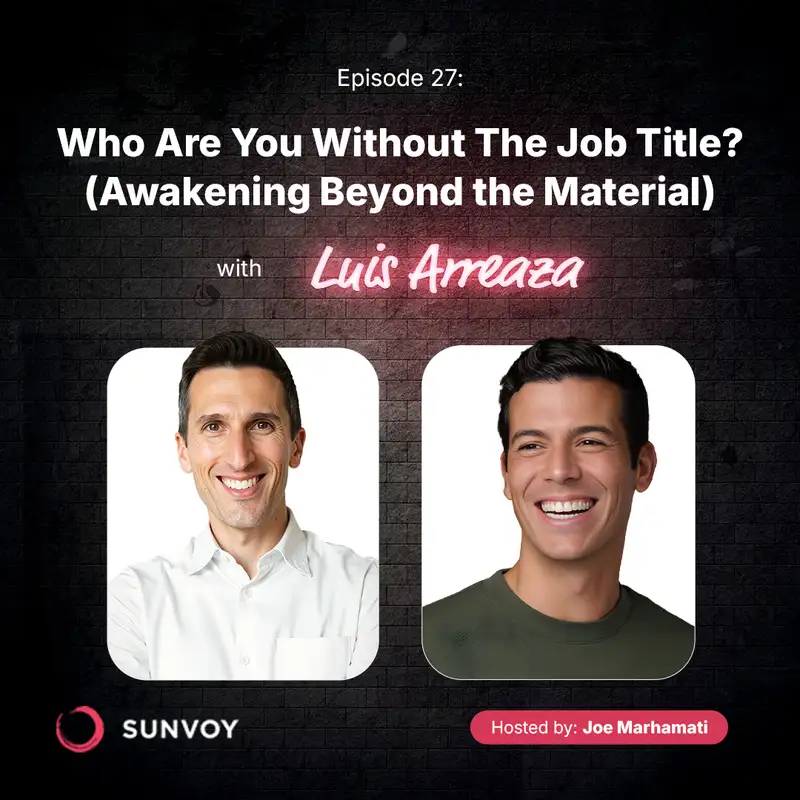
 Episode 27
· 55:16
Joe Marhamati (00:00)
I can turn it a little bit. you know why? Because I moved. It's the camera on here. wasn't able to get it to be... I don't even know if we're really going to use the video anyway. Actually what would be ideal is if I could go like that.
There we go. Hey. Then I just can't. There's a way. There's a way. Exactly. I like it. Yeah, actually it will go like that. Okay. That's good. So you were just talking about the desert and the Canary Islands. Yes, in Fort Ventura there's a desert that has dunes. Yeah. And it's surrounded by this kind of landscape that looks like Mars. It's just rocks. And then the desert, this part of the desert was sensing my back here. I was living there post pandemic. And
I would just take walks. The desert had the beach. It was nice, but it was too windy. Yeah. So it bothered my ears a little bit. So we got to a desert that was less windy. And of course, literally no one. No one, no thing, no animals. And that was one of my most enlightening experiences. Because I mean, in the silence with nothing except just the wind. Yeah. I was like, wait, I am not this body.
I felt that I felt like after years of meditation, I felt that I was like, wait a second. I'm not this body. I am not these thoughts. It's like a realization right now I'm thinking, but the realization from the conscious way is like, wait, I am not those emotion life. am whatever is watching this. And I know that a lot of practices tell us, you're not this body. You're not this.
conscious, they are not certain of the thoughts. when we literally let that sink in and we realize in fact, yes, it's actually true. It is an experience that we're having as consciousness. When was this? What months was this? in a year? It was in, I think it was January or February 2021. Oh, okay. So, so that was
right before the pandemic, because the pandemic was declared like, March. So this was a year after. Exactly. Right when they opened borders, we went to first Portugal and, for Tremontura. My wife and I went to Portugal and then for Tremontura. There was no one there. It was just us surfing, working, having my private clients like we usually have.
and then just enjoying nature. It's so funny because I was doing the same thing and there was only an ocean between us. I was in Ocean City, Maryland around that time and I did the same thing. I was walking on the beach every day with my dog and it was right on the Atlantic Ocean on the other side of the ocean from where you were. I was doing the same thing and I started listening to Tara Brock who's this big meditation teacher in the US and had a lot of the same realizations. I guess a lot of people have like a spiritual awakening around.
Because you're isolated, it's just you with your thoughts, you know some people didn't see anyone for a year. So it was like if you're gonna have an awakening that was the time that you would have an awakening. Which actually gets me to my first question, the who are you test. So it's like if you stripped away your business, your net worth, how would you describe yourself to a stranger? And the reason I ask you this is because you're probably asking us to allow your clients, right?
people that are coming to you trying to figure out who they are after 10, 20, maybe 40 years of an entire career. So how do you answer that for yourself and how do you help other people answer that question? It's a really hard-hitting question, right? It's like we're starting strong. I like to dive in the deep end. I know it. I know it. I think it's something that we, all of us, be asking at some point in our lives. I think we wait too long to ask this, simply because we are too immersed in our habits.
in our, in our families, our habits, in our businesses, in our daily days, in our routines of a gym or whatever hobby we have, but we don't stop. like you say, in the pandemic, a lot of people have realizations because all that stopped everything. And you were probably separated from your loved ones. I was separated from my wife. Really? Yeah. We were separated for nine months, nine, 10 months. Why? Because she was in Spain.
So we were only the beginning of the pandemic when they locked down the United States. She was in the United States with me. And then her visa, her, know, ESTA, which is the visa for European citizens, expired after three months. And they let everyone, all the Spanish citizens back. And since then, since that, March until October, were separated. Wow.
So a lot of people have realization because we stopped their habits. so to answer your question, who am I beyond businesses, beyond family, beyond everything that we do, we have to ask who is the one that's knowing everything that we do? Who is the one that is observing or experiencing everything that we do? And most people say, I am exactly. That's what you are. That alone, that statement.
is alone what we are. We are the I am, the awareness that's saying that the knower or the listening, the listener to the thoughts or to the emotions. We are the one that's always there, has always been there since the beginning of our lives. We were young, we had a small body. We were there when that body started changing, became teenagers. Then we switched, you know, the hobbies from playing with little cars and
And the footballs to doing marathons and we, changed our bodies. Our hair started changing. Some hair fell off and hair got, know, gray hair. All that we have always been there. That's the only thing in us that's never ever changed. If you think about it, when I ask people question that people have had successful careers or people that have are going to,
you know, changing complexities because I also work with business owners or founders that just got an investment of five million dollars. That's like where's my identity going? If you're rooted in the I am, if you're rooted in the consciousness and you develop that specifically through meditation, the changing circumstances of life will not necessarily affect you, but you will ride with them. You will be essentially in both riding the waves.
And you always anchor in the fact that no matter what happened externally and that even means in the body, you have ultimate self-worth. Your value is what you see yourself to have internally. And the definition of that value is also on the word is intrinsic to the values that you live by. That's, think, the ultimate.
question of your identity. Yes, you are the I am, you are the consciousness, but you're defined ultimately by the values that you demonstrate in your daily life. But why does it take some people 40 years to figure that out? Some people 60 years to figure that out. Some people never figure it out. And some people seem to know that innately from birth or from childhood. Why do you think that is? Is it the culture they come from?
Is it something genetically? What do you observe about why there's such a difference in people realizing?
Well, I think that that's also a great question. think that it's inherently tied to some very tangible things. You know, the environment that you were born in, perhaps a culture that you're born in that tells you, look deeper. And when you look deeper, you have many avenues to go deep. know, some people go through religion, some people go through spiritual practices, some people go through, you know, connection with nature. That in itself, to me, serves for practice.
I honestly don't have necessarily a very tangible question, but I do have an intangible question. I do believe that as an awareness, as consciousness, we live many, lives. In my deepening meditation experiences, I've seen past lives. Really? I have seen past Is it pictures? Is it ideas? What does it look like? It is both. mean, it is photos or pictures moving.
motion pictures of specific moments that marked those lives. And it's interesting because it is not a thought necessarily. It's like a knowing. You know, it's like you see yourself in the mirror. You know, that's your body. That's you. And in these moments where I have been so deep into subconscious, into this subconscious mind, because that's where all the information is stored, I see myself.
in other bodies. Yeah. And it's just too obvious. And then it's just a very deep inner realization that it's, yeah, we've been here too many times. And so I think that to answer the question of why is it some people never figure it out or some people figure it out since birth is because in the advancements or the spiritual advancements in those lives.
for whatever reason, we're able to simply know more about ourselves, which is the ultimate reality. Ourself, the one that never changes. And so I think in many lives we can awaken to that knowledge and live this any life empowered by the fact that you know that you are that constant principle. But do you think there was a time when everyone had that knowledge innately? Maybe before industrialization?
before modern materialism or advanced civilization, maybe when we were in these in-between states of homo sapiens and more animal version of ourselves and that materialism as a philosophy and as a system has caused us to lose that knowledge? I think that materialism causes us to lose that knowledge, that's for sure. I think that externalizes our point of reference to the things that we own, the stuff that we do.
Instead of looking inside for that answer. Yeah. That's for sure. And now that whether we have had that knowledge in the past, I think that when we're close to nature, that knowledge becomes very obvious. When we are consistently close to nature, it becomes very obvious. So perhaps when we're closer to nature, we understood the mystery, let's say, unconsciously. So we knew, we simply knew, we didn't know why, but we knew.
Now I think we're in an era where we can know consciously what we're doing and say, wow, literally, I am not those things that I'm doing outside. I am that, that never changes, but I'm engaging this because I'm part of this whole mystery that we're living. Because we don't know where we are coming from and we certainly don't know where we're going. That's a fact. No matter what you read, it's not like, you know, you're in this room and this...
you know, because of the light, you know, this is certain color. We don't have that tangible knowledge yet of our origins or of our future. you think we will? Do you think that, is it something you're happy to live with not knowing if you'll ever know? I'm happy not knowing where I'm going. I'm happy knowing that what I am or what each of us is and discovering the capacity of
that consciousness because he has innate capacity. Attention is one of those innate capacity of consciousness or will is an inner intrinsic capacity to say value or or characteristics of consciousness. So that discovery makes a lot of things have more sense. The fact that you can bend and create future reality based on a visualization that you have because your attention.
is given into a thought and the thought has energy and that energy is projected into electromagnetism of the plania of the universe and that in itself then collapses a particle into an experience that is becoming the ultimate principle of consciousness. To create a life based on your vision, also intrinsically related with other
know, individualized forms of consciousness that we are, each of us is. So what causes a business owner to find you, both practically and what are they discovering themselves or what do they feel internally that makes them recognize that they might need someone like you? Give us a story of someone that you've worked with that went through something really difficult, maybe where they lost their identity or they weren't sure where they were.
how they found you and then where they found themselves on the other side of that. Yeah, most business owners or the people that I've worked with come, had come to me in a point where they needed a deep change. They were in a state of mind and body that they could not sustain anymore. So Luis, this life that I have, the way I'm feeling, the way I'm thinking, my thoughts, this negativity or this angst that I feel, I don't want it anymore. I don't know.
what to do. I've done everything and I don't know what to do. And so we take it from there. We take the person, the situation, the experiences that this person is having first to create function in their lives, to change the point of view of those situations to the point of view that is not only a problem, created a problem, but it's giving them an ultimate opportunity.
awakening because we are essentially the potential for our awakening, for our awakening beyond these problems, beyond these situations is directly related to the, let's say the gravity of those situations. people, some people who are, for example, going through bereavement or deep loss, their opportunity for awakening for to
create a beautiful life is exponentially bigger than someone that's going through a mild problem. Just because the situation, the problem or the challenge requires something different of us. So something profound requires profound seeking, profound understanding of ourselves. Where there's something mild requires simply some mild seeking, solutions.
So when they come to me, they want to simply live better. in the process of that, realize that living better means changing the quality of the thoughts, changing the quality of the emotions, changing the quality of the things that they do. And so we begin changing aspects of inactions, thoughts and emotions, and then through different actions, different thoughts and emotions, you create a different.
And so in that process, not many people realize that ultimate identity that you and I are talking about, but they do have a better life. So the chances of them discovering that identity through that better lives is higher because they have peace. So when you have peace, you're able to go deeper within because you're not bothered by the things that before unsettled you. you think that it's a coincidence that you're working mostly with business owners?
who have to go through a difficult, maybe decade or two or more, of business challenge to have these realizations. Or do you think that people that are predisposed to externalize their self-worth use business to try to define themselves and then come out on the other end realizing that they never found the why of life? Yeah, think, I mean, a lot of people that I have worked with, I would say in our turn, they realize too late.
what they need to do. I think we live in an era because of the information that our generation, millennials by the way, we had a great chance to not only have a better life now, but to find that self-worth that we're seeking outside, inside. Because we have so many tools. mean, if you're not looking at things that can make your life better, and you're simply covering that with acquisitions, with more businesses, with more getting busy and grind or whatever.
that you're missing the opportunity of information because information is right in our hands it's everywhere and it's a matter of applying that to real scenarios in daily life you know business challenges are real family challenges are real but how we approach the challenges is really what matters and that information is at hand so to tell us a story of someone that came to you like what what position were they in in
So you kind of give an idea, but give us like a tangible, a real story. How do you help them and where they are now? Okay. So I would like to talk about my, um, applying that being with me for, uh, think three years now, he, at the time who was 60, 67, 68, something like that. Now he's 71. So yeah, so around that. Right. So he came to me, um,
I met him through an acquaintance and he said, say, Luis, you work? hear that your friend told me that you do coaching. What kind of coaching that you do? I said, well, that's hard to explain. What do you call it? I said, no, it's a personal coaching. I keep it simple. But I do it through mindfulness. I said, oh, I mindfulness. said, okay, what I do is a little different, but we start.
with mindfulness, we just create the right state of mind and emotion for you to thrive, to feel better. I okay, I like that. I mean, that's tangible. That's really what I do. I mean, we can extrapolate that to anything, but that's really what I do. Create a different emotional state. I asked him, so tell me about your situation. said, well, I've been a business owner for my whole life, essentially.
I sold my business 10 years ago and since then, because I lost that kind of purpose, I've not found any purpose. feel like, excuse my language, like shit for the last 10 years. My relationship with my kids is awful. I don't necessarily, I'm not enjoying my relationship with my friends. So I have no direction and I really need help. I've tried everything.
Most of the people that come to me have said that I've tried everything, nothing worked. They tried therapy, they tried a lot of things. I think that normally people find the, let's say the solutions or some ease in these modalities of therapeutic practices because they still externalize the solution to the situation with the therapist, to the actual method.
instead of understanding that the changes happen because you change. So we started working with, I mean, to map his mindset and to map his emotional state. And of course he was suffering depression, slight depression, mostly anxiety. And he had a very negative nagging mental state. would complain about essentially everything. And so
The first thing that we do is to follow through steps, self-awareness, self-acceptance. So I become aware of what's on my table, of what's in me, the way I am. I see the things that's happening and I help them do that. have you noticing that you're nagging about all these things. Are you noticing that you have this kind of mentality? Are you noticing that you're driven by this kind of anger? I help them with awareness. Then the second part,
because we can be aware of things, but we can deny that they're there. Second part is self-acceptance. And we accept that this is the way we are. This is the way they're handling themselves in lives. And then after self-acceptance is interesting because the next step happens automatically is self-understanding. I know why I feel like this. So you can sort of draw the causal link from
Something that happened to where you are. What do you mean by why? Exactly. So the self-awareness allows you to see what's on the Acceptance tells you accept that in fact you are there right and then understanding is simply not necessarily the cause But understanding is who you are in terms of that. How are you being approaching that you you come to an ultimate understanding of?
of your own life on your own situations that drove you there. when you, when the clients realized that they simply understand that they can let that go because that's no longer who they are today. So they, they make the flip from awareness to acceptance, to understanding, to something new. So they become aware of different parts themselves. So we create that. when we.
Essentially bring function into your lives that I no longer want to be this way and I'm acting in alignment with that desire the fact that I don't want to be this way. I don't want to be complaining. I want to be toxic. Right. Who do I want to be? That's the next step of what we do. So we begin anchoring the attitudes in them. You have it's new type of actions that would drive them to who they want to truly want to become. So my client.
It took a long, long period. would say a year and half, almost two years. Actually two and a half years to go from all these stages until he had an emotional breakdown. Emotional breakdown while he was working with you because he had that understanding. Out of the blue, yes. It was, I said, go through this, sustain this, to, he said, I feel like I want to go to a psychotherapist. Go to a psychotherapist. Do whatever you feel is necessary.
Because I've done that because the key is that they know that they have the answer for whatever is best for them. Instead of externalizing the solution, listening to someone. I say, I need to listen to myself. So you bring the point of reference inside. It's like an internal locus of control versus an external locus Exactly. And that's what helps most people heal. So change, let's say drastically. I think change is healing.
We're going from something that doesn't work for us to something that works best or better So when he did that he came out two weeks later. He was actually he wanted to the to hospital Huh? He went to a sleep therapy. He came out of that completely changed everything that you and I have worked Sunk in yeah, and I'm here ready to create something new. That's exactly what you say. I'm here ready to create something So how do you how do you?
create something new from that place because then you have the self understanding to then change. You have to go through two, three years to get to that place so that you can then even conceptualize being different. Exactly. Exactly. then when you see that what you have been thus far, this is the way I've been thus far, I'm suffering because I don't want this anymore. Yeah. And then you slowly begin separating from that person.
as paradoxically as that may sound, you stop engaging in thoughts that are not working for you. You stop actually expressing toxic words because you're like, wait a second, what am I doing? I don't deserve to treat myself that way. To treat myself that way and treat other people. It's easier to start outside, right? I don't want to treat my wife that way. I don't want to treat my friends that way. And then you say, wait a second.
What I don't say, I say to myself and then they realize the inner narratives. I don't want to be that way. That's what people suffer is little suffering, psychological suffering. And then when they turn the page, they say, I want to create something new. They realize that those thoughts have also a positive aspect. Negativity, the other side of negativity is positivity. So that polarity helps them say, who do I really want to be? How do I want to engage myself?
And so they begin creating this new, essentially, personality that's aligned with who they want to become. And so my clients become more peaceful. He's there today. He's doing the thing that he loves doing, expressing gratitude. Gratitude is a great way to not only change your mindset, but to expand the goodness around you. Gratitude, being grateful for.
his wife, even though he's scared, even though he doesn't necessarily jam with them, you know, they don't have a great relationship, not because any of them is bad, just because he accepted that they're just different. I have expectations they will never meet. And we don't necessarily jam that way. We get together, we love each other, but from a distance it's fine and I'm happy with that. He came to that acceptance as well. And then he's someone that decided his lifestyle as well.
He's now living in three different places. He's a snowbird, so they're from Canada. And so when they are, there's a winter in Canada, in Florida. When Florida gets too hot, they go back to Canada. They have a cottage somewhere. So they change their lifestyle as well, and they are enjoying in the process. Do you think that age and location matters? Like I would guess it's harder to change a 67-year-old brain.
than a 27 year old brain. And also I'm guessing it's not a coincidence you have lot of clients from US and Canada versus here. I guess this is my public announcement that I moved to Spain a year ago. We're having this conversation in Barcelona. But I mean, I've just noticed, know, independent of doing any work, just being here, everything feels a little calmer because I think people here are more like what you're describing.
There's less materialist external anchors of validation here. So do you find that the age matters and that do you think if just changing locations can change a person's perspective or is it everyone is suffering with this to various degrees and needs to have these realizations whenever they're ready? 100%. I think that, I mean, one of the things that define us as individuals is our culture. Yeah. And for example, I grew up in Venezuela, but I did my undergraduate degree in the United States.
And I've seen how the American culture is driven by an external point of reference, our anchors of worth and value is just inherent in the culture. It's not wrong, but we just simply have to realize that that's not necessarily positive for us. We can, it's interesting because it drives, it's driven the American society to accomplish amazing things. But at the same time, at the expense of the individual feeling whole on its own.
See, I find that funny that you say that's not wrong, but then you also say that it's causing so much suffering. I have a hard time swearing that myself because to me, if anything is wrong, it's when people's behaviors are not in alignment with their goals. Presumably, the goal of everyone is to be happier and healthier and have self-worth. Why do you say you don't think it's wrong? Because I think right or wrong is a judgment. At the end, there's many people that are just doing that.
And that's just culturally what it is. And I say that it may not be functional to them because it's essentially robbing them of their inner happiness. I mean, we see that in the States. A lot of people are unhappy. I mean, percentually, I think a lot of people are not satisfied even though they have a lot of things. So right or wrong is just a judgment, I think. And it's just how it is. So I'm no one to say.
That's wrong. You don't want to say that they're bad, right? Because it's just how it So right or wrong to me, just necessarily not something that has in me my philosophy of how I see things value as much as to say it's functional or dysfunctional to society. And I do agree with saying that first in other cultures, we value other things. In Venezuela, we value other things. But there is also materialistic inclination, I think, is
It's the sign of modern times everywhere. Even people who are less materialistic like India, but they live in extreme poverty and what they do, they want the materialistic share part. So it is, think at the end of the day, also is about a balance and a harmony between, because it is true, we need materialism because we live in this earth, this physical plane. But we also need internal fulfillment because
from the internal fulfillment, the things that we do assignment, realistically, will change too. And so we change the individual, we change the things that the individual does. And so for example, as business owners, when we change the way we feel inside, and we make it more functional for us, whole, the steps that we take in business, the way we treat our teams, the way we handle our companies, we change.
the businesses that we do, the deals that we close, will change because we have changed. We'll begin feeling resonated with different deals or different people, different decisions differently than if we were in stress and in anxiety or burnout. So have you had anybody come to you who's actually running a large business? Who's, know, hey, I'm running a hundred million dollar business and something doesn't feel quite right.
But I'm afraid that if I change, I'm going to lose control of this business. It's going to stop growing. Maybe they're micromanaging. They're unable to delegate. They're worried about the business collapsing. They feel responsible for hundreds of people that they've employed. And what do you find happens? Do you find that their business continues to grow even faster once they've made these realizations? Or they just retired because they couldn't handle the stress anymore? Yeah. You know that one of the biggest misconceptions that
you know, founders, business, active business owners, call that. How about inner or personal development that goes to a deep level is that they lose their sense of self for some reason in what they made them successful that they will become hippies or they have to move to a community. But no, totally not. Yeah. That the the the way is very neat.
Yeah. And so what I found when I worked with active business owners, their grown businesses is that they first they have more clarity. They know what's best for their business from their own wisdom inside. They become wiser because they're not stressed. So stress chemically, right? Let's talk about stress chemically.
is that the cells are cluttered with stress hormones. There's keys that go into the cell and stress the mouse and stress the cells in survival that it just, you know, jittery. So when we begin relaxing, we begin through breath work or through meditation or through moments in nature, moments where you go and you internalize yourself as a business owner, that receptor site, that's what it's called, it detaches.
the stress hormone. The stress hormone no longer is produced at the same rate, so the cell is clean. And so when the cell is clean, you literally feel more clear. And so you're able to make better decisions. It's not esoteric. It is chemical. It is also psychological. When you are not functioning through the cocktails of stress hormones, your brain works better. What do you think the difference is between meditation and prayer? This is something I've been thinking a lot about.
And the more I think about it, the more I want to converge the two. But in my mind, meditation is more honing the ability to listen to yourself, gaining that self understanding that you talked about. And I had the same experience you're describing. It took me years to be able to just get to the point where I could meditate without so much resistance. There's this story, I come from the TM, Transcendental Meditation, kind of tradition.
And one of my mentors told me this story, people going to a Long Island facility, a TM facility, and they physically could not sit for 20 minutes, which is the length of a TM meditation, because their mind was so busy and so cluttered that it was harder for them to sit for 20 minutes than to run 20 miles. I had that, kind not quite that bad. I was able to get through the training and it took a few years and now I can meditate with minimal resistance.
But I associate prayer with more like a conversation with an external God. Maybe you're asking for things. But I want to believe that the two are closer than they may be in my mind. How do you think about the two? That's a really interesting question. I've been thinking about that lately. And meditation to me, like you've said, is something that is in your experience. more, let's say, receptive. You're there, and there are different types of meditations. know that transcendental meditation, mantras, that's active as well.
There are other meditations where you simply relax into inside into this called the emptiness that is full of something, but it's an emptiness. It's more receptive to look within. Yeah. The focus meditations where you simply focus on my part of the body. I do that a lot with people who are starting out because it's easier, it's more tangible. Focus on your finger. You're like, okay. You know, when your eyes close, it's easier to begin building up the capacity. And then the
Prayer what I consider I mean prayer is similar to in a way to recite in mantras or to phrases because you are Essentially engaging the mind which is okay The mind is there to be engaged in and this case the prayer is something let's say positive for us now Prayer to me and meditation go hand-in-hand because you can relax and go deep inside meditation, but then prayer or
conversation that you said, which is by the way, the way I do it as well. is talking to something greater than just my self about, deep things, about connections, about things that I, I desire for my life. So it is, mean, and by the way, to me, at least is something that is internal because as I am,
I like this in the way the yoga puts it. am an individualized consciousness that is part of a notion. I'm a drop that is part of a notion. That ocean is you can call it the universe, God, the intelligent infinity, ultimate love, many names. And that prayer is directed to that intelligence. And so when I internalize myself, when I teach someone to internalize themselves, and then in that depth,
you pray, you connect and you verbalize what you want, what you thank it for. We have that, I would say that intertwining of the two. Because the deeper you go, the easier and the closer you are, the easier to talk to this force and to simply
I think it's connected. You recommended a great book to me which I read about six months ago called Letting Go which I love and it's funny because you talk about the letting go technique and I actually didn't find the guy focused too much on the technique it was more about the process and the levels of consciousness he has this zero to one thousand spectrum and it's like everything below 200 is like guilt and shame and anger and sadness
and everything above 200 is higher levels of consciousness that are connection all the way up to like the love of Jesus, a thousand I guess. But when you find somebody that's suffering, how do you help them, even if they're not gonna be a client of yours, how do you help them to see themselves so they don't have to hit the bottom of the barrel, they don't have to wait till they're 67 years old? Or is it just the kind of thing that everybody has to have this moment for themselves? I think it is something that comes
It's very personal, it's very individual. if I wanted to, I mean, based on the book, what I learned in the book, which is fascinating, way, it's really interesting. In terms of the level of consciousness, the trust between negative consciousness, like shame, that, shame, fear, apathy, which is the lowest, by the way, when you don't really care about things, apathy, it's anger.
So if I wanted to help someone kind of make it flip, I would get them angry. Yeah. Oh, really? Have you ever done that? Of course, through clients. In order to unearth those emotions that they're not aware that they have. Exactly. And to get them to put angry in a way that kind of make them think of what they've done so far and what they're doing to themselves and why they want to change and they're not doing the things that they're supposed to do. I get them angry.
because anger has an externalized desire to prove the other wrong. So when they do that, it always works. always works? always works. Wait, so walk me through that process. What does that look like? How do they make the connection and how do they realize that their anger is righteous in a way that they need to overcome?
In the beginning it's not rational. I gave them with that. don't think you... I sometimes actually, I I have told the clients, I sometimes, I know you have what you got. What it takes to do everything that you and I working for, but sometimes your attitude doesn't show that. So sometimes I'm slightly disappointed or very disappointed in the things that you're doing because you come to me, you pay a lot of money, and then you suddenly don't do what you say you were going to do. What do you think?
you're showing me of what you're capable of doing. So they begin like, wait a second, their self image begins suffering. And then also, wait a second, I need to prove this guy wrong. Because they're successful business owners. know where the buttons are. So the people, a lot of people begin just trying to prove me wrong.
Yeah. Trying to remember. I say, by the way, I meditated three times. I checked the box. I checked the box. And that's how.
A lot of people come from a low energy standpoint, especially people who are in a depressive state. need anger. You need fire to get them out, right? To get them to the emotions of the change, you know? And that's necessary. Sometimes I help them. I, sorry, I make them go to exercise, go into competitive sport. Something that get the fire going. They need that.
Chemically speaking, it works. But what if you just encounter someone that isn't going to be a client? Do you just pray for them to have this moment soon? Do you just hope that they can realize this sooner rather than later? Yeah, I I don't give advice unless I'm asked for. That's something that's tough lesson to learn because we are in a position to help many people when we dedicate ourselves to helping others.
It's only possible if that door is open. And so it has happened to my family, for example. I've seen things happen in the past, especially seen things in my family that I could help them with. you know, when I have stepped in, I'm told to back out. So I respect that. What do you find happens in the business when someone changes for the better? They treat themselves with compassion. What happens to the employees?
to the mission of the business, to the growth of the business, to the impact of the business. Have you been able to observe that? In a very interesting way. A lot of people associate also to be compassionate or to be understanding to weakness, and that's something that is obviously not true. When you're receptive, you still enforce your authority, you enforce your knowledge, but in a different way. So people also, when you're receptive to people, people...
receptive to you. And so what I have seen is that teams begin listening to that leader, that director, that executive or founder. They become more receptive to their ideas because he's also, when you're receptive, you're also open for challenges. For someone saying, well, I don't understand why we're doing this. And then you're not responding with arrogance or responding with an explanation. It's like, hey, we're doing this because of that.
And then I've seen people get their teams behind them where there was before just chaos because they as leaders set the attitude in motion for that chaos to be in place in the companies. If the leader changes, everything around this person will change. The way the business is done, maybe you need an overhaul depending how bad it is. But the way business is done in your company is a reflection of
that's leading it, bottom line. Have you ever seen a leader change so much that the culture of the company, which may have been negative or toxic or unproductive, couldn't withstand the change that that individual had just gone through? Because maybe it was a culture of control, of intimidation, of hierarchy, and that then needed to flatten out, and that the entire culture of the company needed to be more enlightened because the leader had changed so much.
that maybe it couldn't withstand such a change. I hope that I see that someday. I've never seen a company that's that bad. Completely, they didn't completely change and going to the other side. Not yet. Yeah. But what I have seen are companies that were chaotic to an extent. Yeah. Not hyper toxic mentality, but chaotic to an extent because the deal she was just, you know, that. Right.
Two realizations of different founders are working specifically with these two founders. I help them first understand each other. We're like heading butts all the time. Butting heads? Heading butts is hard to do. It's a different thing.
That's okay, I only know one language so I can't make too much fun of you. my god. Butting heads. They were butting heads and they were essentially just driving each other apart from business. Yeah. And that, hey, if that doesn't work you have people who side with one, you people who side with others, it's just a mess. I, know...
My last business had a little bit of that. I it wasn't, I wouldn't say it was toxic. I would like to believe it was, we used to call it like destructive creativity or something like that because I would butt heads with my co-founder and we have very different personalities. I can say this survey because he's still my partner at some point. And now we have a third partner and the business is fantastically generative and positive and we have a great culture. I think in construction, things can be harder.
By the way, this is what solar installers need to know. And you're the first person I've interviewed who's not in the solar industry. But the reason I wanted to talk to you is because I've seen the full spectrum of solar business owners from people who have very flat businesses that are non-hierarchical, where there's shared understanding and shared values across everybody. And that was a lot of the community I was in when I was a solar installer. To very hierarchical businesses, very control-based businesses, micromanaging businesses.
publicly owned companies where people live in fear. And I've seen everything in between. how do you shift? Have you worked with a business culture or is it always with one individual? Have you ever kind of come in to be like a leadership coach for an executive team before? I've worked with executive teams or founding teams mostly. Not necessarily in a professional setting like a
publicly listed company that work with, with their leadership team have not done that. I like working with founders, the people that can, they have a different stake in their businesses. and through their changes, seeing the company change, that's extremely sad story. And, but interesting thing about the different cultures in business, in this case, solder is that.
I think people have to realize what, especially people that are working in these businesses, one is best for their peace of mind. There's a lot of employees that stay because they fear, of course, their job and it's natural. I mean, it's easier to thrive in an environment that's better for the person at the personal level. So maybe you thrive in hierarchy businesses and you're in a flat organization. That's not...
Sure, that's true. Yeah, kind of that. So that's also what personal development is about is self understanding what's best for you, you ultimately. And so in that way, who's to say what's right or wrong? So if it works for you genuinely and it's helping you, it's aligned with your values, it's helping you improve your life in any way, financially, emotionally, mentally, that's your place.
Why do you think this isn't taught in school? it seems like this should be, you know, life 101 in, I don't know about first grade, but maybe seventh grade or 10th grade or certainly a first year of college. What are your values? What are your needs? Who are you? Do you think that that's, is it just, is it intentional? Is it unintentional? Is it ignorance? Is it Western culture? Is it materialism?
How is that not the first thing that we learn as adults? Yeah, I've asked myself that same question many years. Yeah. And I think it's just the inertia of society is materialistic. It's outside. We were taught to do things, how to do things outside. Striving, Exactly. It's striving. And then this is something that we learn along the way. And I think times have changed though. I've seen, for example, my nephews.
They are now in fourth grade and sixth grade. In the US? In the US, in Florida. In Florida. In a public school. Okay. And they're meditating. Really? Every morning. And that's from the curriculum? Yes. Really? In the curriculum. Wow. They all, the whole class meditates. How did, do you know how that came about? I have no idea. But when they told me, there was a program, I honestly don't know the full story, but...
It is something this school implemented right after COVID. So they've been meditating since first grade, second grade. That's amazing. That's amazing. And you see the kids, for example, one of them has they also taught him to handle his, he's an angry part of the personality. So he has a name for that. So when that part of the personality says, wait a second, I need to handle this part of my personality. He goes into a quiet pace.
takes a few breath and comes back out. Wow. That's evolution. That is. That's very rapid evolution. What happened in the last 10 years, 20 years that enabled that? There's some kind of shift. Maybe it was COVID, but it feels like almost more cosmic or something. Something happened in the last 20 years where it's like we reached this tipping point of materialism that
The humanity as one consciousness started to look inward and ask what are we doing? I think it's kind of ecological, but I'm curious what you think. I think the same way. think it's something that is We changed as a planet we change the frequency of the planet So we are naturally leaning towards frequencies more aligned with gratitude more aligned with the or energies frequencies energy same thing yeah of energies of
gratitude of peace, we want peace. mean, what? That's outdated. Like all these things. Although normal, we know, I would say most of us know that's not good for any of us. And so with that, think all these changes have come alongside. And I'm glad that our generation, we are adults that are still young, very young.
And we're depending on why you consider young, but I consider 40 is very, very young. But we are in the right moment to embrace these changes and first, you know, affect positively our families and our surroundings with these. So there is a better way of living for sure. And I really like the way this is going. I really think that our earth is moving towards an amazing level.
Yeah, think so. We're going through chaos in the States. It's going through challenging times, Venezuela as well, different places. ultimately I feel I have a feeling, I don't know how to explain it, but I have a feeling that things are just choppy waters. Just like when the river meets the oceans, always choppy. But then you have that sense of unity and that
Unity in differences because we will always be different But there is more acceptance because we know that for that other person to be in a certain way doesn't mean that to be not yeah, and if we are You're respectful. think peace always comes So if someone's listening to this because I can I can imagine myself listening to this conversation five years ago when you know, I was in a very stressful place when I was running a solar installation business and
I had this sense that something was off that I didn't feel the way I wanted to feel. But I didn't know enough to know if that was, maybe just everyone feels this way. Or maybe this is just what it's like to run a business. Or maybe this is just what it's like to be human. So what questions would you ask our listeners to ask themselves to see if they would need or want to work with someone like you or if they need to go on some journey to...
Be in greater peace. What are the questions they can ask themselves to answer to figure that out? Yeah, I think Especially it's all about figuring out what are the leads what what are First, what are my values? Why I think is the right way to live and You say well, okay. Well, I think I like peace. I like kindness I like I mean acceptance so
With that values in place, when you figure out your values, you have to ask, am I living through these values? Am I being accepted? Am I being kind? Say, well, I am kind if someone is kind to me. If someone is not kind to me, I am not kind. So you're not kind. You're not living through these values. I'm serious. This is very hard to do. But we have to, especially people in places where we are influencing others, doesn't matter.
in which level of your organization you are, if you live through your values, that would take you to better places. And so that's one question. What are my values? Am I living through these values? Always. I'm committed to these values, no matter what. And so that is a journey, of course, of understanding and say, well, how can I be kind with someone who's not unkind? the person's not kind to me.
It's not within my proximity all the time. simply don't engage. It's fine. But then it takes some adjustments. That's, say, one or two parts. The other part is how would I like to be treated? That is very simple. How would I like to be treated? And then why I like to be treated with certain ways, then embrace that yourself and treat the others.
that will ultimately, any questions will reveal the inner world. And of course we will see, you see through these questions that you are not in alignment. Most of the time, if you're not aware of what you're doing, you won't be in alignment. And that is fine. I mean, I like to always highlight the fact that being wrong is a first step to start or being wrong in the sense of, Hey,
Wow, I am not being a kind person. I'm being a very foul person. I'm not being, you know, kind to myself. Being a weird self to others. Yeah. Okay. That's my starting point. Do I want to be this way? Well, you can say yes. Okay. Fine. Yeah. That's fine. If you want that, that's one of the value. Go for it. I'm not saying I support that, but that's literally one is your value. Have your life.
Yeah, be committed to it. So whatever your answer is, be 100 % committed. Because this is, the life will always show you the way. Always. But as long as you are in alignment with yourself, you will feel fulfilled. How do you know when you're there? Is it that you get to the place and then you're there and then you know that because you feel a certain way? Or is it just the fact that you're on that journey every day?
Both. So you know when you're in that journey and you're consistently there because you feel in a certain way that is aligned with what you've you wanted to achieve, let's say. So, for example, one of my my biggest challenges was to be always kind and then to be always kind was challenging because you have moments when you could be unkind. Right. And so the journey of being kind and knowing
how that works for real, or like setting boundaries with people, setting, you know, saying, no, thank you, like I have had enough of this. Right. In a kind way, kindness is not weakness. We think kindness like, oh, well. That's a hard distinction, isn't it? That's one of the hardest distinctions is knowing yourself so well that you know when to say no kindly and knowing that
It's not just about saying yes to everything. hundred percent. This is the nuisance that of course we had to discuss. We have a podcast for years. This is part of the self-discovery. This journey. I think when we are kindness is all about that you don't feel moved inside. You don't feel that anger when you respond.
You can feel calm. say, no, don't think enough for me, I've had enough. Please don't come back this, because I've had enough. That's kind, sure. Because you're not, there's no turmoil inside. But you're also not ceding yourself to that. You're not just accepting that this is the situation you're in, you can't extract yourself from Exactly, no. It's never about giving your power away. It's never giving your power away. So in context, you will know that you've
Got in there, cool, cool.
And at the same time, you know, there's always a journey, but it's easier to embrace because we'll get quickly into into the way our brain works. We'll repetition that attitude, that kind attitude becomes automatic. habit. Neurons, our brain cells connect. And then with that connection is easier to to express the attitude, be kind without even thinking about it.
but also you will feel kind because the connection creates from the middle brain instead of the same hormones that make you feel the way you're the way that connections meet. It's just like brushing your teeth for 21 straight days and then you don't even know you're doing it. It's the same concept. It's the same concept applied to something else. I love it. You know, I could talk to you for hours and in fact, I actually only read the first question on my list of 10 questions. So that entire conversation was one question.
So maybe we'll do this again and we're at the hour mark but I want to make sure people know where to find you because I'm guessing I'm hopeful that people at least a few people listening to this conversation will be interested to learn more about you. So where can people find you? Yes through LinkedIn is the best way Total Human Development that's the name of my company. Yeah, you can always send me a message and reach out. Well, and if they can't find you find me and I'll introduce you to Luis.
That would be pleasure and congratulations to be first person on What Solar Installers Need To Know who's not in the solar industry that's how highly I think of you I think everyone who is moved by this conversation should make a connection with you and I'm proud to call you a friend. Thank you so much, I really appreciate you man. It's always a pleasure man. It's always been great meeting you and yeah walk alongside my friend. Let's do this again. For sure. Thanks everybody. Thank you.
Listen to What Solar Installers Need To Know (by Sunvoy) using one of many popular podcasting apps or directories.
