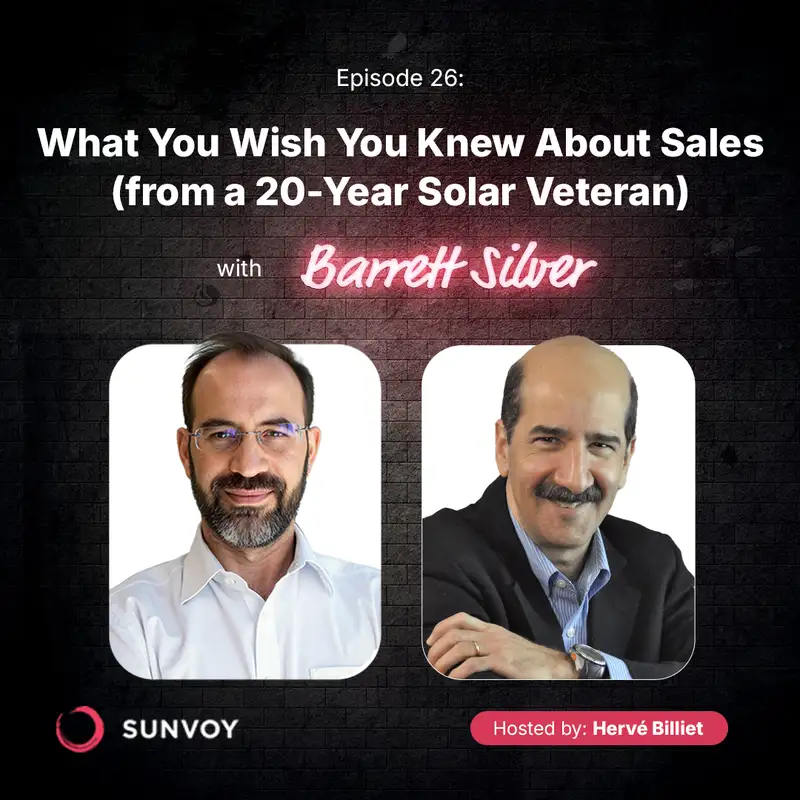
 Episode 26
· 28:59
Herve Billiet (00:00)
Hey everyone, welcome to another episode of What Solar Installers Need to Know, where we invite Barrett Silver. Hi Barrett!
Barrett Silver (00:07)
Hey everybody, thanks for having me.
Herve Billiet (00:08)
You are just starting your retirement. You are retired for two days and you're back in the solar industry helping others, giving advice about like the many years, I think 20 something years that you've been in the solar industry,
Barrett Silver (00:20)
it's hard to believe it's been 20 years, but I tell people I'm finally hanging the cape up.
Herve Billiet (00:25)
Your Superman cape. Well, you back here helping other installers with some piece of advice. And so for people that don't know you, you currently stopped working at Accord Solar and you had your own solar company too, Silver Solar.
Barrett Silver (00:40)
Silver Lining Solar,
I had my own company which was kind of...
a dream in a way, and at times a difficult dream because things are not as easy when you're having all the responsibility as you're wondering when someone else is the boss. But I actually loved having my own company and it was kind of a dream because I didn't really have to ⁓ second guess anything that I was doing. I knew from my experience in the industry, at that point having already
been, I guess, almost 15 year veteran. I'm close to it. You know, I had worked at other solar installation companies. I had also worked for some of the largest racking companies and solar panel manufacturing companies. So, you know, except for
⁓ never having worked at an inverter company. I pretty much knew the industry inside and out. And so it was, it was a great opportunity to do things my way and to do them from what I really thought was the right way in the sense that I was always trying to put myself in the shoes of the customer. Right.
How would I feel if I were them and somebody was trying to tell me what I was trying to tell them? And would it be credible? What questions would I have? Why would I wonder whether or not it was reliable? And I tried to answer all of those questions upfront so that, I've always said, and this is especially true,
in sales, but I think in life in general, our biggest responsibility is to accurately set expectations and then do our best to make sure that the expectations that we've set are met. And if you do that well,
you usually have success. You usually have happy customers and happy customers are the key to having a profitable business because especially now when everything gets amplified on social media and everywhere else on the internet, you know, have one grumpy unhappy customer and that ripples through the world in a way that's almost impossible to stop. sure.
Herve Billiet (02:50)
Yeah, but let's go back to the early days. So you were already
15 years in solar. So how did you started then Silver Lining Solar?
Barrett Silver (02:59)
Lucky in the sense that at the previous company, I had landed what I considered a marquee customer. You probably have heard of them, called Regeneron. And without getting into too much of the ugliness of the parting with the previous company, I'll just say that I landed a large project with Regeneron and
there was a falling out between me and my previous company over compensation. And so we parted ways. And to my surprise, Regeneron came back to me after I had left and said, hey, Barrett, you know, we would still really like to work with you. Is there an opportunity to do that?
And so, you know, having a customer like that who was willing to kind of give me a leg up the ladder really was the impetus for starting Silver Lining Solar.
Herve Billiet (03:50)
It's always a good way to start with an actual paying customer to start a business.
Barrett Silver (03:54)
It's amazing how it helps, right?
Herve Billiet (03:56)
Yeah,
I've never done anything else. Every business I start, always had a paying customer sometimes even before doing anything. It sounds great to me to invest a lot of money and then see if people want it or not. I know a lot of people do it. It's so risky. For Sunvoy too, we had a paying customer and then we started developing it.
But I digress. Back to your story. So you had a new customer. That's the beginning. And then how did you grow the company over time?
Barrett Silver (04:18)
You
So
I guess that ⁓ we were lucky in the sense that, and I think that, anybody who pretends to be, you know, self-made and all that stuff, I kind of poo-poo that because I think it always takes a little bit of luck. Yes, you have to know what you're doing. Yes, you have to treat your customers with respect and honesty. And yes, you have to do the things that you're telling them that you're going to do, but it also takes a bit of luck. And I think the luck that we had was the timing in the sense that I
had a financial partner who was willing to take some risk. This was at a time before not-for-profits could directly participate in the 30% federal investment tax credit for solar. So we were able to offer PPAs to not-for-profits
so that they could participate in solar because a lot of them were highly motivated. A lot of these were religious institutions. They knew that it was the right thing to do. They wanted to be environmentally forward thinking.
And so they were already predisposed to want solar, but they couldn't afford it. And they also couldn't monetize the ITC. So when we came along with a PPA product that allowed them to go solar to save money right up front without having to invest the upfront capital that they didn't have anyway, then it was kind of an easy sale. And what made it, think, especially easy for us was we had kind of a unique spin on the PPA. And I don't think that too many other
companies have done this or are doing it now or even are considering it. But the twist that we had that I think was compelling
was that a lot of people said, look, you know, we've seen these PPAs and when we do the math going forward, we see the two cost lines crossing. And what they meant by that was that there was a possibility that with escalators on PPA pricing, the cost that they were paying per kilowatt hour could actually in the out years be higher than what they paid if they hadn't done anything. And they were all scared by that. And I don't blame them...
Herve Billiet (06:20)
Yeah.
Barrett Silver (06:25)
because you can't pretend that that risk didn't exist. As it turns out, I don't think it was a great risk. I don't think it was as big a risk as maybe some of these people thought it might be. But what we did to alleviate that concern was we said, look, we'll write into the language of our PPAs that we'll participate if electric costs go down so that your PPA price will also go down.
So we were willing to sort of hedge the risk for them on both sides. If it goes up a lot more, we said, we'll bump up our rates a little bit too. But if the rates go down, we'll protect you so that you're never going to be upside down on your PPA. And people saw that and they said, there's no really downside here. Let's do it.
Herve Billiet (07:10)
Wow. Now, funny, you said that those religious institutions were an easy sale. I experienced the exact opposite. Let me explain to why. Those churches and other institutions, some popes also said that they had to go solar and so on. So there was a push to do that. They knew it was the right thing. They could save money. Not everybody could afford it. Like you said, they didn't have the capital. Some churches had, others didn't. So that's why we had also PPA solutions.
The biggest hurdle to selling to religious institutions is that it is a clear democracy and nobody wants to overrule and be a dictator. So you, you sell to a church, you do multiple meetings and presentations. You come in person, meet everybody in the church, but then there was usually at least one person like, well, wait a second, should we wait for solar panels to be more efficient? And then nobody there to say like, look, you want to have the latest and greatest iPhone. You'll be waiting forever because there's always a next one coming up.
And so nobody dared to overrule that just to make the project happen. And so I saw so many projects just not sold, just not going anywhere because of that.
Barrett Silver (08:10)
Absolutely, I
completely agree with what you're saying and I saw that happen multiple times and I think the way that we sort of went straight at that problem was by
not trying to pretend that it didn't exist because that was always going to fail, but by recognizing that it was to be expected. And the way to really go straight at that is to get an internal champion at the institution that knows all of the players and that can kind of map out what's to be expected before even the first meeting happens. And then when we get into that first meeting and someone raises those objections, then we hear them out and we listen to them.
And we don't say that that's wrong or absurd or never could happen. We recognize that that was possibility and that we wanted to understand what the main concern behind that was. Were they concerned that they were going to regret the purchase? Well, wasn't a purchase, right? Were they going to regret that they didn't get the greatest, the latest and the greatest?
You can't have a 20-year deal where you're always going to have the latest and the greatest. So once we would talk through all the objections, it would get to the point where people would kind of understand that, yeah, it's not going to be perfect. Maybe nothing's perfect, but it's OK.
Herve Billiet (09:15)
Mm-hmm.
Now I saw a of deals crash on that. guess I couldn't convince enough people like that. But we had one trick or a process in place. So just like you had that champion, without one champion in the church that knows everybody, it's really hard to get a thing done. But besides the champion, what we also saw is that several people said, I know a rich person in the church that's going to pay for everything. The first time you hear that, it's like, this is going to be great. We're going to have total projects.
But you hear this all the time. So once a person says that in the next church you go to is like, yeah, but of course you have like, would be strange if you didn't. But what we've done is we had like a memorandum of understanding, which was really one pager and they had to pay something. But that the money part was like kind of like completely negotiable. The amount didn't matter. What mattered is that
Barrett Silver (10:10)
system.
Herve Billiet (10:11)
Only certain people in the church could sign on behalf of the church. And it was hard to know because every green commission or association, they had an expert that could do certain things. But then once you ask them, can you pay a dollar for your church and sign on behalf of the church, that changed the dynamic. So by having an MOU that was just an empty document, like you'll be working with us and it's a dollar to get started. I mean, sometimes we made it more.
But what matter was just having somebody can sign. And then you find out if the person that's leading the charge should point of contact if they actually can sign.
Barrett Silver (10:37)
Mm-hmm.
great
a great point because you have to be dealing with people that have the authority to make decisions.
Herve Billiet (10:48)
Yes, that's one of the rules in sales, no matter what industry, solar or anything else. Yeah, I agree on that one.
So back to your company, you grew it. You found like a nice way of selling PPAs to also go down in price if the hedge is the beds there, hedge is the risk. So that's great. So you also did your own installation and maintenance or was it only project development?
Barrett Silver (11:12)
No, we did it all. I mean I subcontracted out the actual installation work. I obviously wasn't installing the panels myself, but I had enough reliable contacts in the industry at that point that I knew who I could trust that was giving me a fair deal. And we worked kind of, you know, pretty easily together because we had worked together at previous companies and we knew each other and it was a comfortable relationship. No one was to take advantage of anyone. We knew there would be more work coming and it was,
It was a good working relationship. But I do want to tell you one anecdote actually about how things kind of went really, I think, south in a way.
Herve Billiet (11:40)
a company. Yeah.
Barrett Silver (11:49)
Why I ended up eventually selling the company. So, I mean, it's kind of in the rear view mirror now, but at the time when I had Silver Lining Solar, at least at the end of it, was when the COVID pandemic was just beginning. And I was working, I remember one specific project that I was working on was a carport installation I was doing in New Jersey. And when the pandemic began,
Herve Billiet (12:02)
Mm-hmm.
Mm-hmm.
Barrett Silver (12:13)
⁓ we figured we'd be okay because we were working outside and, we weren't really around anyone else, you know, it was in this kind of isolated area on a parking lot. And then the next thing we knew, the governor of New Jersey halted all construction. And we kind of got stuck in a really awkward spot because we had equipment that had already been delivered.
I was basically on the clock with my crew because the client had to, this was for a restaurant that was seasonal and they had to have their parking lot back by the end of the spring because they were going to start up the restaurant business again. And we had our equipment all over their parking lot. It was completely unusable. So the client was literally screaming at me to continue construction.
And we had this statewide ban on construction because of pandemic. So I didn't know what to do.
You know, I wanted to keep going because every day that I wasn't working it was costing me lots of dollars and yet when I spoke with my insurance agent, they told me that if God forbid we had had an accident while working during a construction ban that had been put up by the governor of the state, they would not cover us.
Okay. So imagine that situation where you're losing money every day. Your insurance agent is telling you, if you go back to work, you're not covered. You got a screaming client and, I had to push back and I had to say to them, look, this is costing me more money than it's going to be costing you.
But it's the wrong thing to do. It's illegal and it's incredibly dangerous because if God forbid anyone gets hurt or falls or even just nicks their hand, I am not covered by my insurance because there is a statewide ban on construction right now. So there were literally nights when I...
could not sleep and I am a world champion sleeper. Anyone who knows me can tell you I could sleep nine, 10 hours, no problem. And I was just a wreck because there was so much pressure on me to keep going and losing money every day.
And it's kind of thing where you don't anticipate that when you own your own company, but it's the of thing that you're responsible for that nobody really can prepare you for. Because here we were in uncharted areas with a pandemic and all kinds of craziness going on. But that was part of the reason why I finally said, it's enough. I can't take it anymore.
Herve Billiet (14:39)
So if you take some shortcuts, are you saying that running a solar company is stressful and telling the company was a way to relieve you of that stress?
Barrett Silver (14:48)
Well, certainly was during the pandemic. I mean, there's always risks involved with any.
But obviously in solar industry, you literally have your installers lives at risks. You know, they're working at height in many cases. There's always safety concerns. There's always pressures. Even then, I think the installers feel that are not coming from the company to cut corners when they shouldn't be so that they'll look like they're the most efficient. And that can lead to mistakes and
and accidents and nobody wants that. I mean everybody probably has already heard about, you know, an accident that happened not that many months ago here in New York where a solar panel fell off of a carport and actually killed a woman. it was my...
Herve Billiet (15:33)
know.
Barrett Silver (15:33)
fear for many years that that could happen and it was kind of a nightmare scenario and then just a few months ago it actually happened. And so you know it's a kind of thing where if you take your responsibility seriously, you have to realize that lives are at risk and no solar installation is worth that.
So you always have to be constantly focused on how are we doing this? Is it the safe way? Can we instill a mindset that will encourage people to do that the way it should be done, even if it costs us a few more dollars? Nobody likes that, but it's the right way to do it. And you can't ignore it. You can't avoid it.
Herve Billiet (16:12)
And I relate to that very much. yeah, I sold my solo company in part also because it was very, very stressful. The amount of stress once I sold it, it took me months, but my wife, that's told me like you're a different man. takes a toll on you. But you also grow with it, right?
Barrett Silver (16:29)
You you sign personal lines, and it's a lot of stress. It really is. You don't want to lose your home because somebody, you know, makes a big mistake.
Herve Billiet (16:37)
Yeah, I'm to go back to when COVID hit. I remember I was running the company and we had a B-Corp developer that we were going to install on a religious building for them. COVID hit and I looked in the contract and it was like exceptions for Acts of God and the pandemic. I probably wasn't really in it. But
you know, obviously it wasn't from our making and putting our own people at risk wasn't possible either. So I had to make a decision to furlough, like close the business for a while. And I remember talking, I talked to a lot of our ongoing projects and it was one call I had to make and that was a call I feel the best about it. It's a B Corp, it's for religious building. Obviously they're gonna tell me that it's gonna be fine that I shut down for a while and I will be back when it's over.
Interestingly, it was the only one of my customers that was actually angry and wanted me to continue. He's like, that was strange. So unexpected.
Barrett Silver (17:32)
You can expect
it, but that's sometimes the way it goes.
Herve Billiet (17:35)
Yeah. And I said, I'm not doing it. And I lost a contract. They asked somebody else to go do it. And I think it was still the right decision at a time with the information at that time. In hindsight, with the information I had at a time, I would still make the same decision, not put my people at risk unnecessarily, especially, you know, the church can have solar just a few months or weeks later.
Barrett Silver (17:54)
Exactly. Right.
Herve Billiet (17:56)
All right, well, let's go back then how you actually sold it. Was it like a lot of contracting involved, a lot of different parties? Was it sold to somebody that you're more familiar with? It was like an easy transaction or was it like months of financial analysis? Like, how did it go for you?
Barrett Silver (18:12)
You know, it really isn't any of those things. So it's hard for me to describe, but I guess I would encapsulate it this way. I would say that, I knew, at least one guy who I trusted, who could help me financially analyze the business in a realistic way. And
he gave me kind of a target number for what the business, what he thought the business could sell for, what he thought it was worth. And I used that as not really just a starting point, but really a solid basis for how I went to market the company.
And, I felt pretty strongly that, you know, it was, not a huge company. It was a small company, but it had a strong reputation to good work. It had happy customers. So it had value and had a good website, I thought. And so it was, it was worth the
money that I was asking for it. And my first preference was to sell to someone that I knew, someone that could continue the business and pick it up and run with it profitably. And I was fortunate enough that, one of my
installers ended up buying the business from me. And it didn't work out as smoothly as I make it sound. It took a long time for the final payments to be made, longer than was originally agreed upon. We worked through it and we did get everything finally solidified in a way that satisfied both parties.
Herve Billiet (19:35)
All right. You worked for several different companies, sales and marketing related or business development. What are some lessons that you've learned in the solar industry that things that work well or things that you say like, don't try that. I tried it. It always failed. Any lessons in marketing and sales in general?
Barrett Silver (19:53)
Well, you you're not going to want to hear this. And I don't think that anyone that hears this podcast is going to like this. But I'm finally, you know, at a point at the end of my career where I can, I can say it directly, which is that I think that a lot of the ways that sales managers go about motivating their sales teams is bullshit.
Herve Billiet (19:59)
Go for it.
Barrett Silver (20:14)
And one of the things that I always railed against was these inflated quotas. You know, the idea being that if you set these high goals for people, you'll get them to stretch out of their comfort zone and perform even better than they had themselves believed that they were capable of.
And you know what? That's never been my approach. I think it's always been kind of the approach of sales leaders who motivate through fear. And my approach was always the other way around. I wanted to be sympathetic to my sales team members and empathetic to my customers. I wanted to treat them like
they would have treated me if we were doing a deal together. And so my approach was always more of a mentoring approach, try and figure out where they were uncomfortable in the process and role play with them so that we could get questions in front of them in a way that they become comfortable dealing either with objections or with questions where they probably should have known the answers that they maybe weren't that experienced and needed a little tutoring or, you know,
that kind of thing. And I found that to be a much better way of going about it. Maybe it wasn't the instantaneous explosion in sales numbers that some people pretend that they get the other way, but it was a longer, more steady approach that built upon success. And I always just felt more comfortable with it because it's more my personality.
Herve Billiet (21:43)
You said at Silver Lining you had one major client that kind of got things started. How else did you find those next clients and the next closing, next sales? Like how did you fill up the pipeline of leads and was it relationships that kind of took a role or like how did you manage that?
Barrett Silver (22:03)
Yeah, so.
At the beginning when we started to do these PPAs, I really have to give credit to my financial partner because he had the relationships at some of these religious institutions. And that really was what started the snowball rolling. Because once we had done one or two, they all, you know, it's a very tight-knit community. They start speaking among themselves. And it's really just then word of mouth more than it is this
enormous marketing machine that overwhelms with just numbers. It's really kind of thing where people talk, they hear good things, and they look into it and then they give you a call.
Herve Billiet (22:40)
Now you worked in marketing at VP of Sales and Marketing at Sun Ray, at SunBlue Energy. So you've had several of those marketing related positions. Any advice or things that you wish you could try in the near future if you were still working in solar? What's one lesson that you can give others about marketing?
Barrett Silver (22:58)
with just a, you're not supposed to do this, but I'll start with a complaint. So the complaint is that I think people have come to hate email marketing. People are bombarded by too much spam.
And so that channel, which could have been, I think, a successful channel for a lot of solar companies, has, I think, unfortunately been polluted. And so it's really difficult to kind of make cold outreach that way. I think that, unless you really want to invest lots of time and money into that in the hopes of throwing a really wide net, I would not
recommend that. I think rather there is still a place even in today's world where everything seems to be online for a personal approach and what I think seems to still work is you know networking through these business groups. There are a lot of local business
groups that are kind of modeled on
the local chamber of commerce kind of old fashioned model. I know that sounds outdated, but you get to talk with people, especially in CNI in other industries, other companies that are building owners that have an understanding of how high their expenses are. And once you start actually talking with people and you know, they're willing to help you because you're willing to help them. It's kind of a, you know, mutual aid society in a way.
I think that you can make some real inroads there, especially if you do good work. I used to say, and I still think this is true, we live in a post-sales society. What I mean by that is that not that there isn't a place for salespeople, there is a place for salespeople, but not in the old-fashioned way where you can just walk into a room,
and win someone over on a big smile and charm and a lot of bullshit. People do their research.
If they have questions, they're going to go online first. They're going to try and find out what they can on their own without having anyone pressure them into buying anything. So you have to respect that. And one of the things that helps that is if you put out a lot of free information online on your company's website, if you're perceived as an industry expert,
then you have a leg up because now you're telling people the ins and outs, the good and the bad, the positives and the negatives, and you're being straight with them and you're addressing what are going to be objections anyway.
Right? So why not start that conversation ahead of time? So that by the time somebody either picks up the phone or emails you, they're already predisposed to trust you because you've given them the real story.
Herve Billiet (25:43)
That's some really good advice in marketing, becoming experts by creating good content. You're talking about B2B, right? But also works B2C is like, if you have a customer asking you a question and you hear the same question two or three times, just write a blog post about it. Stop answering every single time that email or that question via phone. Just say like, I have a good article about this. Let me send it to you. Increases traffic to your page.
Reduces your workload because you don't have to repeat yourself all the time. Yeah, that's a very good model.
Barrett Silver (26:14)
And let me just tag
onto that because I think that's great advice. And I think there is a risk there too that needs to be addressed. Some people take that advice and they get lazy, right? Instead of actually treating the question as though it came from a real person who's a potential client, they just get lazy and they just say, here's the blog post on that. Why don't you read it?
Herve Billiet (26:31)
Mm-hmm.
Barrett Silver (26:36)
Not really sufficient, right? You want to at least go half the way to addressing the question right up front and then say here are the details that back up my answer.
Herve Billiet (26:46)
No, that's true. Yes. Yeah, you don't want to tell a person: "Oh, you have a question going my blog." No, I agree.
Barrett Silver (26:50)
Right. I mean, it's
easy, but it's lazy. It's not really what people want to get, you know, instant gratification these days. And if you can go at least half the way to answering their question, you know, by saying, yes, and here's why or yes, but that's usually the hook that will get them to follow up with the rest of the answer.
Herve Billiet (27:09)
Yeah, I totally agree. So what I expect is like you explain some of the answer as like here's the full answer. I'll send it to you so that they have that to read.
Barrett Silver (27:18)
Right, but
with enough meat on your response so that they feel that they've been heard and that they know what's going on.
Herve Billiet (27:26)
Absolutely. Barrett, I want to thank you for this nice conversation. Also want to thank you for 20 years of service in the solar industry. You're retiring now for two days. So thank you very much for being willing to speak more about solar even in your retirement. Thanks, Barrett.
Barrett Silver (27:40)
Wow,
it's my pleasure. Thank you so much for the opportunity. I'm a big fan of Sunvoy, I love what you guys are doing. I wouldn't just say that if I didn't believe it. So I wish you the best of luck. Great, thank you.
Herve Billiet (27:51)
Thanks, Barret.
Listen to What Solar Installers Need To Know (by Sunvoy) using one of many popular podcasting apps or directories.
