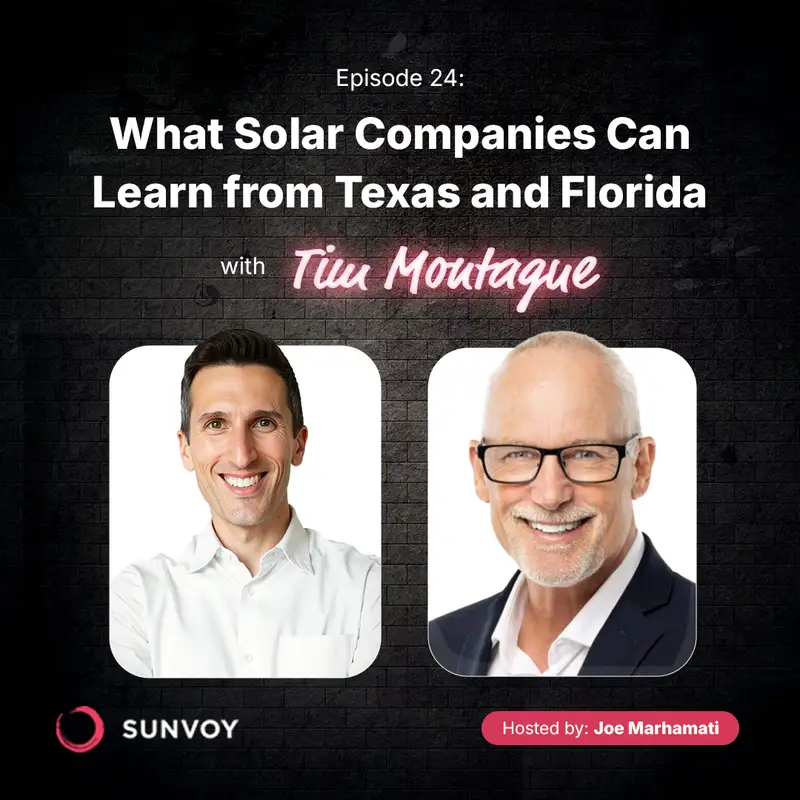
 Episode 24
· 45:09
Joe Marhamati (00:00)
Hey everybody, welcome to today's installment of What Solar Installers Need to Know, brought to you by Sunvoy. Today I have Tim Montague, who is a Solar Business Coach and Consultant, an AI forward, a solar business coach and consultant and the host of the Clean Power Hour and founder of Clean Power Consulting Group. Welcome Tim.
Tim Montague (00:20)
I just had a thought that maybe you should interview my avatar instead of me, Joe. My avatar might be in a better mood. It's good to be here, Joe. I really appreciate the opportunity.
Joe Marhamati (00:30)
man, I thought that you were the avatar. All right, sorry, I got mixed up. No, okay, it's the real Tim. Yeah, yeah, I'm still training my super intelligent avatar. He's coming out in a few months. Well, you know, there's few people in the solar industry, I can honestly say, who know more about what solar installers need to know than you because you talk to so many installers, both rooftop installers,
Tim Montague (00:33)
I'm just him. Sorry. I tried to bring super intelligent Tim, but I couldn't find him today.
Joe Marhamati (00:56)
you know, utility scale developers and you've been in a game yourself. So tell folks how you got into the industry and the types of folks that you're talking to and helping today.
Tim Montague (01:06)
Thanks, Joe. Yeah. Solar was a homecoming for me in 2016. I should have gotten into solar right out of college. You know, honestly, Joe, but I didn't. I was distracted. I had too many interests. I became a biologist and then I became a social worker and then I became a recruiter and that was my entree to business. I should have been an MBA, but I was a forest ecologist. I love
three things, I love humanity, I love technology and I love sustainability. And so when the opportunity arose in 2016 to get into solar, I dove in with both feet. I didn't even know we were about to get FEJA, the Future Energy Jobs Act in Illinois, which is landmark legislation as you know, and really rocked the world here in Illinois. We had a RPS since 08, but our RPS was broken.
And so not a lot of solar was happening, like very small amounts of solar. They would release like a small amount of wrecks and then they would dry up. Now we have these programs, FEJA. then CEJA. Now we just got this big omnibus energy bill, which even gives it more life. So we have a lot of wind at our back in Illinois. Thank God, Joe, because the federal government is putting the squeeze on solar. And so it's kind of gnarly.
Joe Marhamati (02:25)
What do you see in out there? You're closer to some of this. I I talked to lot of installers, but I also see headlines about modules being held up at the port and solar factories being furloughing their workers. And then, know, obviously change in regulations and tariffs. How bad is it out there and what are you looking for in 2026?
Tim Montague (02:46)
Well,
let's just say it like it is. Mr. Trump likes chaos. He likes to cause pain and turmoil. And he is causing a lot of turmoil for the solar industry in particular. He's causing turmoil in a lot of industries, not just solar. He's putting the fear in immigrants. And we are a country of immigrants, Joe. You and I stand on the shoulders of our forefathers who immigrated from somewhere else to America.
And even the Native Americans came from somewhere else. Like humans didn't evolve in North America. They evolved in Africa. For goodness sake, we're all from somewhere else. Why are we in denial of this? I don't know. But brass tacks for the solar industry, we're going through what's called a major contraction. There's lots of mergers and acquisitions happening. There's lots of blood in the water. We will come out of this stronger. So hang in there, solar professionals.
It's a rough ride right now. Residential solar is going off a cliff at the end of 2025, right? Because of the ITC going away for Resi solar. We have a little more runway in CNI until 2027. The ITC is extended on batteries. Thank you, God, because we need lots of batteries. We need six terawatt hours of battery storage on the grid in order to green the grid, Joe. That's a lot of batteries, and grid operators
really like batteries. But and you know, it can totally work. John and I just reported on a story in Abu Dhabi where they're installing a five gigawatt solar farm and a 19 gigawatt hour battery farm that will power a city of millions of people 24 seven with just those two technologies. know, Abu Dhabi is a super sunny, consistently sunny place.
It's in the Middle East, it's in North Africa. But truly we have the technology and the federal administration has decided that we're going to go back to the dark ages and put wind at the back of fossil fuels and nuclear, both of which are strategically very poor decisions. Fossil fuels are bad for human health. They're bad for the climate, right? We put a trillion tons of carbon in the atmosphere.
And that is going to really hurt my children and my children's children and every generation for many generations forward because we didn't have the foresight to go, wait a minute, maybe we should reconsider this. This doesn't look like a good idea. We're not very good at long-term thinking and we could talk about that. That's one of our biggest problems. And I'm also of the opinion that Trump is just like a symptom. He's not necessarily the cause. There's a bigger
force at work in America. And it's not easy to see that with any clarity. But anyway, lots of turmoil, lots of contraction, lots of batteries. That's the good news. Installers are doing more battery storage. I just came back from Tennessee. Okay. In Nashville, they had the meeting in Nashville. They moved the meeting around every year. This is the TVA, Tennessee Valley Authority, which is a federal ISO.
It is a very unique ISO as far it's different than all the other ISOs in the country. And this is an emerging market for solar. And so what it means is those installers who have been around a long time are beasts. They really know how to sell solar. And now they're selling batteries. 100% of their projects have battery attachment. And you can't say that about very many markets in America, Joe, can you?
100% battery attachment rate.
Joe Marhamati (06:26)
No?
That's amazing. Well, and what's California at now? Because obviously since NEM3, I think the vast majority of systems have been with storage, right?
Tim Montague (06:35)
Yeah, I think the attachment rate in California is about 80%. And M3.0 did cause it to go way up. that's, you know, As I say on the Clean Power Hour, if you want to see the future, go to Northern Europe, go to Australia, go to China. You don't have net metering. Net metering is not necessary to have a robust solar and battery industry. You have to have batteries. You have to have batteries.
Joe Marhamati (06:39)
That's amazing.
Tim Montague (07:05)
And they're like peanut butter and jelly, solar and batteries, right? Because solar is intermittent. We have to acknowledge this. It only works when the sun is shining. The sun is super abundant. We have 10,000 times more photons than we actually need to power all of society. So it is actually an easy problem to solve, technically, in terms of powering society with renewable energy. It's a no-brainer. But you need batteries.
Joe Marhamati (07:30)
You think things might have turned out differently for us if we didn't have sort of the crutch of the ITC, and one-to-one net metering for as long as we did? When you look at these other countries, it sort of went straight into solar and storage, or do you think that they teared off the technological progress of the United States to be able to do that?
Tim Montague (07:48)
That's a tricky question. I don't know the answer, okay? We can't change the past. The IRA, the Inflation Reduction Act, that we were enjoying until this year when Mr. Trump destroyed it, did create some really good incentives. It caused on-shoring and reshoring
of manufacturing of some things like solar panels, like batteries, like EV charging infrastructure, like EV cars. And now a lot of that is on ice. And I think we as a continent sized country really want to have onshore manufacturing because as we saw during COVID, when supply chains get janky, that really is painful for the economy. It creates a logjam and you can't get stuff built.
And China is now building electric infrastructure almost 10 times faster than we are in the United States. And as we see, compute is the limiting factor for the AI economy, and electricity is a limiting factor for compute. These gigawatt scale, so-called hyper scale AI facilities need lots of electricity
Joe Marhamati (08:54)
Mm-hmm.
Tim Montague (09:05)
are going to double and then triple and probably quadruple the amount of electricity we use in America. But How quickly can we build it? We have created a system, the grid FERC, the ISOs, which is very good at a 99.9 grid, right? We have an amazing grid. It's very reliable, but it doesn't change with the times very fast.
And it's not keeping up with technology. And so we are now in a position where the grid is a national security threat. And I don't like that. Even though I have nothing against China, and I don't know that I want America to continue to be the superpower, like right now we are the preeminent superpower on earth, and these things have a tendency to change. Like you don't remain the superpower forever. So we're a superpower in decline.
That's not a judgment. That's just an analysis that many people smarter than me have made. And the question is, what's next? And it could be China. So anyway, we need more grid electricity, and that is a national security issue and a human health issue because we need to clean the grid at the same time. And we have to suck out that trillion tons of carbon because cleaning the grid doesn't suck the carbon out of the atmosphere, Joe. Unfortunately, solar panels are not air cleaners.
Joe Marhamati (10:29)
Yeah, hopefully somebody's working on that. In the meantime, you you're kind of hinted at this, but the electricity prices across the United States are skyrocketing well beyond inflation. I've actually heard some installers say they're less worried about the ITC going away now than they were six months ago because of how fast utility rates are increasing. Do you think that that could be enough of a mid again in the next two, three years?
that a lot of these companies that might have been afraid of whether they're going to be in business or not could just ride on or piggyback on the utilities, kind of giving us a gift of massively increased utility rates.
Tim Montague (11:08)
Yeah, this is a very good point. I'm really glad you brought this up. And this is one of the weird things about the AI economy. The AI data center build out is one of the factors that is driving up electricity prices because electricity has become scarcer. And in a market economy like the US, that means the price goes up. this is This is painful for consumers. Jigar Shah said on my show recently, you know,
20% of Americans can't afford their power bill. And it's okay for middle class and upper middle class Americans when you have a 20% or 30% increase. Some markets have seen more. But for low income Americans, this is very, very uncomfortable. And we see what's going on with the shutdown and the SNAP benefits, right? 20% of our population is food insecure. We're in denial of this.
It is not a stable scenario. Like we can't have this huge poor population and expect society to function normally. It is a drag on society. These people have more health problems. They have more social problems. There's more drug abuse. There's more crime, et cetera, et cetera, et cetera, because they're just, they're desperate. And now we're just making that worse. So,
this is good for the solar industry in a way, Joe, as you said, because the more expensive electricity gets, the more lucrative it is to install and embrace solar and batteries. That helps the ROI. It shortens the payback period. So that's why solar emerged first in California and on the East Coast in places like New York State and New Jersey, places that have very high energy costs. Here in the Midwest, I have grid power for four cents in some places.
Three cents, crazy cheap coal, crazy cheap coal power. Now that's changing too for everybody still. And so now the middle of the country is getting the solar coaster, getting the wave and we're catching up. Like Illinois is now a top five solar state thanks to legislation. You've got to have good legislation. It doesn't just happen. And every market is different though. Urquhart is the
Joe Marhamati (13:16)
Hmm.
Tim Montague (13:19)
number 1 solar market now on a volume basis. They installed like 10 gigawatts of solar in 2024, That's nuts. We're gonna do 10 gigawatts of for lucky in Illinois in 10 years, not one year. That's how big the Texas market is. That's mostly utility. There is a robust resi, mostly around resiliency, right? Solar batteries and backup generators. it's a both and. All the installers I talked to in Texas, and I'm talking to a lot of installers in Texas because it is such a vibrant market
are doing a lot of batteries.
Joe Marhamati (13:48)
What can we learn from Texas and I Florida as well put in some solar approval permitting legislation. Is there anything particularly in Texas that we can learn to increase adoption of solar across the country?
Tim Montague (14:01)
I'm a little torn in markets like Texas and Tennessee for that matter. What you see is the installers focus on a almost exclusively on a higher net worth, higher income population that can afford a $60,000 or $100,000 solar and battery system. And that's great. We want everyone to have solar and batteries. So you
also then need programs like third party ownership. I'll think of it in a second. But there's a company in Texas that is installing VPPs, virtual power plants using batteries. They have designed a battery that is the size and shape of an air conditioner. It's a cube and they install it outside your home next to your air conditioner. And then you have and what And the consumer leases the device from the
company and then they provide resiliency in the case of a grid outage and they provide, you know, they provide services which save the consumer money. Okay. They, The battery absorbs cheap power from the grid and it discharges power to the home when electricity is expensive. Electricity prices fluctuate during the day and during the month, right?
As the weather changes and as the supply and demand goes up and down. And so this is a new market and it is accessible to everyday consumers. And so that's what I love. Now, they're not in every market. They're in Texas. And I got to look this up, but that is a great innovation. So we want it to be equitable, Joe. We want the transition to happen. We want it to be as equitable as possible. Wealthy consumers will own the system. Low income consumers will lease the system.
And then we can green the together.
Joe Marhamati (15:51)
So you mentioned TPO. One thing I'm hopeful about, I want to call it prediction, but I'm at least hopeful about is that there will be a broader adoption of third party ownership of solar systems, particularly behind the meter rooftop systems, particularly residential rooftop systems. And I think that could open up the market for potentially tens of millions of homeowners that were previously locked out because those types of innovative financing models didn't exist or were as pervasive. It's mostly been a cash
and loans to high credit worthy residential customers market for the first 10, 20 years of the solar industry. Do you think that there's the potential, somewhat ironically, that with all the change in regulation and subsidies, that we could see more solar on more homes because TPO becomes the default way of going solar?
Tim Montague (16:39)
It's entirely possible. And for sure, this is another major trend, right? In the residential space, especially in 2026, we're going to see TPO go through the roof. Okay. Because those, those owners, those asset owners can use the ITC still. And so they're motivated to install projects and yeah, then it becomes energy as a service like
We already have grid power, that's energy as a service. And now we're just making it more nuanced. We're gonna have solar batteries, panels. It's all of those things, right? And by the way, I found the company, it's called Base Power. Check them out, basepowercompany.com. Are you familiar, Joe?
Joe Marhamati (17:25)
haven't heard the name, but I haven't investigated too much.
Tim Montague (17:28)
Yeah, colleague of mine in California tipped me off to this company and I just love this business model and they have a great photo right on their landing page of this box. It looks like an air conditioner, literally. And I'm like, this is awesome. And I think they pay for the necessary upgrade to the service to the building if need be. Because that's another question, right? Is the pipe big enough that comes to the home to...
manage all this juice that's potentially flowing in and out because it is an out also. It's a two way. The home is becoming more of a two way street, right? The home was just a load on the grid and now it's also a source of power when you have a battery on site or a solar ray, right? A solar ray alone can spin your meter backwards in the middle of the summer if it's designed to offset 100% of your load, right? Every installer should know this if they don't, shame on them.
If you're going to offset 100 % of the load, it's spinning in the middle of the summer, your meter backwards, and you're maybe getting some credit, which we call net metering. And what we're saying is that's going away, people. Okay. You may be lucky. We still have net metering in Illinois. It's stepping down, but we still have it. but the battery, you can think of the battery as just chopping off that extra part of the, of the curve, right?
It absorbs that energy and then it monetizes that energy, reduces your power bill or your demand charges and provides things like frequency regulation or grid ancillary services is the geeky term for that. The battery can provide ancillary services to the grid and it's a win win. The grid becomes more stable. And is it's it's more like an intelligent machine right now. It's a machine, but it's not that intelligent. And then we are in this
greening of the grid. en masse.
Joe Marhamati (19:18)
Yeah, it's super interesting. I'm seeing a lot of change in business models too. Like, you know, when I started a solar business almost 10 years ago now, it really was kind of solar only. And then a few years later, storage became more mainstream and then EV charging, greater EV adoption. And now, you know, there's HVAC, a lot of solar companies are doing it in mini splits, whole home electrification. A lot of them are doing roofing.
And I was talking with a colleague the other day and he was asking if I could do it again, how would I get into the solar industry if I starting a business? And I don't think I would start a solar company with solar in the name. I think I would start with the gateway drugs, which is like consumption monitor, which is so cheap that most people have absolutely no idea what is consuming what in the home and have that kind of be a foray to all the other smart
home electrification and renewable energies kind of cherry on the top. What are you seeing happening in terms of how businesses are changing, how new entrants are coming into the market and how existing businesses are changing what's on their menu?
Tim Montague (20:23)
And just to remind our listeners, when solar really started back in the 90s, it was mostly off grid. And so there were batteries in the picture. They were lead acid batteries. OK. And then the and then And then the batteries kind of went away because the solar panels became affordable. And then they and that was the modern era of of solar's going mainstream. And and now we've come full circle where batteries are, you know, just
Joe Marhamati (20:35)
That's right.
Tim Montague (20:49)
becoming the norm. An installer named LightWave in Tennessee told me, Tim, in two years, we're battery first. It's battery plus solar, maybe. And truly, like base power shows you, right? They don't care about solar. It's OK to have solar to charge the battery or feed the home. That's fine. But you can just install a battery today. And if you want resiliency, a battery is way more useful
Joe Marhamati (20:57)
Mm-hmm. Right.
Tim Montague (21:16)
than a solar array. Now there are limits, of course, right? Because when the grid goes down, then that battery starts draining. And if you don't have a generator like a solar array to feed the battery, to recharge the battery, then you're SOL. So it is truly the peanut butter jelly. We have to remember this. You want the generator and the battery. But I guess as far as business models, yeah, you put your finger on this trend of diversification.
Joe Marhamati (21:31)
Right.
Tim Montague (21:44)
Like there was a wave of solar companies that were solar installers first and foremost. Now what we see basically is an integration emerging of roofing, HVAC envelope, energy efficiency and solar. And so I love saying energy solutions in some format, right? You're an energy company.
And you might also do HVAC. You might do roofing. It's all about the build, you know, the building and now micro grids. that's, guess, the other big trend that we really want to put a pin in. Check out E.L.M. micro grids out of Dallas, Texas. They were at this conference in Tennessee. They're doing C&I and utility storage. They were in the Rizzi storage space. They're exiting that space. I'm not sure why. I'm going to bring
I'm going to bring their CEO on the show here in the coming weeks. But but that's I think micro grids. And then I gave a short talk on community scale micro grids. You know, you see people like A.J. Perkins, who I had on the show recently, who's doing these large scale residential developments with third party ownership of solar and batteries in Hawaii, providing low income residents that resiliency that you get. And then
They're they have a big battery like we're talking a 40 megawatt hour battery broken into many little parts called residential batteries, right? Residential batteries like 10 kwh to 60 kwh if it's like really robust for off grid. A standard off grid home might need a 30 kwh battery and a, you know, 5 to 10 kwh solar array.
But microgrids are really the business and it's a minor change. You need that smart switch, right, that knows when there's no grid power, it isolates and then you have a microgrid and then you load shed when you're in off-grid mode because you don't necessarily wanna power all these power hungry things like HVAC. You might just power the fridge and the lighting and the internet so that you have a good life. You're not just camping in the shell of your home in the dark with no.
no HVAC, no light, no refrigeration, but that's the future is both microgrids at the building level and then at the community level.
Joe Marhamati (24:10)
Yeah, you sent me something a few days ago that I've been thinking about over the last week, which is a survey from Home Analytics. They talked to installers and asked them what's on their minds. And the last slide of that survey, it said pretty overwhelmingly, the number one thing that's on their mind for 2026 is operational efficiency in terms of bringing the price down and making sure they remain competitive and that solar systems pencil out for most homeowners. And when I first saw that,
I thought, operational efficiency, that means the warehouse and the installations and kind of like the meet of the project development. And then the more I thought about it, it kind of can apply to every aspect of the business, right? There's a certain operational efficiency in the sales and marketing, just literally bringing down the cost of a position for the sales and marketing side of the business. There's efficiency in the operations and the procurement, in the design, in every facet of the business.
So how did you interpret that? And what are you hearing from your clients and installers who you're talking to?
Tim Montague (25:13)
There's two sides of this operational efficiency thing. There's the company itself and how efficient that machine is. A company is a group of people that are on a mission, let's say to install solar and batteries, right? And you can of course work on making that machine work much more efficiently with tools like artificial intelligence. I'm now a certified AI consultant because
I am a tech stack consultant historically. I help solar installers integrate the tools and technologies they need to become a large CNI solar installer. But there's also this bigger context of the soft cost of solar and the system that we've built in the US, right? In Australia, you can...
you can sign on the dotted line as a residential customer, right? And then get a solar array or solar battery installed within a week. In the US, you're lucky if it's within a month or two months. And so permitting needs to become much more efficient. If you have to have a project manager back and forth with the AHJ 10 times about the permit, that's a lot of cost and friction, right?
and we need to reduce our soft costs. In Australia, solar is one half to one third the cost installed as it is in the US and the same in Germany. And we are very proud, Joe, of, you know, we are such a great country. We're so tech forward. We created so many cool technologies. The internet, you know, Google, Facebook.
Amazon, you name it, right? And it's true. We are an amazing innovation machine, but we haven't done everything right. We have a lot to learn from our cousins across the pond and in Australia and in China. You know, if you want to see the future, like I haven't been yet, but I pay attention to people that have been to China. And that is an amazing tech forward country in certain places. It's a both it's a both end, right?
They also have a very rural, poor economy, agrarian. It's that dynamic and that juxtaposition is intense. And I choose to live here. I still think America is a great place to live. And even after we're not a superpower anymore, Joe, it's still going to be potentially a great place. It's the transition that concerns me, how you get from A to B. Think of Great Britain when it was a global superpower versus today.
It's no longer a superpower, but it's still a good place to live. It still has a high quality of life. And I wouldn't hesitate to live in the UK and hopefully we can get there. We just have to be more innovative about reducing soft costs. So back to that conversation. Yeah. Efficiency really matters. There's a lot of fat we can trim both internally, but also in the greater context. And that's why we need the solar app and the DOE that
built the solar app in collaboration with industry stakeholders. And it's not perfect. I work with an installer down in Houston that's, you know, trying to use the solar app. And as soon as there's batteries in the picture, gets, it gets janky. So we, we, we have a long way to go, but just know that it can get better. And yeah, I'm not, I'm not surprised at all by that survey result because that's something that they can control, making their company more efficient,
and being more competitive, right? They can't control the incentives necessarily. I mean, they can be active and I would encourage all of our listeners also to be active in your local trade association. know, The Illinois Solar and Storage Association is my association here in Illinois or SEIA, our national association, Solar Energy Industries Association. But for the most part, you can only control so much.
Joe Marhamati (29:08)
Yeah, you know, it's funny, I was in the UK a few weeks ago for a Solar and Storage Live event and it was fascinating because I had never been there for a solar conference. So everything was the same as though I was at InterSolar or RE+, but I didn't know anybody. So was like I was starting from zero in a parallel universe where everyone was like, oh yeah, we install solar in two weeks. And you hear about this stuff and then you actually meet people who are doing it. And you're like, my God, the amount of stress that I would have saved.
If I had started a business, a solar business in the UK, which two weeks versus, you know, when we were doing it years ago, was three to six months in the Washington DC area where it's particularly complicated and bureaucratic. So you're right. is, there's a certain irony in America being probably the most innovative country in the history of the world. And yet I'm not even sure. we have 18,000 AHJs or 40,000? I've heard both depending on how you count the Hamlets. But, you know, I got to talk to the solar app CEO,
and RE+ is so impressed with what they're doing. think Maryland even passed a law requiring solar app in all of its jurisdictions. And that seems to me to be the number one way that we can kind of uniform the permit approval process. But I worked in jurisdictions in Virginia where they were proud of the fact that it took them two years to approve a solar permit. They thought that was a badge of honor that they required 10 revisions at $500 a pop.
Tim Montague (30:27)
Oi. Oi.
Joe Marhamati (30:34)
I don't know if it's changing, should probably still that way. But that's hard to overcome.
Tim Montague (30:38)
And just to,
I wanted to riff a little bit on this thing about what's possible. know, Think about World War II. We converted car factories to airplane and bomb factories. And we did that in a very short period of time, right? We pivoted. When we got into the war, we were serious about stopping the Nazis and we did it. And we threw everything we had at it, right?
We put women to work in the factories. Women were stay-at-home mothers for a large part, except for teaching and healthcare, right? They were not a major part of the economy. And we said, okay, it's all hands on deck, we're going. And we started building ships and tanks and planes in incredible velocity. It just boggles the mind. yeah, the federal government took charge and it took control of certain assets, factories, and it said, look,
Mr. Ford, here's the deal. You can't be making cars. You need to make airplanes and bombs and tanks, right? And it worked. So we need a little more of a good top down. I'm all for the bottom up, but we need better industrial policy to see the innovation that we see really works. And it is a national security issue.
Electricity is the new oil and photons can power that machine. We know it. It's physical fact. There's no greenwashing here, Joe. It's not a green scam. I do use a green screen, but it's not a green scam at all.
Joe Marhamati (32:17)
Hey, let's talk a little bit about the AI certification that you got. I'm super curious about what you're advising solar installers to do in their tech stack. Because I get this question all the time, because obviously Sunvoy integrates with the installer CRM. So a lot of folks ask me what CRM I recommend, what design tool I recommend, what your PA recommend on and on. sure you get these questions too. But also I had a little bit of a friendly disagreement
with the CEO of another solar SaaS company about the role of AI in solar sales. I think AI has the potential to dramatically bring down the cost of acquisition for installers. Not because I think everybody wants to be sold by bot. I think most people don't want that. But I think that they can be educated on solar before they talk to a person, because a lot of people don't want to just talk to a salesperson straight away. So how are you advising solar installers to intelligently, thoughtfully use AI?
And if somebody comes in, hey, I'm starting a solar company from scratch. What do you advise them on the tech stack side?
Tim Montague (33:18)
This is a great question and it's question that every small and medium sized business owner and of course enterprise business owners and operators are thinking about. Big business is throwing millions and millions of dollars at this problem. per se. We now have a moderately intelligent artificial intelligence, right? We call them frontier models or LLMs today, right? Like that's the format that we, that has emerged. Everyone is familiar with chat GPT.
And many people are dabbling now with chat, GPT. Most people are just goofing off with it, asking it silly things. Make a photo of me with an elephant on my head or something like that. Right. Or a video. Right. And it does amazing things graphically. The content creation side of it is stellar. It's really good at writing and revising. It's good at analyzing contracts. You can feed a construction drawing into it and say, create me a statement of work
for this project. So EPCs are using it to just go from a process that took two hours to a process that takes 10 minutes. It's an accelerant. It's like electricity, Joe. Once you have electricity, you don't go back to not having electricity. No society on earth has done this. Why would you, right? I have nothing against wood, right? Wood is an awesome thing. It's a storage device that
that powered industry and lighting, you know, but electricity is way better. So what I do is I'm a Sherpa. I've just been certified by WSI, this global, they're historically a digital marketing agency based in Toronto, Canada. Turns out Toronto is an AI center. The Toronto University has an AI program and is pumping out some very smart AI geeks.
One of them is Mark Kashef, who check him out on YouTube amazing youtuber and AI consultant. Kasef That is the biggest bomb. I just dropped on your show. Okay, Mark Kashef that dude is a gem and he's a super incredible youtuber I'm so jealous Joe because I don't think I'll ever get there. I I'm a youtuber and I think I'm okay, but Mark is is just amazing. But anyway, I help guide companies
on whatever journey they want to go on from short to medium to long term. The longer term is, we are going to become AI forward and you need to develop a vision, some policies, some guardrails for your employees. You need to upskill your employees to create a solid foundation because most people really don't have a solid foundation. They hear stuff, they dabble, they learn as they go.
And then mistakes happen and they don't realize that, yeah, I really have to have the human in the loop still. The AI does hallucinate. They're cutting down on that with their newer models and it is getting way, way better. And it's as dumb as it's ever going to be. And eventually it's going to be just like a million times smarter than us, which is frustrating to know that like in 10 years, we might be just like cockroaches to the AI. And then what is it going to do? Can we contain it?
People very smart, way, smarter than me who have asked this question and done thought experiments have concluded that it's almost impossible to contain and control. And that is very scary. Like people say, well, you could just unplug it. Well, guess what? When it knows you want to unplug it, it tricks you into not unplugging it, or it hides in ways in places that are unpluggable. Right. I mean, it could create a microgrid.
You know, when it's way, way smarter than us, we're the weak link, right? And it will inevitably trick humans into doing nefarious things on its behalf. But anyway, I'm just riding that wave, right? Like if you're a knowledge worker, your job is at risk because of the AI revolution. And so the way to create job security for yourself is to be AI forward and knowledgeable and become a super good bot wrangler. If you're not a good bot wrangler and you're a knowledge worker, you're toast.
Now, the good news is the manual labor jobs, nursing, doctoring, lawyering, electricians, plumbers, installers, they're not gonna get replaced tomorrow. I am a board member of a robotics company called Luminous Robotics, which has created a robot that picks and places solar panels, right? It has a robotic arm, goes to the stack of panels, picks one up, puts it on the rack, right?
That's a heavy, repetitive job that humans are doing still in most places, in most solar installations. And it's a good job to be automated by a robot. It improves worker productivity, safety. And frankly, the day will come when we can install solar 24/7 with inventions like create is doing in Tennessee. There's a, there's a factory or a company called create that is building a designing and building
a solar module that clicks in electrically and mechanically. And so a robot could just go snap, right? Today, the MC4 connector that we're doing, that requires a lot of dexterity that the robots don't have. But tomorrow it'll be boom, click, you can have 24/7 installation. That's my dream.
Joe Marhamati (38:45)
What's your dream 30 years from now? Let's say we get to net zero. Let's say we get to a renewable energy powered world and that all of the pattern recognition jobs are taken by AI and there's the service industry jobs maybe. What does that society look like? Have you thought about how that would even function?
Tim Montague (39:05)
Yeah, I actually started a conversation yesterday with Chet GPT about this just for fun. And, you know, one of the things I think about is how efficient, for example, HVDC, high voltage DC power. We don't have a lot of HVDC in the United States yet. They're doing more with it in China and Europe. It works better underground than AC does. You notice that we put.
the vast majority of our high voltage AC lines in the air on big poles or towers. Well, it turns out that HVDC works underground and under ocean. And so you see projects running huge undersea cables using HVDC from Northern Africa, where there's a lot of sunlight to Southern Europe, for example, or from Australia to the Asian continent. And so I think we will build a Dyson Sphere
Okay, the Dyson Sphere was imagined as a device that was around the earth, okay, in orbit, but you could just bring it down to earth and you think of the lines, the latitude and longitude lines, turn those into big aluminum cables. Chat GPT called this out. They said, we're gonna build this out of aluminum, not copper, because it's gonna be cheaper and more effective.
And every installer who does ground on solar knows that this is always like a calculation that has to be done. Are you going to use copper or aluminum? And many times now they're going to aluminum for fat cables. Aluminum, turns out, is a very good conductor. Most people don't know this. I didn't know it until I got into solar, Joe. I just thought, it's light and strong and we use it in airplanes. But I didn't know it was also a very good conductor.
But anyway, so we're going to build a Dyson sphere. So we have 24/7 renewable power and it's moving around super efficiently because HVDC that's the that's the kicker with HVDC. It's much more efficient. There are less line losses, I think by a factor of three or four less line losses. So that's good. And then so we have a sun, wind and geothermal hydro. We'll still have this mix of renewable energy.
I say save the fossil fuels for the future, for a rainy day. Okay, we have them. We know they're there. They're a good storage device. Let's keep them though in the ground. Because if we burn them, we know that we're going to have runaway climate chaos, which is going to cause things like food system disruption. And that's going to be very painful societally when hordes of people come across borders, right? It just causes chaos and violence. You don't want that. So we're going to have cleaner air. We're going to be healthier, right?
And then we're going to have this super AI driven economy where fewer people are going to have to work. Frankly, the AI is going to take a lot of jobs. And so we're going to need universal basic income, which is a well defined thing. And there's many small experiments being done around the world. And it turns out when you give humans UBI, universal basic income Joe, they don't just sit on their butts and become fat slobs. They do stuff. They have hobbies.
and they do volunteer work and they find ways to have a stimulating, interesting, creative life. But they're not sweating it out going, God, how am I gonna get my bread and butter, my food on the table, right? Like food insecurity is a very stressful thing when you have so little income. And I've heard interviews of people that are on Snap, for example, right? Which is food stamps. These are working poor.
Many of them have jobs, full-time jobs, but the wages are so low, you know, you're a greeter at Walmart making eight bucks an hour and you've got a family of four, you can't feed your family on that income. So we will have the luxury because we have 10,000 times more photons than we actually need, that is actually money raining down on us, Joe, and we're gonna leverage that and I think create. what is,
you know, possibly a utopia. And, you know, Nick Bostrom wrote a book recently about this, don't know the title of the utopian story, but he was the first guy that turned me on to the potential dark side of the A.I. explosion. And that is a book called Superintelligence, which was written, I think, in 2012. I think I read it in 2014. Actually, Elon Musk tweeted about it. So Elon, you know, paid attention. And thank you. And I was I was very fond of Elon back then.
I'm no longer fond of Elon. think Elon has gone to crazy town. It's not his fault per se, because he is super intelligent. I mean, he's a genius. And, and when you're that smart, you can go over the edge and he has clearly just gone over the edge. You know, he's doing so many weird dark things. so anyway, a safer, healthier future is one of the missions I'm on Joe. We need to suck that legacy carbon out of the sky. It's not that hard. You know, there's plankton in the ocean that can do this.
When you get a volcano, okay, that blows dust into the air, it lands on the ocean. This happened in 1993 with Mount Pinatubo. It flatlined global CO2 levels because the plankton blossomed and absorbed CO2. And so we could actually geoengineer the atmosphere using biomimetic technology like ocean iron fertilization, which almost nobody knows anything about. And we need to do more experiments at scale. Okay, it's not completely tried and tested out.
but we need to invest in that. And it turns out Peter Fiekowsky wrote a book about this called Climate Restoration. I have had Peter on the show and I've written an article. I wrote an article in PV Magazine about this. It turns out that for a billion or $2 billion with a B, not a T, with a B. So for a fraction of our global GDP, the US GDP is like,
$20 trillion is something crazy. It's a huge economy. So for a fraction of our GDP, we could actually suck that carbon out and create a more safe. We have to go back to 300 ppm. That's the mantra I have. That's what it was when I was a kid. Now we're at 430 and we're going to 450. And that's just clearly not safe. And just one last statistic for our listeners. Billion dollar storms have gone from 90 day frequency
in the 1980s to 19 day frequency. So every 19 days now we're having a billion dollar weather event in the US. That's how dramatically the weather has changed. And we're weathering the storm so to speak Joe, right? We're insulated somewhat. But if you're in Africa and your food economy collapses, the agricultural economy collapses because of climate change.
Then that's going to cause a lot of civil chaos and it's coming.
Joe Marhamati (45:59)
Yet the ROI on our federal policy right now is lower than it could be, that's for sure. Where can folks find you, Tim, in terms of your coaching, your podcast, your consulting, and what types of clients are you looking for?
Tim Montague (46:14)
Thanks, yeah. My main website is cleanpowerhour.com. It's easy to remember. There's a contact page. There's an about page. If you want to book a strategy call with me, go to the strategy page and you can book a call today. And I'll give you two free consultations on whatever it is that you're working on if you're an EPC trying to grow into large CNI.
That's my zone of genius is helping solar installers grow into large CNI and small utility like community solar with tools and technologies that you just don't know about. If you're a resident installer, it's not your fault. I'm an accelerant and then connect with me on LinkedIn. love hearing from people on LinkedIn and, uh, I use, that's the only social media platform I'm really active on. also on Facebook and, but, but I like, I like LinkedIn. So that's a good place.
Joe Marhamati (47:08)
Well, if you're listening to this and you're a solar installer, I highly encourage you to take Tim up on his offer. You know, there's two podcasts and people ask me what I listen to that inspired me. It's Suncast and it's a clean power out. I love your interviews, the people you bring on, the insights that you provide, your newsletter. And so if you haven't had the opportunity to talk to Tim, I highly encourage you to try to grow your EPC solar business. Tim, thank you for taking the time out to...
Tim Montague (47:18)
Mm. Mm.
Joe Marhamati (47:34)
Chat with me and inform our listeners on What Solar Installers Need to Know.
Tim Montague (47:40)
Thank you, Joe. I really appreciate the opportunity.
Joe Marhamati (47:42)
All right, next time our super intelligent avatars will talk to one another maybe in five years. Thanks everybody.
Tim Montague (47:46)
I look forward to that.
Listen to What Solar Installers Need To Know (by Sunvoy) using one of many popular podcasting apps or directories.
