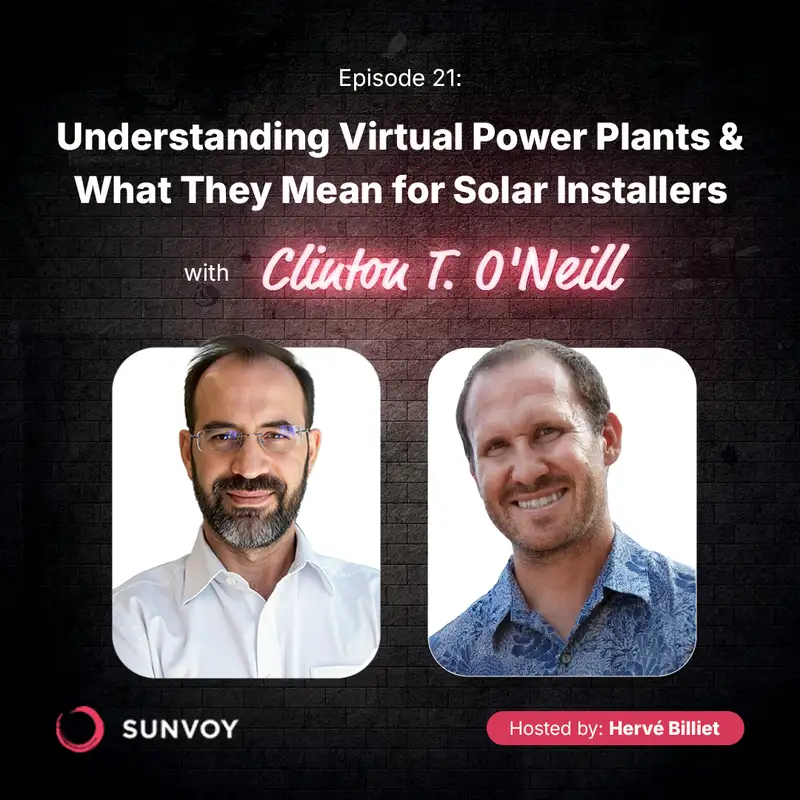
 Episode 21
· 25:57
Herve Billiet (00:00)
Welcome, Clinton O'Neill, to the podcast What Story Installers Need to Know.
Clinton O'Neill (00:03)
Hey there, thanks for having me everybody. I'm glad to be here.
Herve Billiet (00:06)
So Clinton, you have had several positions, and one of them recently was you were the Electric Utility Commissioner for the City of Loveland. You worked at Sunrun. You were a Partner Performance Manager. You were also at Lumisolar in Boulder, Colorado and Lighthouse Solar also in Boulder, Colorado. So you've been in the solar industry for quite some time. You were also running your own consulting company beyond great energy, I see.
Clinton O'Neill (00:32)
Yeah, that's right. So I've been in renewables for the last 17 years, worked for a handful of different operations, done some things on my own. I actually got my start in Hawaii before all of that, where I ran a full-scale EPC developer as well.
Herve Billiet (00:48)
Wow. So very knowledgeable about the solar industry. You've been in it for a while. And right now, you have a recent new job with EG4 Electronics, where you're the VPP and DER development manager. So maybe first, about EG4 Electronics. You want to give a bit of a history with the company? Because that name recently started really popping up everywhere. James, the CEO, is also quite active recently in all the lobbying.
Who is and what does EG for electronics do?
Clinton O'Neill (01:16)
Yeah, yeah. So, it is a newer name to the industry, but we specialize in hybrid inverters and energy storage, right? So,
we've been creating and manufacturing our own products for about four five years now and really gotten a lot of momentum in the industry. We have a unique approach, blending in kind of the technical capabilities of the product to support
to support the end users and really support the installers to make sure that they're successful at deployment of energy storage that's kind of seamlessly integrated with both the home and the solar and hopefully some future devices as well.
Herve Billiet (01:54)
All right, and if I understand correctly, EG4 electronics is a combination of three companies. You have the signature solar, the distributor company, then EG4 is building its own inverters and batteries, and then they also acquired Outback Power, which is like a very well-known name in the industry for a long time.
Clinton O'Neill (02:14)
That's correct. Yeah, that's it.
Herve Billiet (02:14)
⁓ is that correct?
All right, well, let's dive in about virtual power plants. So, let's not assume everybody's fully aware of what that actually means, but why don't we start with, could you explain us, Clinton, what a VPP is?
Clinton O'Neill (02:30)
Yeah, well, it's magic. So we've been working so hard as an industry the past couple of decades on really deploying grid-tied solar and in the last decade, energy storage. And it's really an effort and a culmination of bringing all those devices together.
Herve Billiet (02:33)
Okay
Clinton O'Neill (02:50)
Having the solar work hand in hand with the energy storage. And then instead of just living behind the meter, we're taking those assets and those deployments and enabling them to provide service in front of the meter. And then we take it one step further and not just at the single site level, but we're taking and stitching together all of these various homes or various facilities for CNI. And when we aggregate or add them together, our capacity goes up,
and it has a similar look and feel to a traditional centralized power plant. So, when we can successfully integrate and aggregate all of these devices together into one larger system, now we have a power plant. And we're starting to see a lot of interesting business models, a lot of opportunities, a lot of what we're calling VPP products surface in the industry. And they're both
good vehicles for the installers, the end users, and the utilities all the way up to the market level for energy.
Herve Billiet (03:50)
So, you mentioned you take solar panels that are installed on homes and commercial buildings. You take batteries, you stitch it all together. And then who's the end client? Who has an on-off switch to turn those batteries or discharge them or charge them? Who's the end user?
Clinton O'Neill (04:07)
Yeah, that's a great question. And I think that right now that's still being defined in this segment. But primarily as it stands right now, it's the energy markets. So the primary product when we think about operating the VPP is we stitch it all together, like you said, and then we operate it, meaning we dispatch energy storage primarily. And that power is then bid into the
energy market and there's value there. And there's a whole bunch of other services that can be enjoyed from that as well. But primarily, the current state of the market is market level programs sponsored either by an ISO, RTO, a larger IUO, investor-owned utility.
And we have now models and platforms and business models that are underneath of those programs to support it. So we have platforms, and then we also have aggregators that are doing the stitching. So they're building the software, and they're building the tech infrastructure,
to put all these pieces together so that when the market wants to turn the switch to the on position, that the power actually flows.
Herve Billiet (05:18)
Let's speak about the different players in the VPP world. You mentioned you have aggregators. What else do you have in that world to make it all happen?
Clinton O'Neill (05:29)
Yeah, so it's a combination. So it really starts up at the market, right? So the market has a need, and there's going to be market desk players. So that would be the ones that are actually working with the ISOs and RTOs, to
handle those scheduling activities and the bidding for the actual energy markets. So there's market desk players which will ingest what the aggregators are putting together. So there are aggregator companies or DERMs, distributed energy resource management systems that
are essentially a software stack that are either via API or some other direct protocol bringing these devices together so that they can slice and dice it and make sure that it's connected when it needs to be connected and signaled when it needs to be signaled. So that's the aggregator level.
And then below that, sometimes parallel with that, are all the utilities. So the utilities are also a part of this equation where we have a direct connection physically with them because of our systems. But we also need to integrate with their IT systems and OT, so operational technologies, so that at the distribution and transmission level,
that these ⁓ systems have their checks and balances and operationalize it all. And then below that's all us, the grid edge, the installers, the OEMs. So we all have a piece to play in a virtual PowerPoint.
Herve Billiet (06:53)
Yeah, now let's speak about all the benefits. So we speak about a capacity market. But what are other things that a virtual power plant could be doing? Other ways to play with it.
Clinton O'Neill (07:04)
Yeah, so capacity is kind of the primary product right now. I think that there's more development to be done on what a capacity product can do below the market level. So when we think about capacity,
the most of the utilities are wanting to understand, you what's my avoided cost. So if I take an aggregated resource like many, many DERs or many home batteries, what's that? What's that? What does that substitute, right? Like what does that cross out as opposed to the day, the way that I'm operating day to day now.
Herve Billiet (07:38)
Yep. Mm-hmm.
Clinton O'Neill (07:45)
And as you get farther down that line, the market down to the grid edge, you start to see kind of different benefits, which is what you were alluding to. So capacity is always kind of there because when we discharge, we discharge a rated capacity, right? So it's kind of
Herve Billiet (08:00)
Yep.
Clinton O'Neill (08:01)
native to the way that our products operate. But, they get more sophisticated the closer they get towards the grid edge because we have things like
congestion a relief. So if the grid operators are having parts of their service territory or their distribution network that are
constrained, we can start to divide our resources and slice it up ⁓ more nimble than what a centralized power plant is capable of doing. So we can provide that kind of relief. And other things would be things like frequency regulation, feeder support at the distribution level to help with the substation operation, and as well as forecasting.
We have a tremendous opportunity to provide visibility to the grid operators, which helps them make decisions for planning, which could be significant as far as deferred upgrades or maybe even line support to cancel an upgrade.
Herve Billiet (09:02)
And then I'm also thinking about reactive power. We could also use that to generate reactive power. It doesn't travel like regular power. So yeah, a of different things that virtual power plants could be doing. Well, let's speak about the devices
on virtual power plants because there is something called demand response. Utilities already have demand response programs with some smart thermostats that it could turn on and off, pre-cool your house, if necessary. So the demand response, how is that different from a virtual power plant and what are all the devices that could be included in a virtual
Clinton O'Neill (09:37)
Yeah, that's a great topic. So, demand response is comes from demand-side management, which is from more of the energy efficiency world. And what we're looking to achieve with demand response is really just shifting our time of use and reducing our consumption. So when we have a device like a thermostat, which is
which is probably the most popular demand response device. We're just looking to pre-cool home or shift the time in which an HVAC unit is going to operate to avoid peak scenarios within a utility's operation. So we're just kind of shifting the energy that's already been used or going to be used to normalize or optimize grid operations.
And when we think through demand response, it was really kind of the gateway to VPP because we were successful with smart thermostat programs at aggregating them and disaggregating them, and then also having that visibility which triggered us to create these software infrastructure and platforms to start to actually use it. And so the next step up from demand response, I like to call it kind of advanced
demand response, which is still not quite a VPP, is taking multiple ⁓ DER devices, so like a thermostat or a heat pump, or anything that is an intelligent device behind the meter that can curtail its consumption of power.
So we can take all of those and we can start to aggregate those to work kind of simultaneously and in tandem. And we get compounding load reduction or load shifting just by shifting our demand. And so that kind of bundle package in an advanced demand response scenario
proves very valuable, right? Because we avoid a lot of peaks and a lot of costs, which then has a trickle-down effect for all of the customers as far as like, right control. So we take that to the next step, which is where we start to get into VVP. So we start to add the battery, right? And we start to add the on-site generation. And those two pieces are
critical to opening the door in this market because the battery is like the Swiss Army knife, right? The battery can do everything we want it to do, kind of absorb or discharge or charge or
go grid invisible and self-consume. And then when we start to layer on what we're already doing demand response-wise, well, now we can shift the way the house is consuming power. That battery might have an on-site generation, so it can top itself off to support the grid or support the customer. And as we build these platforms and these programs out, we have a very refined amount of control.
Herve Billiet (12:22)
Yeah, the batteries like you said, three sorry me life and the man control the man response is where you just change demands you can look to it and but with a VPP you can Self produce power and and push it back onto the grid. So we have very different kind of like you said advanced demand response. I've seen several utilities now switching their demand response just changing the name to VPP. I guess that's the first play first step into our direction, I guess
Clinton O'Neill (12:47)
Yeah,
fine of the times, yeah.
Herve Billiet (12:49)
But let's go back to when you were an electric utility commissioner for the City of Loveland. You talked with lot of players in the VPP. Could you explain what a city was trying to accomplish at the time? And maybe can even mention the major players that are in the market. We can drop some names like the Energy Hubs and some other aggregators, maybe some of the software players like a Leap that provides
access to certain markets together with a flip doing somewhat of the similar items and then the pure API players therapy. yeah, we also play, we do the same, we have access to over 200,000 systems. So we do the same way I control platform. So we also play on the market, of course, but,
feel free to jump in and say what the goal was for the City of Loveland. Is that possible?
Clinton O'Neill (13:43)
Yeah, so the City of Loveland is located in Northern Colorado and we're a municipality owned distribution utility, so electric distribution grid only. But we're also part of an ownership group where we own our generation and transmission utility in the northern Colorado region. And we have a non-carbon goal for 100% non-carbon by
2030. And part of that planning and implementation process was several procurements over the last four or five years in mostly technology. So either upgrading or changing the existing technologies at the distribution level and then the generation and transmission level to be VPP ready. So we're looking at things like advanced distribution management systems or ADMS.
AMI projects, course, so switching all the meters over to AMI and finishing those out, but then also building out the meter data management systems, so that we can actually ingest and use that AMI data into a DERMS, right? So we have distributed energy management system DERMS, which we went through procurement on. And the goal here regionally is to have a operational VPP
Herve Billiet (14:38)
Mm-hmm.
Clinton O'Neill (14:59)
that we're starting to backfill with devices and enrollments and subscriptions for a future entrance
into the market. So we're actually going to be joining SPP in 2026, which is a big move for us. And the DERMS procurements and a VPP are kind of a critical piece in the modernization of the grid that we're going through. And we're also going through a shutdown of our coal plant. So ⁓ we got a lot of things happening.
Herve Billiet (15:26)
A lot of things happening.
.
Clinton O'Neill (15:27)
But yeah, so, with
all those pro-cambians came with a lot of research and due diligence on a lot of the different players in this space, both on the utility kind of operational technology side. Think like OATI, OSI, true enterprise kind of utility software terms. But then there's also players like Leap and players like CPOWER who are
kind of market access players who are helping give those market desk services to help utilities navigate what that looks like to schedule and participate with whichever energy market they're participating in. And then we have, of course, all of the, I guess, edge DERMS or non-enterprise DERMS which would be like your energy hubs, your virtual peakers
of the world who are tech platforms that are directly integrating with utilities, right? So their primary customer is a utility and they can help facilitate program design, program administration, and ultimately connect that and integrate that with market access players like Leap.
Herve Billiet (16:29)
So we just went over a few. Thank you for dropping some names. Makes it more clear for people. How is the benefit? we have a lot of solar CEOs listening to the podcast. They will have to deal with a tax rate going away, residential in January. How is a VPP in any way beneficial for a solar installer?
Clinton O'Neill (16:51)
Yeah, I think that there's still, there's some interesting opportunities that are starting to surface. I think that there is opportunity probably
kind of establishing a baseline. So as these programs and these grid services become important, it become more requirement for the utility. If that utility is active in that space and the installer is in that territory, we're going to see an uptake of VPP ready requirements, meaning we need more systems either retrofitted to become VPP eligible or
installing new equipment that is already VVP ready out of the box. So I think that's gonna build up to more of a steady kind of pipeline of projects and work for installers that they can forecast and rely on. And then, I think there's some creative models coming out on what that looks like as it go forward with partnerships or strategic partnerships between maybe
a combination of like an OEM, an installer, and a financial product or a finance provider in like a third party ownership model where some of these VPP programs start to evaluate what opportunities there are to do revenue sharing with, you know, of course, the homeowners who have the devices, but also the players involved in keeping them running,
installing them to begin with and then making sure that they're ready to be called upon and all the way up to the market level.
Herve Billiet (18:14)
Yeah, that's how I see a solar installers role that they are part of the equation to make it happen. You need an installer that goes install and maintain those batteries anyway.
I see a revenue share model. I mean, that's what Sunvoy is working on. So that we have a revenue share module with that solar installer. So the benefits, the way I see them today is all for utilities and the ISOs. But if the revenue of those benefits, somebody's pay for it, can be distributed, obviously, to the homeowner. They own the battery. But then also to the people, that can install them. So the way I see this, and correct me if I'm wrong,
but the solar installer has two avenues. One is to enable everything they've ever installed, all the historical, all the legacy systems, and then make it an incentive for them to keep installing. And so, maybe there is like a financial play here, like a discount or an incentive to add batteries in certain areas that the utility wants or needs the most. So that way
it helps a solid staller by having an incentive to sell batteries. You see the same way?
Clinton O'Neill (19:22)
Yeah, I think that is definitely one of the, I think, emerging kind of models. And it helps market entrance too, right? So there's a need on the utility side. If there's a need on the reliability or resilience side of the utility, then it becomes really compelling. So if you're in an area that has outage issues,
you really have an opportunity to continue to open up the market as an installer that is able to
offer a compelling VPP solution because the homeowner can get that energy storage, which also comes or can come with some outage protection. So the utility is happy about that because their reliability numbers go up because they now aren't having as many outages on the grid edge. But then that battery, like I said, it's a Swiss Army knife.
Herve Billiet (19:57)
Mm-hmm.
Clinton O'Neill (20:11)
it could conceivably, you know, concurrently provide, you know, outage protection, but it could also provide grid services and support the grid in time of need. And with that comes those innovative structures for incentives to
alleviate the upfront costs for the homeowner because there's a utility need. And then also the installers can have a ⁓ robust kind of value-based proposal and value-based solution to take to these markets and help deploy.
Herve Billiet (20:47)
And what you just explained, recently found out, has a term, like DCP, Distributed Capacity Procurements, or Distributed
Capacity Planning, but basically an utility needs to give out signals like, I need more batteries in this area on the circuit and then installers can sell more. Right now, I don't think the utility speaks with installers, too many of them. I think one of them, Sparkson does that, but like a more like larger CNI level, they have, I think, a few utility clients and then they try to deploy in certain areas. But I think
especially to a certain voice, would be totally possible for utility to say, like, I would like to have more batteries in this area. And then some of what we connected with all those installers in across the country. And then we would just give out incentives. We could even mark leads that come in as like, hey, and this is a top lead because it's literally where you, but utility wants more and more more batteries being deployed. So we could prioritize leads too, which helps us all install ourselves more
and grow. So that distributed capacity planning of procurement DCP, think, will, you know, with the right technology in, because an utility doesn't have time to talk to all the local installers and this is not going to work with SMRFP. there's a way to, it needs to be a lot faster, but some work could play a part there to just get the messages, to get the signals to the installers faster. I think in a few years we'll see
DCP operating also on a smaller distributed level.
Clinton O'Neill (22:17)
Yeah, I love that.
Yeah, I love that. So I think that you hit on a couple of important things there. So I think there's a tremendous opportunity for these, like a distributed capacity product. And I think the utilities are starting to understand that there's that need, but they also need the education
with the VPP providers, right? So as these products come
we want to make sure that we can build those relationships and build that model so that there's a level of transparency and a level of reliability that they know that when they're, because they're accustomed to buying capacity, right? Like that's their primary, their primary day-to-day activities is making sure that they have that committed. So when they are evaluating something new and something distributed and something very tech heavy and tech based, they
want to make sure they can measure and verify it. So a challenge for our industry is making sure that we're able to support that journey that the utility is going to need from a diligence perspective ⁓ to enter into those capacity agreements.
And be confident that if they're gonna be committing to a five or 10 year term of a capacity commitment, that we're gonna be able to be there and fulfill that obligation. So, I think that it's an interesting time in the market with our traditional grid-side solar and storage with incentives sunsetting and how we
we need to be very close to our customers and support them
and cultivate those relationships and keep that going. But we also need to be close to our utilities and build those relationships and the fruits of those relationships and being able to position ourselves and provide these true value-based solutions. That's what opens the door and that's what unlocks these opportunities with the 3,000 utilities across the nation.
Herve Billiet (24:20)
Clinton, I want to thank you to be part of the podcast, what solar installers need to know. And hopefully we learned a bit more about VPPs and what it could mean for the solar industry, but also for utilities that have access to capacity. They just don't know it. And hopefully it benefits our nation, the grid on the United States. And since Sunvoy has clients all over the world, hopefully it can be replicated in other countries.
VPP is called in America, but in Europe it's more called like Home Energy Management Systems, EMS or HGMS. So hopefully we all learn some more. So thank you, Clinton.
Clinton O'Neill (24:54)
Thanks everybody.
Listen to What Solar Installers Need To Know (by Sunvoy) using one of many popular podcasting apps or directories.
