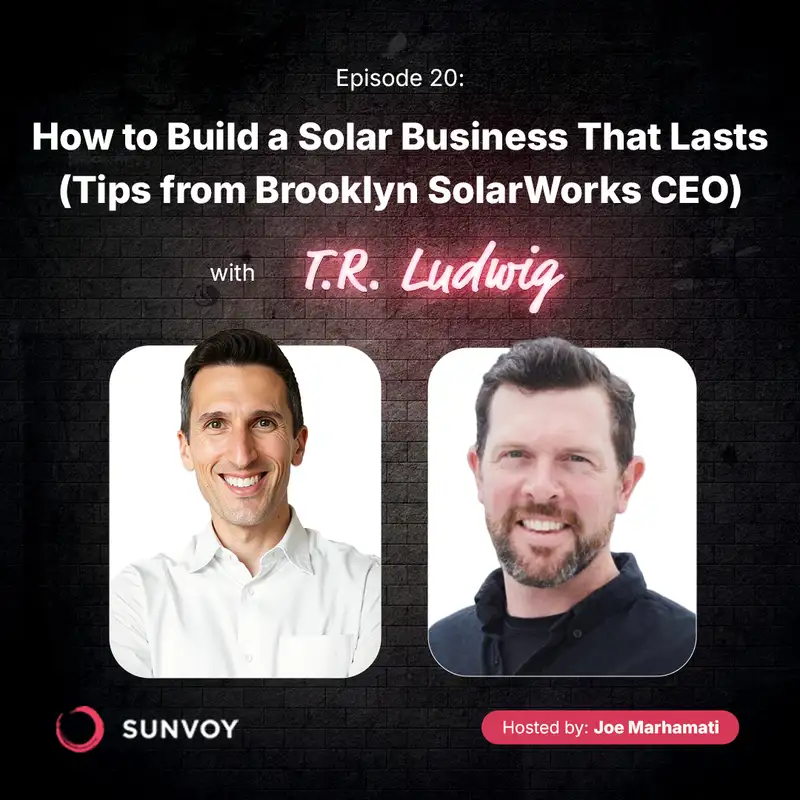
 Episode 20
· 47:17
Joe Marhamati (00:00)
Hey everybody, this is Joe Marhamati with T.R. Ludwig of Brooklyn SolarWorks and Brooklyn Solar Canopy. Welcome to another edition of What Solar Installers Need to Know, and welcome, TR.
TR (00:09)
Thanks so much. Thanks for having me.
Joe Marhamati (00:11)
Well, we always get started by just giving folks a little context for your company, your work, your mission. So tell folks about Brooklyn SolarWorks and Brooklyn Solar Canopy, how many team members you've got, what kind of volume you're doing, and most importantly, what your mission is.
TR (00:26)
Yeah, yeah, thanks. So my name is T.R. Ludwig, CEO, co-founder of Brooklyn SolarWorks. We're a solar company based in New York City. We call ourselves an urban solar company. So we focus on brownstones, row houses, condos, co-ops, things that are sort of in the urban core of New York City, generally flat roof buildings
started about 10 years ago, just 10 or 10 year anniversary a little while ago, extremely excited about that. But yeah, we got started as a small company looking to try and penetrate what we thought was a really could be vibrant market that was totally underserved in New York City. Flat roof buildings are a little bit more difficult, a little bit more challenging than a typical pitch roof building out in the suburbs. So we
developed a solar canopy as a solution to a lot of the flat roof issues in New York City. As you can imagine, the flat roof buildings and fire codes in New York City are pretty strict. And the canopy sort of elevates above a lot of the code requirements. And therefore, you can just get more solar on a roof when you use a canopy. So developed that concept with a few other collaborators
launched the company 10 years ago. Right now, we focus on those segments and we've deployed over 3000 systems around the city. I have about 80 folks on the team and they are mostly sales, marketing, engineering, design, project management and permitting, which you can imagine is pretty heavy here in the city.
And then of course our rad install crews that are out there getting these systems up every day. So 80 folks, then because the canopy was so effective, we decided that we'd create a separate product company called Brooklyn Solar Canopy Company. And that has been around since 2018. And that we're basically selling our canopy to other installers around the country.
And have also developed additional products beyond our classic canopy to address other needs for canopy. So parking lot structures, backyard pergolas, larger canopies and more commercial style buildings. So that's been an evolution of our canopy company and my partner Galen runs most of that. But it's been a lot of fun, you know,
both being installer, sort of a classic turnkey installer, and then also playing sort of the equipment space. So, you we get to go to trade shows and meet up with you, Joe, every now and again.
Joe Marhamati (03:00)
Manufacturing sounds so intimidating to me. I can't even begin to fathom the idea of taking something from prototype to mass manufacturing or even mid manufacturing. What is that process like? Where do you make this thing? How did you get it from like a prototype to something you can build out in a manufacturing facility?
TR (03:21)
Yeah, yeah, I think, you know, sort of classic entrepreneurial naivete. When we first started, we were like, yeah, we'll just create this thing and it'll work. And they're like, well, how should we do that? And then we did have some really good partners at the very beginning. We worked with Situ Studio, which is a design and fabrication firm in the city, very close to us in Brooklyn. And they helped us sort of like take it from
literally like a sketch on a piece of paper through to modeling in software, like what it would take to get a canopy structurally sound, given all the bizarre building stock we have here in the city, and get it to a point where we felt like we had a good sort of software model of the product. And then through to fabrication, which is like just basically taking all of these sort of structurally
optimized models and then actually going and burning wire and cutting metal and getting something together. And that partner is a great collaborator that we still work with all the time. And he's up in Rhode Island. So he's been kind of an essential part of this, essentially our manufacturing wing. And so we really lucked out with him. He's been
awesome partner and really helped us iterate on the product over time as, as you know, we've installed more and more of these things. you know, we've just optimized all these little tweaks that we put into the product to make it easier to install, easier to move around, you know, stronger, lighter, less expensive. So, you know, it's been quite a journey to go from like what we originally thought it would be through to getting a few on a roof.
And then optimizing it for New York City. And then when we created this separate company in 2018, we knew that we were going to try and like bring this to the rest of the country at least. And so that kicked off like a crazy engineering exercise of trying to build all these different models for all the different wind and snow load zones in the U.S. And we were just kind of reminiscing about how nuts that,
that was back then. And that was a really interesting exercise because it really made us think about how could we bring this to basically everywhere in the United States. And yeah, there's some structural changes we had to make to the design. But yeah, it's worked quite well. And now we've deployed canopies pretty much all over the continental US. Still have to get Hawaii under our belt
fixing to do that. But yeah, it's been been really great. You know, the core product or A-Frame canopy, you know, is really all over the country now. And some of these other products I mentioned earlier are also getting deployed pretty, widely around the US. So it's been pretty awesome to see. You know, my partners and I, didn't really have much of a background in manufacturing, but we were more kind of
sales, marketing, a little bit of engineering. So we've had to learn a lot of new stuff about what it takes to make a product and extrusions and fabrication and all that stuff. So you're right, it is a whole new world, but it's been awesome. as you know, having the right partners in this is just so critical to making it successful and enjoyable.
Joe Marhamati (06:43)
And so how does having that canopy relate to the some of the made in America by America provisions and is that related to the new wooden I think city had a woodcar port coming out or out now.
TR (06:55)
Yep.
Yeah. Yeah. So all of our aluminum is extruded, cut up, fabricated, welded in America. So it very much is a domestic product. If you want to get super technical, it's a manufactured product. it would sort of fit into one of those categories if you're looking at
like a domestic content adder. It doesn't unfortunately like land in any of the safe harbor schedules when you look at domestic content. So you have to kind of go the more difficult route of your direct cost method for domestic content, but it's an American product. So we love that. The wood canopy that we've developed, we are super excited about.
A set of engineered brackets and rail that we ship really to anybody that is interested in buying the canopy. And then that screws into wood that you buy yourself. And so we specify the type of wood and the member sizes, but we like that because it really eliminates a lot of the shipping costs.
We're just shipping lightweight aluminum brackets and rail that gets on site. And then you buy the lumber wherever you'd typically buy wood. So it's an interesting concept. A lot of people like it. It's got a really natural look to it. So we think that that's going to be pretty popular. And we've got some out in the world already. And it seems to be the sentiment that folks really like the simplicity of it.
It's quite robust and we delivered it to Vermont and Massachusetts where wind and snow loads are pretty heavy. these things are pretty diesel as well. we're excited about being able to deliver something like that to the market where people can DIY their stuff, but they're not going to have the robust engineering and structural diligence that we put into the product
which is always the most important thing when you're trying to get permits. So yeah, so we're really excited about that. And of course, that also the wood canopy is, it's all made in America. assuming the wood is grown in America, we think that that can also be certainly be part of a domestic content credit.
Joe Marhamati (09:11)
Nice. And when you're looking at the kind of the post ITC climate, you know, how are you thinking about the next couple of years? Because obviously it adds to the cost if you need to put a canopy over your air conditioning and your items on your roof in New York City. So I'd imagine the install costs would be a bit higher and that folks have been benefiting from the ITC. Do you think you're going to have similar uptake because utility prices are rising so fast or how are you thinking about the market in the next couple of years with your product?
TR (09:38)
Yeah, mean, I do think, you know, short term, like we're all in for a little bit of a bump. But, you know, utilities are doing a great job of making our job easier by raising electricity prices. And I think over time and potentially not even that much time, you know, things will kind of normalize a bit. I also think like canopies in general,
solve the issue that a lot of solar and solar have currently where maybe they've already like maxed out someone's roof, you know, or maybe they have a customer that they have never been able to get across the line because the customer is just too resistant to having holes put in their roof. And a canopy is great for that. You know, it can either be a parking structure, backyard structure that, you know, both enables and activates a space.
in the backyard or on the rooftop or provide some shade or snow relief from a parking structure. you are able to add more solar or get someone to go solar who was resistant to do it. And in this age of electrification, who doesn't want more juice? we see so many customers that would just,
maybe we did a canopy on the roof or maybe we did just a smaller system or a tilt system on the roof. And then they just want more juice. So we'll go back to them with a backyard solution or a carport. And yeah, that can immediately add another call it 10 kilowatts. So someone that might have gone from like a five or eight kilowatt system, they can immediately get into the, you know, mid teens to potentially even 20 kilowatts
system and yeah, that's meaningful and for a building, you know, in our, in our world, if you're able to get over, you know, 20,000 kilowatt hours in a year, you know, you're getting pretty damn close to, getting to be net zero. Um, you know, if it's, if they've electrified their heating and cooling loads, uh, yeah, it can be close, but like, it's pretty good and it's way better than, you know, paying the utility for that electricity for sure.
Joe Marhamati (11:41)
And what's a project that you're really proud of that you look back and you're like, wow, that looks beautiful. This is so challenging and you just love the end product. And what's a project that you look back on that maybe you should have said no to, but sounded really fun and you end up spending two years on it. I know you've got one project like that because I've got about five.
TR (12:01)
Yeah, mean, part of the one I'm most proud of is a custom canopy we did for Havana Outpost, which is a restaurant in Brooklyn. It's a really legendary restaurant. the building that we did had a big portrait of Biggie Smalls on the side. And it's painted in this sort of like really unique
color scheme and so we we matched the color paint to the building and When we put in the canopy It just like just it just really popped because everything Matched and came together and you know, it's sort of like a cultural icon. I would say in our neighborhood. It's like three blocks down the street from my house, so it's uh, it's really great and so we we flash that around wherever we can because it's
something we're really proud of. It looks really good. It's part of the community. And, you know, the owner is also really very mission driven. So it was really cool to collaborate with him on that one. And of course he wants another one. So I have to go figure that out. You know, I'd say projects that have not gone the way we thought they would. We do a lot of new construction
jobs or renovation jobs that always take longer. So there's probably a few in there that if we could have not taken it on, we probably would have knowing what we know now. We just completed, I think, the first residential battery in New York City. And that has been an absolute slog. That is
very patient customer that stayed with us and it's taken us almost eight years to get permitted and constructed. So it was a very long journey. We don't think the next one's gonna take that long, but you know, it's really at every juncture of that project, it was just a slog to get through. FDNY got very involved and they didn't
really kind of know what they wanted for a very long time. it's, it's, we've literally like hit every snafu possible on that project. I'd still have done it. So I don't think we would have like backed away from it, but yeah, we're kind of gluttons for punishment sometimes here. But yeah, I think that's kind of what makes us different. You know, we're, willing to like put in the time on something that we really believe is going to be the right
solution for folks and this is kind of an example of that but definitely a lot of brain damage.
Joe Marhamati (14:36)
Yeah,
you've got to be a glutton for punishment if you're putting canopies on New York City roofs. What was the first, what was it like the first time you did that? Trying to explain that to the permitters and the approvers and the inspector. Can you remember the first time you tried to explain this to an inspector?
TR (14:52)
yeah. Yeah. I mean, what's interesting about it is like when we were developing the product, we knew the constraints of the codes. And so, when we, when we developed it and then, you know, we had to like create plans for it. I, a lot of like, we didn't get the resistance we thought we might because people like pretty immediately understood that it, it like complied with the fire codes and
⁓ so like once we got people, you know, it didn't take much to get an approval on it. ironically, because it just, you know, implicitly imply, comply with the fire codes. And, and then once we got inspectors to take a look at it, they're like, this is cool. Like this, this is what you need to do. You know, so, you know,
We didn't really invent canopies in New York City. There were other companies that were doing sort of bespoke solutions, but like kind of creating a product that was scalable and modular and could effectively fit on 95% of all flat roof buildings in the city, that was unique. Yeah, we've had others sort of try to get in on the market as well.
Yeah, I still think what we deliver is by far the most robust and really scalable product for that market for sure. So, you know, it's interesting because you'd think that there would have been a lot of pushback on it, but it was embraced pretty quickly, certainly by the fire department because they like it. But even buildings got it pretty much right away.
Joe Marhamati (16:20)
⁓ That's really cool. But residential batteries are a different story. I remember in DC the first time explaining to the perimeters and to the utility and they really had just no idea. They thought it was almost like a new technology. And in a sense it is kind of a new application. So are there just not residential batteries going in in New York City? Presumably that'll change after you do a few and they get comfortable with them.
TR (16:46)
Yeah, yeah. Yeah. So there's a very complicated set of hurdles that you have to jump over in order to get your battery approved by New York City, FDNY. And because like the over time, the requirements and testing standards have evolved, you know, the goalposts have been just consistently moving and, and
So it's been like nearly impossible to get these approvals from FDNY and there's a very limited set of products that are approved currently. So there's really only two right now that are even possible at the residential level. One of them is Powerwall 2, which we know is now old and not being offered. So
the other one is Simplify Battery, which is by Briggs and Stratton. And those guys have done everything they possibly could have to get their battery approved and been very committed to the market. So, you know, we applaud that quite a bit. But I think there'll be others coming shortly. And as they do, you know, things I think will open up. it's definitely it's a bummer because we know
how powerful storage can be and like the benefits it can deliver. And, you know, we look and see California, you know, shaving their peak with a VPP and other places and, you New England are able to do it. And we know it would be super valuable in, in Con Ed territory here in New York city. like that's, I mean, these peaks can be extremely expensive and very valuable if you can deliver value to the grid. So
we do see that happening. Just, you know, it's been painstakingly slow here in the city.
Joe Marhamati (18:27)
But you guys, know you're doing a lot of SMA still, right? String inverters. And so there's not as much concern about rapid shutdown. Is that because you're doing this on top of canopies? Or are you able to also use string inverters on roofs?
TR (18:42)
Yeah, we've moved away from SMA a couple years ago. They weren't able to comply with this. What's it called? I don't know. was a UL standard. It was like 1703 or something. Can't remember. Anyway, they were not compliant. And so they just effectively exited the market, which is
kind of a bummer. And they're back now, but it forced us to switch. And so we've been on end phase for the duration. we're really happy with them. And I like their sort of system approach to things. And we're hoping that they get a battery approved by FDNY fairly soon. And also really interested in their charging
solutions that they have. It's pretty cool. I do like this sort of whole system approach. To the extent you can cobble it together as one system and one software, I think that is also pretty awesome. So I'm sure you guys have your thoughts on it as well, given your product. It's
as all these other vendors start going out of business or, like the sun power issue, like, I do think like just having things aggregated in one pane of glass is going to become more and more important, because it's complicated, you know, if you're stitching all this stuff together, but that was Sunvoy.
Joe Marhamati (19:57)
I did not ask for that ad in case anybody's watching, but I appreciate it anyway. All right, the softball portion of the show is over, T.R., so buckle in. We're going into the existential portion of the show now. The real hard questions. Looking back over the last decade, what's a belief you were completely wrong about in the solar industry, and how did that realization change how you lead today?
TR (20:00)
Yeah.
Yeah.
I guess there were probably two things. One is us I was getting in, as Brooklyn SolarWorks was forming, I did think that leasing was going to be way bigger deal than it turned out to be. So I thought that having a lease, having third party owned financing product was going to be totally critical to our success. And I think I quickly realized that it didn't matter.
Um, and so really up until right now, we have not sold a lease ever. Um, we had access to it and then we realized that no one wanted it. Um, and so that was quite a surprise to me. Um, Having worked at Sunrun and helped start a solar leasing company before that, I was pretty convinced that that was going to be necessary if not like, you know, existentially
necessary and it just didn't turn out that way at all. And yeah, there's others that offered leases but I just didn't materialize the way I thought it would. So that was one. And I was also convinced that batteries were going to become much more of a thing over this past 10 years. Like, you know, the writing was on the wall even when we started that it was going to be important. But
Uh, you know, it's, didn't anticipate how hard it would be to, to really get this market going, uh, in batteries, uh, because it just seems so logical. Of course we would, you know, start selling battery systems relatively quickly. Um, And in fact, we, uh, Galen and I, one of my co-founders, we, we even were thinking about doing that before we even started Brooklyn SolarWorks, you know, trying to get batteries going.
But yeah, just didn't all of the regulations and red tape and administravia and safety concerns and all that stuff has really, really slowed down battery deployments in the city. Certainly at residential scale, it's nowhere. There's you know, potentially just one system out there, a permanent system. Who knows? I'm sure there's some rogue folks out there, but for
For what we've done, we believe it's the first.
Joe Marhamati (22:26)
And what shift are you expecting in the next five years? If you had to bet the company on one shift happening in the industry in the next five years, what do think it'll be?
TR (22:34)
You know, I, I hope that it is going to include batteries and I hope it's going to make, our value to the grid much more substantial and, and defensible. You know, I think, I think any, anyone that's operating on the assumption that net metering is going to just continue into perpetuity is, is probably a little naive.
You know, New York, thankfully, is still very much a NEM market. And I think that will continue for a bit longer. But I think eventually, if we want to get off of subsidies, we want to make ourselves sort of more indestructible in a way, we have to be like true assets on the grid, It's just the way it's going to have to work.
And by the way, we'll probably be some of the cheapest assets on the grid and probably the most nimble assets on the grid. So it's hard for me to see that like in five years, know, we and all my peers in New York City aren't moving into more of like a sort of a energy service provider type of role versus just like pure play solar installer,
because there's no question that energy will be kind of transformed, I think, in five years. So it might take a little bit longer in New York City, but I could definitely see that happening. I do hope it goes that way so that we're a bit more insulated from all the ups and downs. And I know Herve doesn't like the solar coaster term, but it is. We're ups and downs, and a lot of it's
know, incentives and fear of things going away. So I'd love to just like deliver solid assets that can save people money, like right off the bat. And there's very little debate on, you know, what kind of incentives need to exist for it.
Joe Marhamati (24:21)
And this is just me not knowing New York City politics, but like how much does it matter who the mayor is? you look at the likely new mayor coming in. Has he talked about solar, renewable energy, policies, subsidies, regulation? Do you look to that stuff? Does it matter your business?
TR (24:35)
Yeah, yeah, for sure. I mean, it's always great to have the mayor in your corner. And, you know, if it's a Democratic mayor, I mean, I'm quite sure it will be this year. Yeah, that matters a lot. I think the biggest thing that we really need is to get a little bit more pressure on opening up the battery market. You know, solar's got quite good support. We have a
property tax abatement here in New York City and that's a great incentive. That's 30% of the system costs gets taken off of your property tax. So we modernized that a few years ago. We got it extended out to 2032. So it was a nice runway there. To the extent that the mayor doesn't mess with that, that's great. And then there's some things that we could do to
to make it more accessible to property tax abatement. So for nonprofits and folks that don't pay property tax, it's not as valuable. So we're gonna try and fix that. You know, and I imagine it seems like Mamdani will take the seat in a couple of months here. And yeah, I think that, you know, he's very much trying to, you know,
level the playing field to some extent. if he's supportive of additional changes that make it easier for low and moderate income folks to access the property tax abatement, that would be awesome. And someone to really like kick it into gear on batteries, know, that to me seems pretty important. And I thought we were going to make some progress, more progress than we have on that with the city. But we know a fair amount of the folks that will probably be in that
administration and I know that they're very dedicated to getting some of those changes made. So it could be pretty transformative I would say over some of the business as usual type philosophy that we've seen in the past couple mayors.
Joe Marhamati (26:29)
Nice, and I'm gonna answer my own question before you answer it because it can be difficult one. Was there ever a moment when you seriously considered quitting and what pulled you back from the edge? And I'll say, in running a solar business, it can be extremely stressful. And Tris is true of all construction companies that are tight margins. We have people on ladders and roofs all day and trucks driving around. And I did have moments like that. I've also been a long-distance runner. So I've thought about quitting a lot.
I find that those moments, pushing through those moments can make you stronger. Have you had moments like that?
TR (27:01)
Boy. Of course, all the time. You know, I mean, it's it is frequent. I think you you learn that you're not going to quit. And so there's no use in like even entertaining that idea for very long. ⁓ But there are there are urges to just
you know, call it quits or, I don't know, sell the company and get out, you know, like, but you know, we're, not going to do that. We're extremely mission driven company, you know, ⁓ all of our folks that we hire, you know, we make sure that they've got these traits of, of passion and commitment. And, know, like I just, there's no way that we're going to give up on that. So,
So yeah, mean, we definitely, I mean, look like battery is a great example, you know, like we could have given up in a year or four and not done it, you know, and just said that, look, it's too hard, but those kinds of things are, I think what make us different, you know, we're just that much more persistent, stubborn, dedicated, you know, and I think if we gave up on some things like.
it would, you know, give us permission to give up on more things. So we just try not to ever, if we can help. But yeah, I mean, it's some dark moments, man. I mean, like, you know, COVID was an absolute shock. When it became very obvious, like we weren't even going to be able to work. Like it was going become illegal for us to work in the city like that.
That was a moment where I was like, damn, like, what the hell do we do here? and, you know, we had to like, sort of furlough folks for a couple months and like, you know, that, that was super painful and hopefully something we never ever have to recreate. yeah, Those, those moments can get, can get very dark, especially when you've got, you know, many families that rely on you.
⁓ You know, benefits and like, ⁓ like the health related, responsibilities that employer has is it's pretty intense. But, you know, I think this goes back to like what I was saying earlier, like you've got to, got to pick the right team. You know, you've got other folks that can, you can commiserate with and, and that you trust and you can kind of
draft off of their energy and being a solo entrepreneur, think would just be unbelievably stressful. I have two other co-founders that we kind of create this triangle of trust and commiseration. That I would say has probably been one of the more
you know, critical pieces to us doing what we've done is just having that level of teamwork and camaraderie as we've gone through all the ups and downs. But yeah, there's definitely, definitely many times that some are like, wow, is this even worth it? But you know, at the end, it definitely is. And I guess the more we've been able to deploy systems and we can like,
literally walk out our front door and see our solar systems on roofs. It's like really, really inspiring, really empowering. It makes us feel like we're having an impact. We know we're changing the way New York City is powered and that's pretty awesome. So it's good fuel to combat some of those urges to just give up.
Joe Marhamati (30:13)
I'll confirm that you really do need a partner. Doing this on your own, I can't even imagine. It happens to somebody that bad ideas off of commiserate with, shoulder to cry on once every couple years, it's very nice to have. What do you feel like you've learned about yourself in the course of starting and running and growing this business that maybe you weren't aware of in the beginning?
TR (30:32)
I think I've learned that, you know
I used to play sports in college as a lacrosse guy. The lessons I learned playing sports, specifically lacrosse, and just like inherently knowing teamwork in a way that like maybe others don't or haven't experienced it the way I have, I didn't realize how much of an advantage that was.
⁓ Until probably pretty recently. You know, the, I've been, I was primed for a decent amount of this just through playing, playing sports, being a leader on sports teams. I didn't really know how good of an advantage that was until, until recently. And then like leaning into that and really exploring like what
what else does it take to create a good team and like a good team dynamic? You know, you guys turned me on to some of this actually a couple of years ago, and it's just been like really valuable to learn about like, you know, big fan of Pat Lynch, Yoni and like five dysfunctions of a team. You know, I wish I had read that many years ago, but like,
to me, that is like the crux of being able to get a group together and get them to be effective, not just show up at a meeting, but actually really accomplish things. So I've become much more sensitive to that and much more convinced that unlocking that level of teamwork is really one of the main things that a leader's job is.
You know, to be able to like congeal the team and get them to move towards a goal and like, really commit, you know. So I don't want to say I've mastered that in any manner. I think I'm just realizing that I am now a pretty enthusiastic student of that. And, you know, as a leader, like building on that because it is a strength that I have and like,
figuring out how I can be better at doing that. Yeah, it's sort of like my new hunt right now is to try and like learn more about that. Because I guess I kind of undersold that early in my career. Just kind of could do some of that naturally. But learning more about it and like how to kind of get even better at it has been something that I'm really interested in doing these days.
Joe Marhamati (32:49)
But you know what really helps with that I found is like our amicus community, being around other people who have themselves learned how to do that, how to be more conscious leaders, how to be consensus builders. I found myself being more conscious and more compassionate and more collaborative when I was around other people like that.
And I know you and I both worked with Maria Kingery who does this type of leadership coaching for solar installers. I don't know that I could have grown as a person and as a business leader without that community of other people who themselves were trying to do that. Is that your experience?
TR (33:27)
yeah. Yeah. I mean, gosh, It's just really hard to imagine where we'd be without being part of Amicus, you know, like we joined Amicus in the fall of 2019. and At the time we were like, yeah, we're to be part of this like cool solar club, you know, like we'll buy equipment together and like whatever. And then who would have known, you know, a couple months later,
with COVID and everything, like just being able to just get on a call with all your peers around the country and compare notes on how people are handling things and be supportive, you know, like some really tough times. But yeah, I totally agree. Like having that community and being able to put yourself out there, you know, with the trust that people will listen to what you're saying,
and provide really insightful feedback and support is like incredible, you know. And we all, think, in the group have learned so much from each other, you know, both, of course, like the technical stuff on solar, but just like how to lead a company, how to take care of your employees, like, you know, some really amazing companies out there that,
they're doing great stuff, like real examples of how to lead a mission-driven company in the United States. So yeah, I couldn't agree more. It's been awesome to be part of that community. I'm looking forward to the next phases of Amicus, because I think those will be super important as we go into this next phase.
Joe Marhamati (34:59)
Amen to that. Yeah. I'd love to know what's the hardest decision you've had to make in the company that maybe nobody from the outside saw or knew about and how did you wrestle with it?
TR (35:09)
Men.
The thing that comes to mind is like having to furlough the entire company during COVID. That was a tough one. There were only like a couple of people in the room when we made that call. And you know, at that time, like we were still relatively young company and you we were cruising, we had done really, really well and we built a really good name for ourselves and you know, we were kind of
think probably a decent amount of hubris had sunk into the company. So we felt relatively invincible. knowing that we just couldn't operate anymore and that this whole issue was way bigger than anything that we had control over was extremely humbling.
When we made it, I got pretty emotional about it. I think some of it was just disappointment, of course, but just knowing the ramifications of what that was going to cause to all our people. Yeah, it was hopeful that we could recover, and obviously we did, but just staring into the abyss and not knowing what the hell was going to happen.
That was pretty tough. I always remember that because it's, no matter how well things are going, gotta kind of remember that it can go south pretty quickly with things that are well beyond your control.
Always keep that in the back of your mind.
Joe Marhamati (36:38)
Yeah, I had the
same experience. I think that was the toughest moment for a lot of people. I was in the solar industry and beyond. I'll never forget where I was when I went through the same moment. If you had one of your installers say, hey, I'm going to move back home in a few years and I want to start a solar company. I've actually had this happen with a few of our folks and been lucky to have several of our team members scatter around the solar industry and do great things,
and they asked you, know, what's one piece of advice to avoid some of the pain that you've gone through in scaling a solar business? What would you tell them?
TR (37:10)
Yeah.
Find the best partners you can. Don't do it on your own. Find the best partners you can and make sure that the skills that each of you bring to the table are different. I think that's so critical. my wife is an entrepreneur as well. She's pretty much a solo entrepreneur.
Every time there's an issue, always, you know, I'm always so thankful that I have others to rely on. I see her going through some of that. Just like, man, I'm really glad I've got a great team. But yeah, I think that's it, man. know, like being very choosy about who you work with, you know, getting to know them quite well before you jump into something I think is important.
And then making sure that your skills are complimentary so you're not all super heavy on one particular discipline, I think is also really important. A tech skilled person, sales and marketing person, and a generalist somewhere in there, I think is great. Two person team, sort of tech and sales, I think, sales marketing,
is pretty important. But yeah, that's what I would suggest to really anybody that's going to try and go do this, is being able to build a really great kernel of a team as you go into it. It's not to say you can't do it on your own, but it's way more lonely and really challenging. I don't know, you kind of need someone to keep you in check.
You know, I know my partners do that all the time with me, know, especially if you're ambitious and you think you can do everything like, and there's nobody else to speak truth to you when you're like just riffing, you know, it can get out of control pretty quickly if there's no one to like tamp you down. So I think even if you're on your own having like some advisors or like
mentor or somebody to kind of like keep you in check a little bit, that can be useful also.
Joe Marhamati (39:03)
But also you hinted at something that I learned along the way, which should be obvious. You want to work with people you like that share your values that you actually want to hang out with, not just to have the skills. So when you're talking to your HR team or the folks that do the hiring now, if you could describe to them, or if you have described to them in two, three sentences, this is the kind of person who belongs at this company. What does that sound like?
TR (39:27)
Yeah, so we have our core values and that is passion, commitment, resourcefulness and adaptability. So those are the things that we look for the most. The passion is relatively obvious, but for us, this isn't just a job and we want people to be great to work with. that goes to like,
would we enjoy having this person be sitting next to us eight hours a day, five days a week? know, the commitment is super important for us as well. And that really goes towards our mission driven, you know, bent around trying to make a difference, certainly in New York City, regarding how we power our city and hopefully making a dent in the changing climate.
Um, And then, you know, because where we operate is like just so challenging, you know, being able to adapt to, you know, all of the weird stuff that happens here in the city. Um, And then responding with not just like going to your manager and asking them what you should do, but being curious and, and looking at a problem and maybe going out and trying to research solutions on your own
and then bring that to a manager. That's like a really important trait that we look for in people because, you know, yes, we all need to have standard operating procedures and do things as much in process as we can, but sometimes there's just no answers, you know, and finding folks that don't just throw out their hands and say, someone else is going to figure this out for me, but having
the drive to be resourceful in that moment is pretty important. are the things that we scan for every time we interview folks. And I'm not saying we're perfect at it, but we have greatly refined the way that we recruit using the lens of those core values.
Joe Marhamati (41:25)
⁓ I just want to put a plug in for having core values. This is like such a blind spot in life, personally and professionally, that I've learned the hard way that if you don't write down your core values and reflect on them and know when or if they're changing, you're going to run into a lot of bumps in life personally and professionally. And it is so important to be clear on what your core values are personally and professionally.
So that you're driving in alignment with them every day personally and so that your team is driving in alignment with them in your business. So I would throw that out there to everyone who's listening to this right now that's running any business, but especially a solar business that is always challenging.
Think about what your core values are and make sure that every single one of your team members know what they are by heart I appreciate you bringing that up. I got one last question for you You're writing a letter to yourself on day one of Brooklyn SolarWorks. What's in that letter?
TR (42:27)
⁓
You're on the right track.
You're on the right track, don't give up. It's gonna happen. You know, may not happen as fast as you want, but it's gonna happen,
you know. Don't compromise on what you know is the right way to do this. I think that's what I put in the I think, you know, especially like we used to work at Sunrun and yeah, we were early, but we saw kind of where the industry was going, know, sort of the
you what we'd now call like the sort of solar bro culture and, know, sort of the, one call close that kind of stuff. And, I think we, we knew that that probably wasn't the right way to be doing things. So, but it's, you know, obviously it can be quite effective and people can make a lot of money doing it, but, you know, we've always had this core conviction that people really need to know what they're signing up for. So, yeah.
Like not compromising on that I think has gotten us where we are and we want to hold true to that. So definitely would have told myself that 10 years ago.
Joe Marhamati (43:31)
you
Well, this seems like as good a time as any and we got one minute left to ⁓ reveal our big announcements. Here we go, Sunvoy and Brooklyn SolarWorks or Brooklyn Solar Canopy are gonna have a joint booth at RE Plus next year. So I don't know about you, T.R., but I've been batting some ideas around in my head. I was thinking we could have a couch and anyone could come sit on the couch and tell us all their problems and everything going wrong in their solar business.
Like a little solar therapy kind of thing? What do you think?
TR (44:01)
Absolutely. Yeah, we'll offer a cocktail at the end and you know some delectable snacks but yeah, solar therapy sessions 15 increments.
Joe Marhamati (44:12)
I think it'll be even more popular than massages. You know those free massages they give at the conferences? I think this will actually be in higher demand next year. But we'll figure something out. It's gonna be cool no matter what we do.
TR (44:22)
Yeah, yeah, I think that's a requirement. And, you know, I think we both have learned that this whole trade show thing is fine. But, you know, we want to create a little home for the folks that really get it. And that's, think, what we're going to do for this coming year.
Joe Marhamati (44:39)
Well, there's only so many folks out there who are ⁓ doing for solar installers, by solar installers. So I appreciate what you're doing. The fact that you guys have been able to operate a such a successful solar business and have a side gig where you manufacture a carport. I still have no idea how you're doing that. but for, can tell you from the outside, it looks incredibly impressive. The product is absolutely gorgeous. Where can people go and find you and learn more about both
companies.
TR (45:09)
You know our websites, so brooklynsolarworks.com and then brooklynsolarcanopy.com
brooklynsolarcanopy.com has all the different products, product pages, tech specs, all the relevant engineering information that's needed. So we've tried to build it so it's super easy to just pop in and see what we've got and get the basics. And then if you are more interested, you just reach out and we'll knock out a quote for you or get you oriented on the product.
Joe Marhamati (45:35)
And I remember, it just popped into my head a few years ago, you guys built a tool where you can design it and see what it's gonna look like, and that thing blew my mind. You guys still have that.
TR (45:44)
We do,
yeah. Yeah, we call it our configurator. so we do have that.
Joe Marhamati (45:49)
Well, anyone listening, living in Brooklyn, or apparently anywhere in the country who wants to check out the Brooklyn carport, please take T.R. up on the offer. T.R., thank you for being on the show today. This was so much fun. And hey, let's do it again next year.
TR (46:03)
Definitely, absolutely. Thanks, appreciate it.
Joe Marhamati (46:07)
Thanks everybody. This has been What Solar Installers Need to Know. We'll see you next time.
Listen to What Solar Installers Need To Know (by Sunvoy) using one of many popular podcasting apps or directories.
